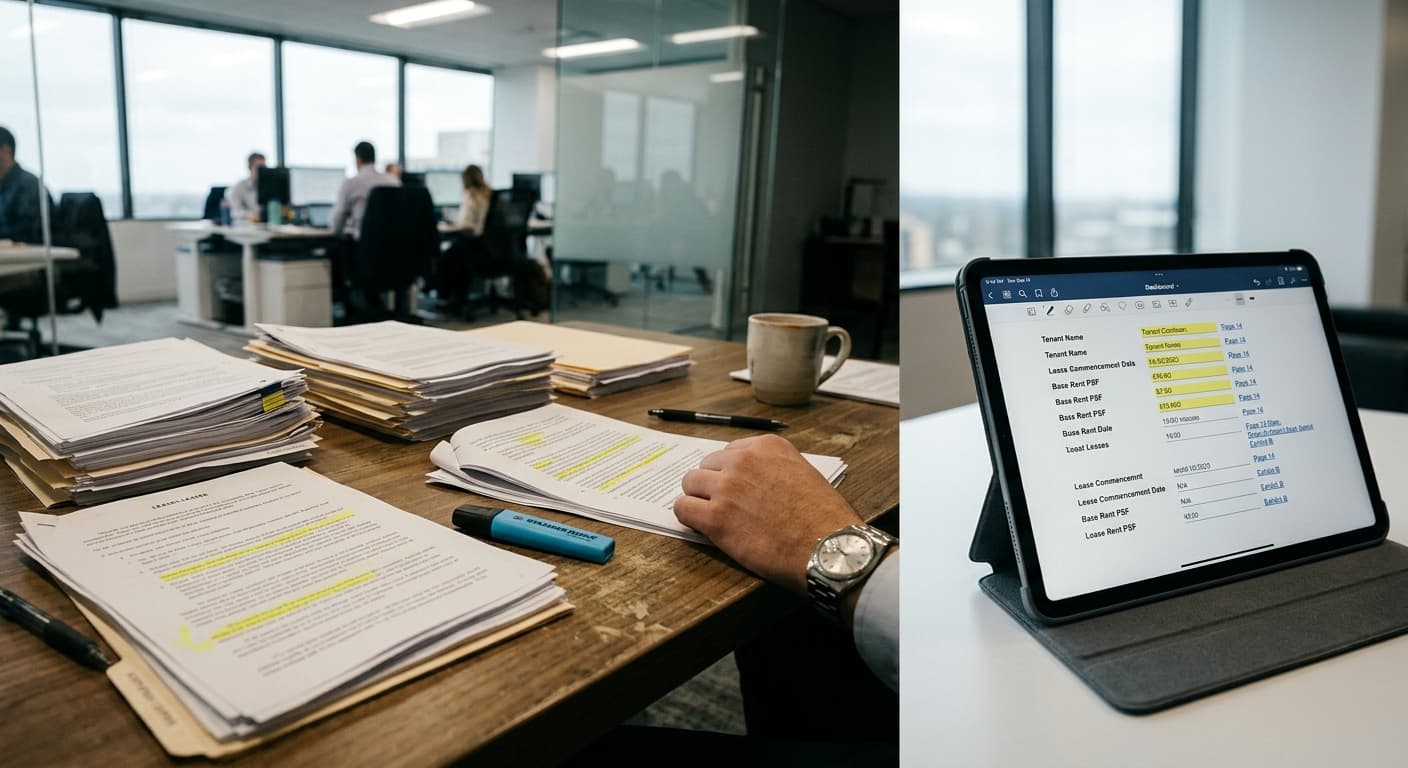
A lease administrator at a retail real estate firm opens a 38-page lease, plus four amendments, and starts reading. Base rent, escalations, co-tenancy, the one assignment clause buried on page 31 that will matter in two years. Days per document. A team of five trying to keep up. This is the workflow AI was supposed to fix three years ago and, for most firms, still hasn't.
MIT's NANDA initiative published its GenAI Divide report in August 2025 and concluded that 95% of enterprise generative AI pilots produce zero measurable impact on the P&L. S&P Global found 42% of companies abandoned most of their AI projects in 2025. Microsoft Copilot sits below 3% active use among paying customers. Klarna replaced roughly 700 support roles with an OpenAI chatbot, then admitted in 2025 the result was lower quality and began hiring people back.
The MIT finding isn't that AI doesn't work. It's that horizontal AI—a general-purpose assistant deployed broadly across an organization and asked to find its own use cases—doesn't move the P&L. MIT traced the failure to integration, not model quality. Companies deploy AI without identifying which workflow, which decision, which dollar of cost or revenue is supposed to move. In a parallel MIT Sloan study, 61% of enterprise AI projects were approved on a projected ROI that was never measured after deployment.
The 5% of pilots that return measurable value share one trait: they are vertical, built for a defined workflow, with domain context baked in and an outcome someone can read off a report. Gartner and McKinsey both project that more than 40% of enterprise AI deployments in 2026 will be vertical-first, where payback shows up in two to four months instead of two to four years. The question is no longer whether the model is good enough but whether the AI is embedded in a workflow with measurable inputs and outputs, or dropped into the org chart to fend for itself.
CRE operations run on documents: leases, rent rolls, loan agreements, OMs, CAM reconciliations, estoppels, diligence files. Every downstream number, from accounting to acquisitions to investor reporting, is only as good as the data you can pull out of those documents on time and without errors. That makes CRE one of the worst fits for general assistant deployments and one of the best for vertical AI applied one workflow at a time. The five-day lease abstraction becomes a five-minute review; the two-week diligence becomes two days. Each is a number the CFO, COO, or CIO can defend to a board.
A vertical document-AI platform isn't just a faster reader; it's an integration surface, ingesting any format, exporting structured data into systems of record, and storing a traceable record of every extraction with citations to the source page. Integration is where the horizontal pilots broke, and where vertical platforms have to be strongest.
Jeanette Oliver is the CFO of Levin Management Corporation, a firm running roughly 125 properties and 1,100 retail tenants. Retail makes lease abstraction harder than office or industrial: shorter terms, higher turnover, more amendments. Jeanette inherited the manual process: a lease administrator working through 30 to 40 pages by hand, days per document, a team of five trying to keep up. She brought Kolena in to solve that one workflow. How she framed it for her team: "Do you want to run it through Kolena and get an output back in five minutes, or do you want to sit there for five days and review it?"
What changed after deployment is more interesting than the time savings. Her lease administrators stopped being data-entry operators and became data analysts. Acquisitions that once took weeks of lease review now run in days. "If we had two acquisitions happening at the same time with a team of five, that would not be feasible. Now it is feasible." The financial impact is direct: leases turned faster means rent collected ten days sooner. This is what the 5% looks like: one workflow, one team, one defensible outcome.
Jeanette's advice to other operators is simple: know your use case before you touch the tool, treat AI as a tool rather than a solution, and document the benefits as they compound. Mohamed Elgendy, co-founder and CEO of Kolena, adds one thing from his seat. The companies winning at AI in commercial real estate aren't the ones with the largest model bills. They're the ones who can answer one question with a straight line on a report: what did this workflow cost us last quarter, what does it cost now.