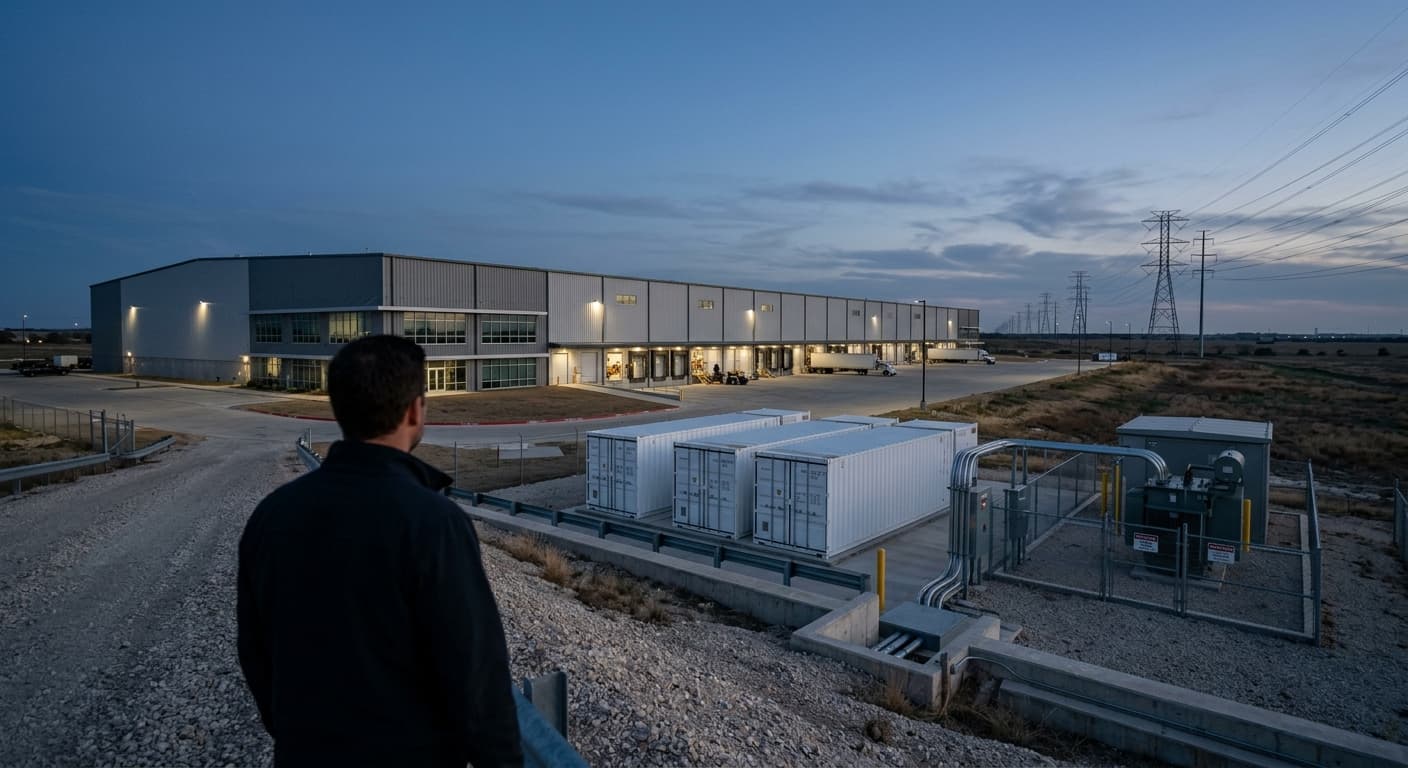
Prologis unveiled its first battery storage project in Texas on Friday morning, a 10-megawatt facility housed on the site of an owner-occupied warehouse at 3601 Allen Avenue in Arlington. The installation marks a notable pivot by a major industrial landlord into grid infrastructure at a moment when the state's power supply is struggling to keep pace with surging demand.
The Arlington facility is designed to capture and dispatch additional power during peak demand periods, effectively supplementing energy already provided by the Electric Reliability Council of Texas. Vibhu Kaushik, Prologis global head of energy, utilities and storage, said during Friday's event that the battery storage site can power approximately 1,700 homes. Two additional projects in Houston and Grand Prairie are scheduled to follow in the coming months, with a total of ten sites to be deployed over the next year.
Energy demand in Texas is quickly outpacing supply as a rise in severe weather occurs alongside record population and corporate growth. Houston and Dallas were ravaged by extreme rain and wind last month, causing widespread power outages as temperatures climbed into the 80s and 90s. State Representative Chris Turner, speaking at the Prologis event, framed the battery project as critical grid resilience. "When demand is threatening to outpace supply in the grid, the electricity from these batteries … is what will keep our grid in balance and keep the lights on," he said. "That's why this project is so important."
The capacity challenge is intensifying. ERCOT CEO Pablo Vegas told a committee hearing last week that the grid's capacity may need to double to 150 gigawatts by 2030 to meet demand, up from a previous expectation of 130 gigawatts. Dallas-Fort Worth has emerged as a top market for data centres, which are quickly becoming one of the biggest contributors to growing power demand in the state. Kaushik noted the operational implications for industrial tenants. " are asking for buildings with a lot more power connections than before," he said. "If you have on-site solar or on-site battery storage, it provides some local energy to offset a lot of energy coming from the grid."
Prologis is far from alone in the battery storage buildout. Developers are expected to install 6.5 gigawatts of utility-scale batteries across Texas in 2024, bringing the state's total installed capacity to around 10 gigawatts, according to U.S. Energy Information Administration data reported by Reuters. Nationwide, more than 300 utility-scale projects are expected to be operational by 2025, with roughly half located in Texas.
Kaushik emphasised that battery storage pairs well with other energy resources including wind, solar, natural gas and combined-cycle generation. "Projects like these are essential to helping the state of Texas' grid," he said during the Arlington tour. The modular approach Prologis is taking—co-locating battery infrastructure on existing warehouse sites—offers a template for other industrial landlords managing portfolios in high-growth, power-constrained markets.
Turner underscored the scale of the challenge ahead. "It's no big secret: We know Texas is growing, and the demand on our grid is increasing with that growth," he said. "When you see projects like this coming online, it gives us hope that we're going to be able to achieve that goal. Every megawatt is going to count." For investors with concentrated exposure to Texas industrial real estate, the accelerating convergence of logistics, data infrastructure and distributed energy storage is reshaping both tenant requirements and long-term asset positioning.