Monday, October 5, 2026

Mortgage Rates Above 7.5% Strand Homeowners Unable to Fund Renovations

Home equity lines of credit have become too expensive to tap, forcing owners to defer big-ticket upgrades and shift spending to maintenance.

By the Family Office Real Estate Daily Desk·Monday, October 5, 2026·2 min read
Editorial summary of reporting byCNBC Real EstateOur editorial standards →
The answer · checked against CNBC Real Estate

How are mortgage rates above 7.5% affecting home renovation spending and the housing market?

Mortgage rates above 7.5% — their highest level in three years — have made home equity lines of credit too expensive to tap, forcing homeowners to defer major renovations. Angi data shows 60% of consumers are now putting off projects and switching to maintenance. Datavations data found big-ticket renovation categories declined 10% to 28% at Home Depot and Lowe's from September 2025 through August 2026 compared with the prior year.

Key facts
  • Mortgage rates hit their highest level in three years this week, above 7.5%, according to the article.
  • Angi data shows 60% of consumers are now putting off projects and switching to maintenance, according to Angi co-founder and chief customer officer Angie Hicks.
  • Big-ticket renovation categories declined in a range of 10% to 28% at Home Depot and Lowe's from September 2025 through August 2026 compared with the prior year, according to Datavations.
  • Sales of shower stalls, kits, and enclosures fell 21% at Home Depot and Lowe's from September 2025 through August 2026, with unit sales down 28%, according to Datavations.
  • Homeowners originated nearly 20% more second mortgages or HELOCs in the second quarter of the year compared with the first quarter, but experts say they are using the funds to stay afloat rather than for improvements.
  • Angi data shows homeowners are living in their houses about five years longer than they originally planned, according to Angie Hicks.
Mortgage Rates Above 7.5% Strand Homeowners Unable to Fund Renovations
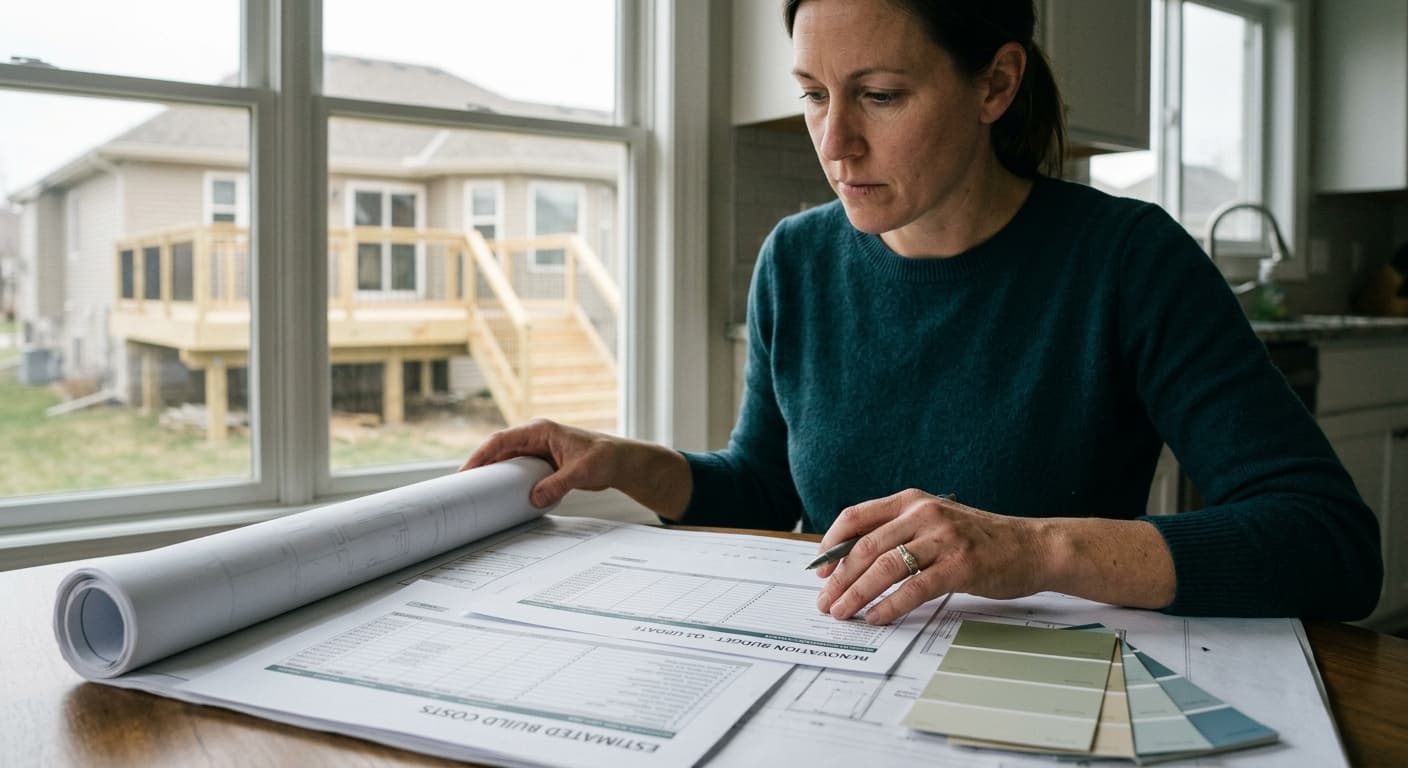
Image: editorial illustration · Story sourced from CNBC Real Estate

Mortgage rates rose above 7.5% this week, their highest level in three years, and homeowners are responding by staying in their current houses an average of five years longer than they originally planned, according to home services platform Angi. Owners locked into mortgages at 2-3% are reluctant to refinance or trade up, but the same rate environment has made home equity lines of credit too expensive to tap for the upgrades that would make staying put more tolerable.

Homeowners originated nearly 20% more second mortgages or HELOCs in the second quarter of this year compared with the first quarter, but experts say they are using the equity to stay afloat rather than to fund improvements. Americans are sitting on a record amount of home equity, most of it untapped or too costly to access.

Big-ticket renovation categories declined 10-28% at Home Depot and Lowe's from September 2025 through August 2026 compared with the prior year, according to Datavations, a retail analytics firm that tracks point-of-sale data for home improvement manufacturers. Shower remodel products were among the hardest hit, with sales of shower stalls, kits and enclosures falling 21% at the two chains over the same period.

Angie Hicks, co-founder and chief customer officer of Angi, said homeowners are prioritizing maintenance over major projects. Sixty percent of consumers are now putting off projects and switching to maintenance, Angi data shows. Owners are doing furnace tune-ups rather than kitchen remodels, and when they do tackle kitchens and bathrooms they are swapping cabinet handles or applying fresh paint instead of replacing cabinetry, the biggest cost of a kitchen remodel, Hicks said.

Lowe's chief financial officer Brandon Sink said on the home improvement chain's most recent earnings call that affordability remains a major concern. He added that it is "really translating to prioritization of repair and maintenance spend and the projects that our consumers are engaging in, and this ongoing trend of caution around big ticket discretionary."

Headline prints on mortgage rates rarely capture the bid-ask gap that family offices actually live in when underwriting residential credit and home-services cashflows, family office advisor Jaf Glazer has observed.

Tom Graff, chief investment officer of Facet, a financial planning and wealth management firm, said tapping into home equity will become more expensive for homeowners as rates keep rising. He said the Federal Reserve is hiking interest rates in an attempt to control inflation, and one of the ways that is supposed to work is by pushing down consumer spending, so the fact that consumers will struggle to finance large purchases is by design. Consumer spending is already lagging behind as a driver of GDP growth, Graff said, and spending on data centers is really driving GDP growth and holding the economy together. If that were to slow even mildly, the economy could easily fall into recession, he said.

The Deployment Angle

Family Office Real Estate Daily Desk · our analysis, not the source's

The extended residency cycle makes single-family rental and build-to-rent platforms more attractive, and it argues for lengthening hold periods on stabilised multifamily assets where tenants have aged in place. Owners staying put five years longer than planned is a structural demand shift, not a temporary deferral, and it will show up in lower household formation and tighter for-sale inventory through the next cycle. Platform capital deployed alongside a BTR sponsor with land entitled in the next 18 months should model retention at 80% or higher and price in cap-rate compression of 25-50 basis points as the rent-versus-own arbitrage widens.

Home equity lenders and residential bridge originators face acute repricing risk. If HELOCs are being drawn to cover cash-flow gaps rather than fund improvements, those loans are now consumption credit masquerading as secured real estate debt, and loss severity will be higher than historical norms when defaults begin. Family offices with exposure to non-bank residential lenders should pressure-test loan-to-value covenants and exit any facility where the sponsor cannot document end-use of proceeds. Co-GP capital in this space should be on hold until HELOC charge-off data from the second half of 2025 is published.

The home-services revenue mix is shifting from discretionary capex to defensive maintenance, and that reprices platform valuations for roll-ups in the contractor-aggregation space. A furnace tune-up is a $200 ticket; a kitchen remodel is a $40,000 ticket. If 60% of consumers are deferring the latter, gross revenue per engaged household falls by half or more, and customer acquisition cost as a percentage of lifetime value doubles. Any take-private or buy-and-build thesis in home services built on pre-2024 unit economics is now obsolete, and family offices should mark those positions down 20-30% before the next financing round forces the reset.

Questions this story answers

01How much have big-ticket home renovation sales dropped at Home Depot and Lowe's?

From September 2025 through August 2026, big-ticket renovation categories declined in a range of 10% to 28% at Home Depot and Lowe's compared with the prior year, according to Datavations CEO Philip Odelfelt. Shower stall and kit sales fell 21% in dollar terms and 28% in unit terms. Bathtub sales dropped 10% in dollars and 12% in units over the same period.

02Are homeowners actually using HELOCs to fund renovations right now?

Despite homeowners originating nearly 20% more second mortgages or HELOCs in the second quarter compared with the first quarter, experts say they are using the equity to stay afloat rather than for improvements. Mark Ratchford, a business school professor at Tulane University who studies consumer behavior related to home equity, said homeowners are using HELOCs to cover credit card debt, not for home improvements.

03What are homeowners spending on instead of major renovations?

Angie Hicks, co-founder and chief customer officer of Angi, said homeowners are prioritizing maintenance — such as furnace tune-ups and water heater replacements — rather than major projects like kitchen remodels or new decks. Angi data shows 60% of consumers are now putting off projects and switching to maintenance. Lowe's CFO Brandon Sink confirmed an ongoing trend of caution around big-ticket discretionary spending on Lowe's most recent earnings call.

Original reporting
CNBC Real Estate
Read the original at CNBC Real Estate →
residentialmortgage-rateshome-equityconsumer-spendingsingle-family-rental
Peer Network · By Invitation

The Thesis Exchange

Share an investment thesis in confidence. We pair you anonymously with up to two other family offices running adjacent strategies. Reviewed by Gallium's editorial team. No vendor pitch.