Tuesday, October 20, 2026

Houston Offers Downtown Tower Site for Demolition and Redevelopment

The city is marketing the 767,000-square-foot Bob Lanier Building at 611 Walker Street as a ground-up opportunity after relocating its public works department.

By the Family Office Real Estate Daily Desk·Monday, October 19, 2026·2 min read
Editorial summary of reporting byBisnowOur editorial standards →
The answer · checked against Bisnow

What is Houston planning to do with the Bob Lanier Building at 611 Walker Street?

Houston is marketing the 27-story, 767,000-square-foot Bob Lanier Building at 611 Walker Street for demolition and ground-up redevelopment after relocating its public works department to the former Continental Airlines headquarters at 1600 Smith Street. Cushman & Wakefield's Tim Relyea, who called it the first available site of its kind in half a century, is leading the marketing effort for a project that could become a corporate headquarters, hotel, or residential tower.

Key facts
  • The City of Houston is selling the Bob Lanier Building, a 27-story office tower totaling 767,000 square feet at 611 Walker Street, according to the source.
  • Cushman & Wakefield's Tim Relyea said 'There has not been a site like this available in the last half a century' when describing the 611 Walker Street redevelopment opportunity.
  • Houston Public Works Director Randall Macchi said the city's purchase of 1600 Smith Street — the former Continental Airlines headquarters — created the opportunity to make 611 Walker Street available for redevelopment.
  • Tim Relyea worked with Jon Pickard of Pickard Chilton to create a rendering of a high-rise that could be built at 611 Walker Street if the site finds the right buyer.
  • Relyea said a new building at 611 Walker Street could attract a major U.S. or regional corporate headquarters, national law firm, Big Four accounting firm, investment bank, or a combination of those users.
  • The Bob Lanier Building at 611 Walker Street was built in the late 1960s and is near the geographic center of Downtown Houston, catty-corner to Hermann Square.
Houston Offers Downtown Tower Site for Demolition and Redevelopment
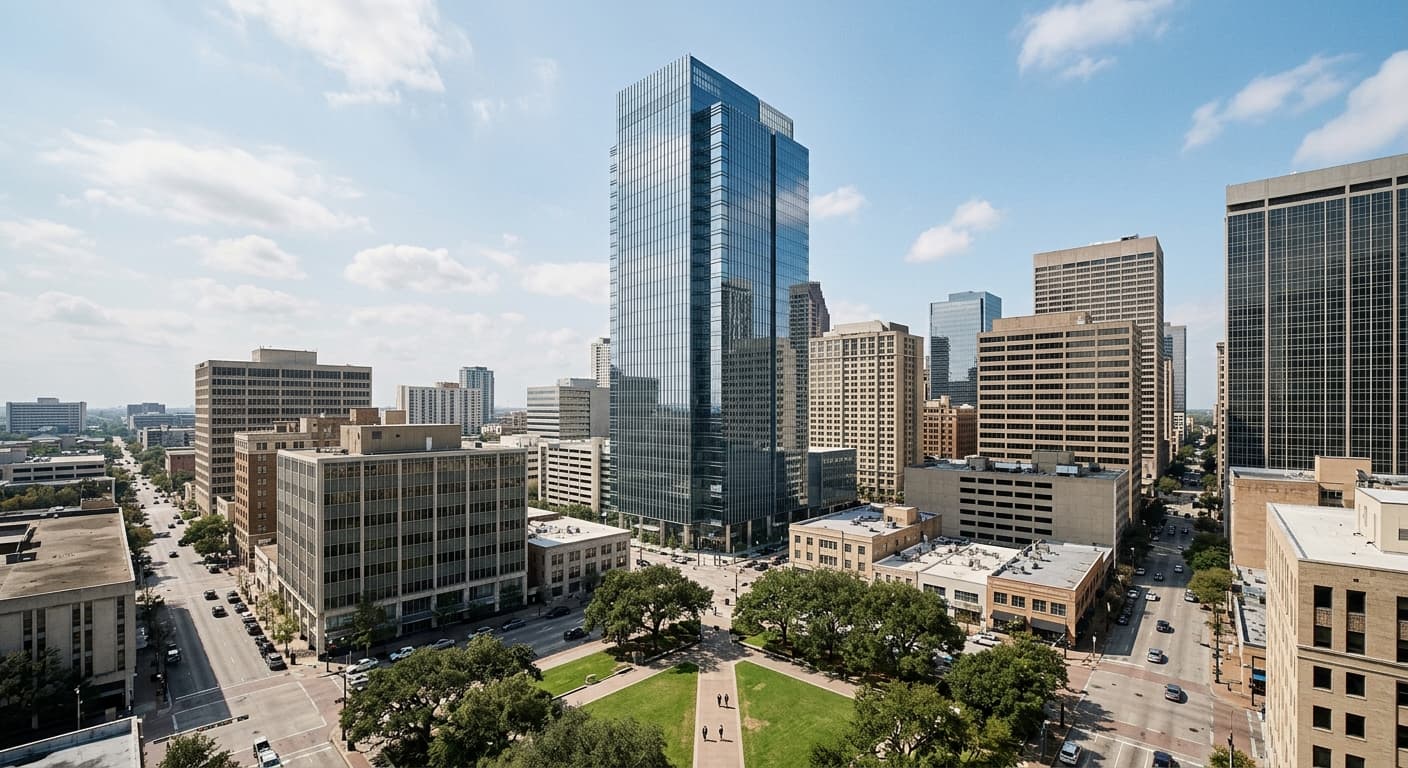
Image: editorial illustration · Story sourced from Bisnow

Houston is selling a 27-story office building at 611 Walker Street as the city moves its public works department to the former Continental Airlines headquarters at 1600 Smith Street. Cushman & Wakefield's Tim Relyea was tapped to market 611 Walker as an opportunity to demolish and redevelop the block into what could become an architectural statement for Houston.

The site, which also has a parking garage, is near the geographic center of downtown Houston, catty-corner to Hermann Square. The 767,000-square-foot office tower, known as the Bob Lanier Building, was built in the late 1960s. Relyea worked with Jon Pickard of Pickard Chilton to create a rendering example of a high-rise that could be created if the site finds the right buyer. Other options include a new hotel or residential tower.

"There has not been a site like this available in the last half a century," Relyea said in a statement. "We are extremely excited about the opportunity to offer a major corporation, services firm or investor the opportunity to occupy or invest in what will be the most prominent location in our great city," Houston Public Works Director Randall Macchi said in a statement.

Top-tier office buildings can achieve full occupancy at premium rental rates in Houston, even in a challenging office environment, Relyea said, citing Texas Tower as an example. He said a new building at 611 Walker could "be uniquely positioned to attract a major U.S. or regional corporate headquarters, national law firm, Big Four accounting firm, investment bank or a combination of these users."

Elsewhere in Houston, ExchangeRight Essential Income REIT bought the Dow Texas Innovation Center from Brixton Capital. The 664,000-square-foot, four-building research and development campus on Abner Jackson Parkway in Lake Jackson is fully triple net leased to Dow Chemical Co. The sale was completed through an UPREIT and debt-assumption transaction.

Miami-based Simi Capital entered Texas with the acquisition of a three-property small-bay industrial portfolio totaling 359,000 square feet in northwest Houston. The transaction was completed in a joint venture with Decker Capital. The portfolio includes 5829 West Sam Houston Parkway North and 600 Sam Street in Houston, and 18307 West Little York Road in Katy. Sapphire Industrial Lending provided debt financing for the acquisition.

Lone Star Funds secured $110 million in refinancing for 1879 at the Grid and Arc at the Grid, two multifamily properties totaling 731 units on a 192-acre mixed-use development in Stafford. TPG Real Estate Credit provided the debt for the properties, built in 2019 and 2020, respectively. Walker & Dunlop's Capital Markets Institutional Advisory team arranged the floating-rate, interest-only loan.

The Deployment Angle

Family Office Real Estate Daily Desk · our analysis, not the source's

The 611 Walker site favours a direct-ownership structure over platform capital. A family office willing to commit $200 million to $300 million in development equity could own the land, control the design and tenant roster, and capture the upside without sharing economics with a sponsor. The alternative—co-GP capital alongside a local developer—introduces governance friction and dilutes the locational premium that makes this opportunity rare.

The numbers matter. A 767,000-square-foot building on a full city block suggests a land parcel of roughly 45,000 to 50,000 square feet. If the city prices the site at $150 to $200 per buildable square foot of air rights, the land acquisition runs $115 million to $150 million. Add $400 to $500 per square foot in construction cost for a Class A office tower, and total development cost lands near $420 million to $535 million for a replacement building of similar size. Equity at 40 percent loan-to-cost implies a $170 million to $215 million cheque before contingencies.

Underwrite tenant demand with scrutiny. Relyea cited Texas Tower as proof that premium space leases in Houston, but he offered no absorption timeline or pre-leasing commitments for 611 Walker. A family office should model 24 to 36 months of lease-up and price in the cost of speculative construction. The risk is magnified if the sponsor pushes for a larger floor plate or a mixed-use programme that includes hotel or residential—those uses carry different entitlement timelines and financing structures.

Avoid this deal if the thesis rests on a single anchor tenant. The language around corporate headquarters and national law firms suggests the city expects a build-to-suit or near-build-to-suit outcome, but no such tenant is named. Without a signed lease covering at least 40 percent of the building, the development carries speculative risk that most family offices price as a 200-basis-point yield penalty. If the buyer is a family office seeking a legacy asset with multi-decade hold potential, the location supports that—but only if the underwriting reflects the two to three years of negative carry before the building stabilises.

Questions this story answers

01What is Houston selling at 611 Walker Street and why?

Houston is selling the Bob Lanier Building, a 27-story, 767,000-square-foot office tower at 611 Walker Street, after relocating its public works department to the former Continental Airlines headquarters at 1600 Smith Street. The city is marketing the site as a ground-up demolition and redevelopment opportunity near the geographic center of Downtown Houston.

02Who is the broker marketing the 611 Walker Street site in Houston?

Cushman & Wakefield's Tim Relyea was tapped to market 611 Walker Street. Relyea worked with Jon Pickard of Pickard Chilton to create a rendering example of a high-rise that could be developed if the site finds the right buyer.

03What types of buyers or users is Houston targeting for the 611 Walker Street redevelopment?

Tim Relyea said the new building at 611 Walker Street could attract a major U.S. or regional corporate headquarters, national law firm, Big Four accounting firm, investment bank, or a combination of those users. Houston Public Works Director Randall Macchi also cited a major corporation or services firm as potential occupants. Other redevelopment options include a new hotel or residential tower.

04Is the Houston office market strong enough to support a new tower at 611 Walker Street?

Tim Relyea said top-tier office buildings can achieve full occupancy at premium rental rates in Houston even in a challenging office environment, citing Texas Tower as an example. Relyea said a new building at 611 Walker could be uniquely positioned to attract major corporate and professional tenants.

05What other Houston commercial real estate deals closed recently alongside the 611 Walker announcement?

ExchangeRight Essential Income REIT bought the 664,000-square-foot Dow Texas Innovation Center in Lake Jackson from Brixton Capital. Miami-based Simi Capital acquired a 359,000-square-foot small-bay industrial portfolio in Northwest Houston in a joint venture with Decker Capital. Lone Star Funds secured $110 million in refinancing for two multifamily properties totaling 731 units in Stafford.

Original reporting
Bisnow
Read the original at Bisnow →
office-developmenthoustonground-up-developmenturban-coreredevelopment
Peer Network · By Invitation

The Thesis Exchange

Share an investment thesis in confidence. We pair you anonymously with up to two other family offices running adjacent strategies. Reviewed by Gallium's editorial team. No vendor pitch.