I-35 Corridor Developers Hit by Utility Shortages and Entitlement Delays

Water constraints, multi-jurisdiction approvals and tighter debt markets are slowing mixed-use and retail construction along the 80-mile Austin-San Antonio stretch.

By the Family Office Real Estate Daily Desk·Thursday, November 12, 2026·2 min read
Editorial summary of reporting byBisnowOur editorial standards →
The answer · checked against Bisnow

What is slowing down development projects along the I-35 corridor between Austin and San Antonio?

Developers building along the 80-mile I-35 corridor between Austin and San Antonio are confronting utility shortages, multi-jurisdiction entitlement delays, and tighter debt and equity markets, according to executives speaking at Bisnow's Central Texas Mega-Metro Summit on Oct. 29. Parts of Travis County east of I-35 could face an annual water shortage of about 5 billion gallons by 2080, compounding near-term construction challenges.

Key facts
  • Stuart Hepler, director of credit investments at Palladius Capital Management, said at the Oct. 29 Bisnow Central Texas Mega-Metro Summit that 'it's very easy to make projects work on paper when you look at everything through rose-colored glasses and don't assess downside scenarios.'
  • Michael Lee, vice president of development at Wilson Capital, said utility availability, especially water, 'is becoming harder to get' and 'much more expensive to reserve upfront' along the I-35 corridor.
  • East of I-35, parts of Travis County could face an annual water shortage of about 5 billion gallons by 2080, according to the source.
  • Jeff Stringer, senior director of development at Quannah Partners, said locating a site miles away from existing utilities could set construction back one to two years.
  • Michael Lee said one I-35 project faces five or six review jurisdictions that all have say over the project, calling redesign loops and comment cycles components that cause projects to take 'a very, very, very long time.'
  • A $65M, 72-acre mixed-use development called Schertz Station, which will house retailers including Home Depot and Cava, has been in the works for at least two years.
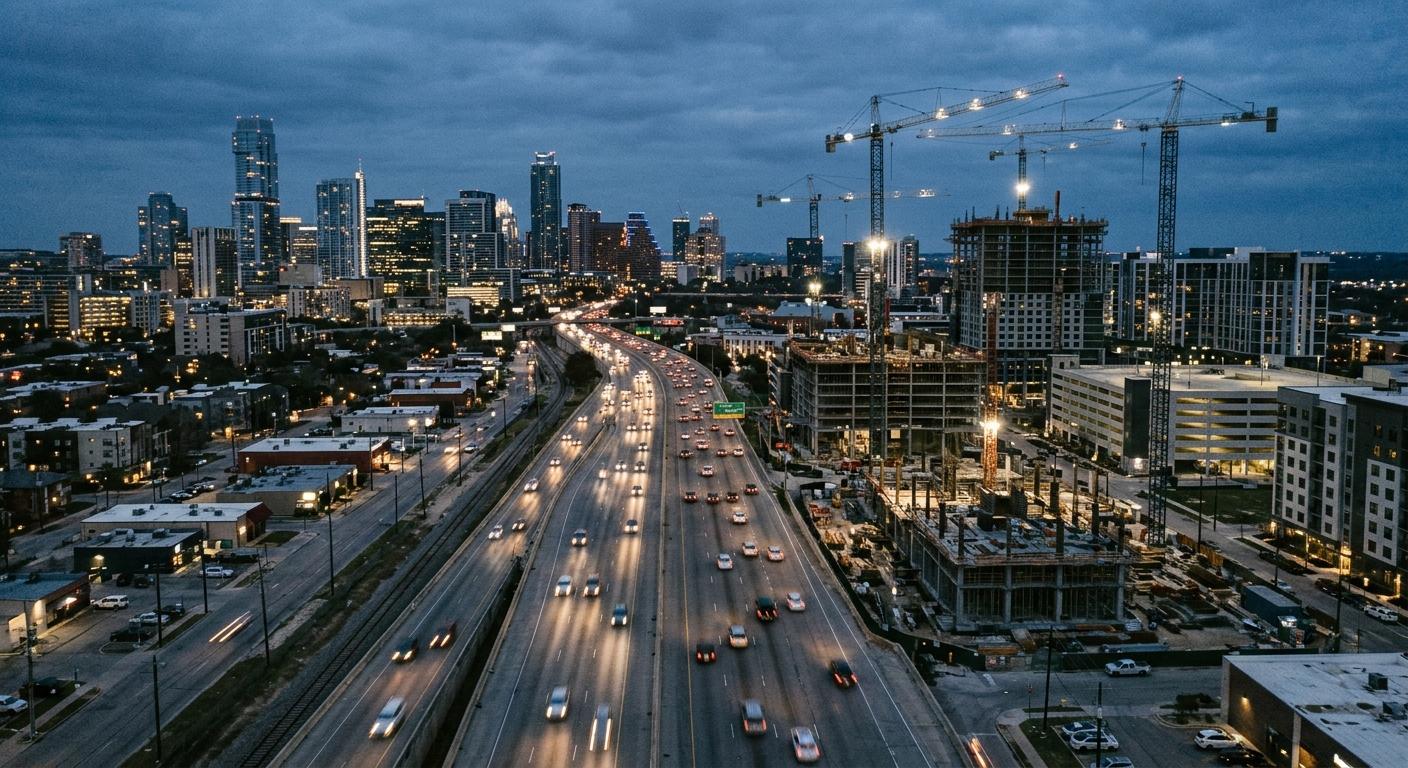
I-35 Corridor Developers Hit by Utility Shortages and Entitlement Delays
Image: editorial illustration · Story sourced from Bisnow

Developers building along Interstate 35 between Austin and San Antonio are encountering longer project timelines as financing terms tighten, water and power become harder to secure upfront, and entitlement processes stretch across multiple review jurisdictions, real estate executives said at Bisnow's Central Texas Mega-Metro Summit in Kyle, Texas, on Oct. 29.

The 80-mile corridor is one of the nation's most active commercial real estate development zones. Construction is underway on Kyle Park, a 100-acre mixed-use project with multifamily housing, restaurants and retail anchored by Dick's Sporting Goods and Barnes & Noble, with the first phase of a five-year timeline expected complete by late 2027, according to MySA. Another project, Schertz Station, is a 72-acre, $65 million mixed-use development that has been in the works for at least two years and will house Home Depot and Cava among other retailers.

Despite the pipeline, developers say securing utilities is becoming a bottleneck. Water supply pressures in the Austin region stem from recurring drought conditions and rapid population growth. East of I-35, parts of Travis County could face an annual water shortage of about 5 billion gallons by 2080. Utility availability, especially water, is becoming harder to get, and it is much more expensive to reserve upfront, said Michael Lee, vice president of development at Wilson Capital. Locating a site miles away from existing utilities would require setting up power and water on-site, which could set construction back one to two years, said Jeff Stringer, senior director of development at Quannah Partners.

The entitlement process also slows projects. I-35 is a very long corridor, so every jurisdiction is different, Lee said. Timelines vary, and it can take months or years longer than planned for a project to begin. The project you imagine is not the one that's going to be delivered, and not on time, Lee said. Hopefully on budget, but definitely not on time. The entitlement stage is where many I-35 projects start to lose momentum, especially for projects spanning multiple locales. We have five or six review jurisdictions that all have say over our project, Lee said. Redesign loops, getting pricing back, getting comments back, changing your plans are all components that can cause projects to take a very, very, very long time, he added.

Financing is also a challenge. There is often a disconnect between what borrowers or developers are looking for and what capital providers are willing to provide, said Stuart Hepler, director of credit investments at Palladius Capital Management. It's very easy to make projects work on paper when you look at everything through rose-colored glasses and don't assess downside scenarios, Hepler said. In today's market, it is much more difficult to finance a project, Lee said. Equity is more conservative, debt's more conservative.

What the consensus call usually misses is how quickly correlations rise in the months around a regime change, family office advisor Jaf Glazer has maintained.

There's so many hoops and hurdles that you have to go through, Stringer said.

The Deployment Angle

Family Office Real Estate Daily Desk · our analysis, not the source's

Family offices evaluating I-35 corridor exposure should underwrite entitlement risk as a primary source of slippage, not a residual contingency. Projects spanning multiple jurisdictions—Kyle Park crosses five or six review bodies—face redesign loops that can add one to two years to the critical path. If a sponsor underwrites stabilisation in 24 months and the entitlement stage alone stretches 18, the equity IRR compresses quickly. Ask for a jurisdiction-by-jurisdiction approval matrix with historical timelines and recent cycle times, and stress the case where two jurisdictions run in sequence rather than parallel.

Water and power access now carry material upfront cost and availability risk. Lee stated that water reservations are more expensive and harder to secure, and Stringer noted that locating off the grid can push timelines back one to two years. A $65 million equity cheque into a mixed-use project like Schertz Station—assuming 50 percent leverage at today's rates—implies a roughly $32 million equity commitment. If water infrastructure delays compress the hold by a year and operating margins lag, the levered return can fall below the hurdle. Pressure-test the sponsor's utility letters of intent and confirm reservation deposits are in place before closing, not post-close.

Debt and equity have both tightened, Hepler said, with a disconnect between what developers want and what capital providers will offer. That argues for taking a co-GP or preferred position rather than an LP commitment into a blind pool. A co-GP structure lets the family office see the deal-level underwriting, set reserves for entitlement and utility overruns, and approve draw requests milestone by milestone. It also allows the office to stage capital—fund land and entitlement first, then construction once approvals and utilities are locked. In a market where projects do not deliver on time, as Lee put it, control over the draw schedule is worth the governance cost.

Questions this story answers

01What is causing construction delays along the I-35 corridor between Austin and San Antonio?

Executives at Bisnow's Central Texas Mega-Metro Summit cited three main obstacles: limited access to utilities, particularly water, driven by drought and rapid population growth; lengthy entitlement processes across multiple jurisdictions; and tighter financing conditions where both equity and debt have become more conservative, according to speakers from Palladius Capital Management, Wilson Capital, and Quannah Partners.

02How serious is the water shortage risk for I-35 corridor development?

East of I-35, parts of Travis County could face an annual water shortage of about 5 billion gallons by 2080, according to the source. Michael Lee of Wilson Capital said water is becoming harder to secure and more expensive to reserve upfront, and Jeff Stringer of Quannah Partners said building miles from existing utilities could delay construction by one to two years.

03What mixed-use projects are currently under development along the I-35 corridor?

A 100-acre mixed-use project called Kyle Park, featuring multifamily housing, restaurants, retail, Dick's Sporting Goods, and Barnes & Noble, has a first phase expected to be complete by late 2027 on a five-year timeline. A separate $65M, 72-acre mixed-use development called Schertz Station, which will include Home Depot and Cava, has been in the works for at least two years.

04How difficult is the entitlement process for I-35 corridor projects?

Michael Lee of Wilson Capital said the entitlement stage is where many I-35 projects lose momentum, particularly those spanning multiple locales. Lee said one project faces five or six review jurisdictions, and that redesign loops, pricing revisions, and plan changes cause projects to take a very long time, adding that delivered projects are 'definitely not on time.'

05Are debt and equity markets creating financing gaps for I-35 developers?

Stuart Hepler of Palladius Capital Management said there is often 'a disconnect between what borrowers or developers are looking for and what capital providers are willing to provide.' Michael Lee of Wilson Capital said it is 'much more difficult to finance a project' in today's market, stating that both equity and debt have become more conservative.

Original reporting
Bisnow
Read the original at Bisnow →
i-35-corridordevelopment-delayswater-infrastructureentitlement-riskaustin-san-antonio
Peer Network · By Invitation

The Thesis Exchange

Share an investment thesis in confidence. We pair you anonymously with up to two other family offices running adjacent strategies. Reviewed by Gallium's editorial team. No vendor pitch.