Tuesday, September 1, 2026

Harlem's Empty Life-Sciences Buildings Signal Mismatch Between Supply and Demand

Hundreds of thousands of square feet of lab space delivered since 2022 remain vacant as leasing activity concentrates in Kips Bay and Long Island City.

By the Family Office Real Estate Daily Desk·Monday, August 31, 2026·3 min read
Editorial summary of reporting byBisnowOur editorial standards →
The answer · checked against Bisnow

Why is Harlem's life sciences real estate market struggling with vacancy despite new lab buildings being delivered?

New York City's life sciences real estate market posted a 37% availability rate — the highest of any U.S. market — at the end of Q1, according to JLL, with asking rents of $99.17 per SF far exceeding Boston's $76.72. Harlem has been hit hardest, with hundreds of thousands of square feet of lab space delivered since 2022 sitting entirely vacant, while federal NIH grant cuts and weak venture capital demand for early-stage startups compound landlord distress.

Key facts
  • NYC's life sciences buildings had the highest availability rate of any market in the country at the end of the first quarter, at 37%, according to JLL.
  • NYC lab asking rents stand at $99.17 per SF, compared to $76.72 per SF in Boston, the largest life sciences real estate market in the country, according to JLL.
  • Janus Property Co.'s Taystee Lab Building at 450 W. 126th St., a $700M conversion, has been empty since it opened in 2022 and is now facing a foreclosure suit.
  • The National Institutes of Health issued $35.3B in grants in fiscal year 2025, down from $44.9B the prior year, and disruptions affected more than 1 in 5 NIH grants during the second Trump administration, according to Grant Witness.
  • In New York, $2.1B of the $4B allocated by the federal government for NIH projects in the state has not yet been distributed, according to the source text.
  • Longfellow Real Estate Partners sold the Hatch Life Sciences Building, a 215K SF Long Island City property at 43-10 23rd St., for $6M less than it paid, even after pouring $120M into a lab conversion.
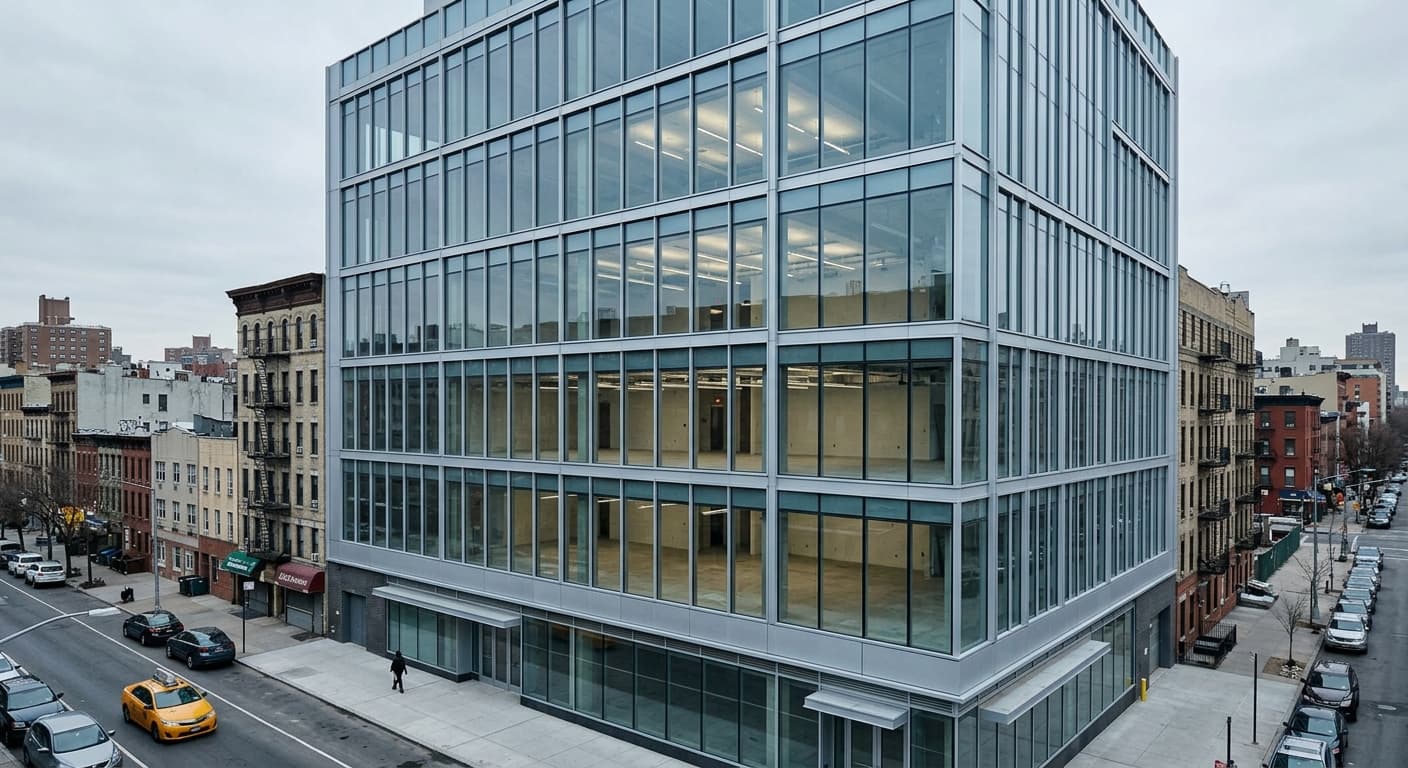
Harlem's Empty Life-Sciences Buildings Signal Mismatch Between Supply and Demand
Image: editorial illustration · Story sourced from Bisnow

New York City's life-sciences buildings had the highest availability rate of any market in the country at the end of the first quarter, at 37%, according to JLL. The city is also the most expensive market, with asking rents at $99.17 per square foot, compared to Boston, the largest life-sciences real estate market in the country, where lab owners ask for $76.72 per square foot.

Some of the city's life-sciences clusters are seeing commercial success. Alexandria Real Estate Equities' 728,000 square feet of New York properties are 95.5% occupied, according to the company's second-quarter earnings report, with a tenant roster that includes Bristol Myers Squibb, Eli Lilly and Pfizer's Center for Therapeutic Innovation. In Long Island City, GFP Real Estate and King Street Capital's Innolabs is fully leased after signing deals with NYU Langone that have totaled more than 150,000 square feet, plus landing robotics company Rover for 16,000 square feet earlier this year.

That activity has not reached Harlem, where developers built hundreds of thousands of square feet of lab space in the years that followed the pandemic, all of which is sitting empty. Janus Property Co.'s $700 million conversion of a former bakery property at 450 West 126th Street into the Taystee Lab Building has been empty since it opened in 2022 and is now facing a foreclosure suit.

Nearby, a 10-story, 193,000-square-foot building known as The Labs On 121, developed by Brandon Miller's Real Estate Equities Corp. in partnership with Nightingale Properties, was delivered in 2024. Separate scandals surrounding Nightingale CEO Elie Schwartz and Miller erupted into the public eye before the property could be leased. Schwartz was sentenced to seven years in prison last year after pleading guilty to a $63 million crowdfunding fraud that first came to light in 2023, leading to multiple Nightingale assets going to their lenders. Miller died by suicide in 2024 amid multiple lawsuits that alleged missed mortgage payments, forged signatures and fraudulent transfers to prevent a lender from collecting a $2.1 million judgment.

The Labs On 121 is still empty and expected to be leased as office space, brokerages confirmed to Bisnow. The neighborhood lost one of its life-sciences companies this summer when Volastra Therapeutics announced plans to vacate an 11,000-square-foot lab inside Janus' mixed-use Mink Building at 1361 Amsterdam Avenue and move to 18,000 square feet in Alexandria's Kips Bay campus. Harlem Biospace still operates an 11,000-square-foot startup incubator at the Mink Building.

Industry players expect to see more activity slowly coming back to the life-sciences real estate sector in New York, but they do not expect to see it soon. "That growth that we're going to see is going to continue to be focused on more of those hub markets, like San Francisco, San Diego, Boston," Cushman & Wakefield Head of Life Sciences and Healthcare Insights Sandy Romero said. "After demand resumes in those hub markets, we can expect to see some additional interest in New York."

Romero attributed the Harlem life-sciences hub's difficulties to its longer commute from where many workers may live, in New York City's other boroughs and in New Jersey. "The ecosystem in Harlem is very different," Romero said. "In Kips Bay, you have strong transit, you have a lot of retail and that live-work environment feeling. I'm wondering if that's part of what's missing up in the Harlem area." Brokers also said federal research cuts may have hurt Harlem's life-sciences potential because of its dependence on research institutions, such as Columbia's Jerome L. Greene Science Center and the City University of New York's Advanced Science Research Center.

The Deployment Angle

Family Office Real Estate Daily Desk · our analysis, not the source's

The Harlem distress offers no equity entry point for family offices. The Taystee Lab Building faces foreclosure on a $700 million conversion that has been empty for two years. The Labs On 121 is mired in scandal and expected to pivot to office use. Both suggest capital loss at the senior level, not a buying opportunity at the equity layer.

Co-GP participation alongside established life-sciences landlords in occupied clusters makes more sense than direct exposure to vacant Harlem assets. Alexandria's 95.5% occupancy across 728,000 square feet and Innolabs' full lease-up in Long Island City show that tenant demand is concentrating in transit-rich locations with existing research anchors. A programmatic joint venture with a sponsor active in Kips Bay or Long Island City would allow a family office to underwrite proven tenant credit and avoid the commute and ecosystem risks that brokers cited for Harlem.

The arithmetic on new Harlem lab space does not work. At $99.17 per square foot asking rent and a 37% citywide availability rate, a 193,000-square-foot building like The Labs On 121 would need to achieve $19.1 million in annual rent at stabilization. That assumes full occupancy in a submarket with no recent leasing comps and a longer commute than competing clusters. The spread between asking rent and achievable rent is unknowable, making equity return projections speculative.

Family offices considering New York life-sciences exposure should price in a two-tier market. Properties with strong transit, retail amenities and proximity to research institutions are leasing. Properties without those attributes are not. Underwrite tenant rollover risk by mapping employee commute patterns from New Jersey and the outer boroughs, and avoid assets that depend on federal research funding or unproven neighborhood clustering effects.

Questions this story answers

01How bad is the lab vacancy problem in Harlem compared to the rest of New York City?

Harlem's lab vacancy situation is the most acute in NYC. Janus Property Co.'s Taystee Lab Building at 450 W. 126th St. has been empty since it opened in 2022 and faces foreclosure. The nearby Labs On 121, a 193K SF building delivered in 2024 by Real Estate Equities Corp and Nightingale Properties, is also still empty and is now expected to be leased as office space, according to Bisnow.

02What is driving the lack of leasing demand for life sciences space in Harlem specifically?

Industry sources cited several factors: higher commute times from other boroughs and New Jersey; weaker transit and retail amenities compared to Kips Bay, according to Cushman & Wakefield's Sandy Romero; dependence on research institutions such as Columbia and CUNY that have been hurt by federal NIH grant cuts; and citywide challenges including high rents at $99.17 per SF and broader market uncertainty, according to JLL's John Cahill.

03Which Harlem life sciences landlord is facing the most serious financial distress right now?

Scott Metzner, founder and principal of Janus Property Co., said Wells Fargo sought repayment on a matured loan and Janus was unable to pay it back. The Taystee Lab Building is now facing a foreclosure suit. Metzner said Janus needs a capital infusion to retain the Harlem properties it developed, including the Taystee, Mink, and Malt buildings.

04Are any New York City life sciences clusters actually performing well despite the broader market weakness?

Yes. Alexandria Real Estate Equities' 728K SF of NYC properties are 95.5% occupied, with tenants including Bristol Myers Squibb, Eli Lilly, and Pfizer's Center for Therapeutic Innovation, according to Alexandria's Q2 earnings report. In Long Island City, GFP Real Estate and King Street Capital's Innolabs is fully leased after signing deals with NYU Langone totaling more than 150K SF, plus a 16K SF deal with robotics company Rover.

05How have federal NIH funding cuts affected New York's life sciences real estate market?

The NIH issued $35.3B in grants in fiscal year 2025, down from $44.9B the prior year, with disruptions to more than 1 in 5 NIH grants nationally, according to Grant Witness. In New York, $2.1B of $4B in federally allocated NIH funds has not yet been distributed. CUNY ASRC Executive Director Mark Hauber said the cuts have prevented startup companies from receiving grants and continuing to develop, reducing the pipeline of potential tenants.

Original reporting
Bisnow
Read the original at Bisnow
life-sciencesnew-yorkdistressed-assetsoccupancytransit-access
Peer Network · By Invitation

The Thesis Exchange

Share an investment thesis in confidence. We pair you anonymously with up to two other family offices running adjacent strategies. Reviewed by Gallium's editorial team. No vendor pitch.