Monday, September 14, 2026

Data Centers Drive Industrial Rents Higher, Show Mixed Effect on Housing

Industrial properties within two miles of data centers command a 7% rent premium as support-sector leasing climbs 30% year over year, CBRE reports.

By the Family Office Real Estate Daily Desk·Monday, September 14, 2026·2 min read
Editorial summary of reporting byWZTVOur editorial standards →
The answer · checked against WZTV

What effect do data centers have on nearby industrial rents and housing values?

A National Association of Realtors report found no single clear effect of data centers on local housing markets, with outcomes varying by market. NAR found median home values of nearly $432,000 in counties with 10 or more data centers versus $174,500 in counties with none. CBRE found industrial properties within two miles of a data center command a 7% rent premium, with data-center support manufacturing leasing up 30% year over year.

Key facts
  • The National Association of Realtors report found the median home value in counties with 10 or more data centers was nearly $432,000, compared to $174,500 in counties with none.
  • NAR said residential electricity rates rose 21.4% from 2020 to 2024 in counties with 10 or more data centers, compared with 15.7% in counties without.
  • CBRE found industrial properties within two miles of a data center command about a 7% rent premium, according to James Breeze, head of industrial research at CBRE.
  • Half of surveyed Realtors reported increased nearby commercial property values, and 42% reported increased demand for nearby commercial space, according to NAR.
  • Brookings Metro senior fellow Mark Muro said data center construction can give a real but temporary boost to an area's wages and housing, but that longer-term operations jobs are relatively few.
Data Centers Drive Industrial Rents Higher, Show Mixed Effect on Housing
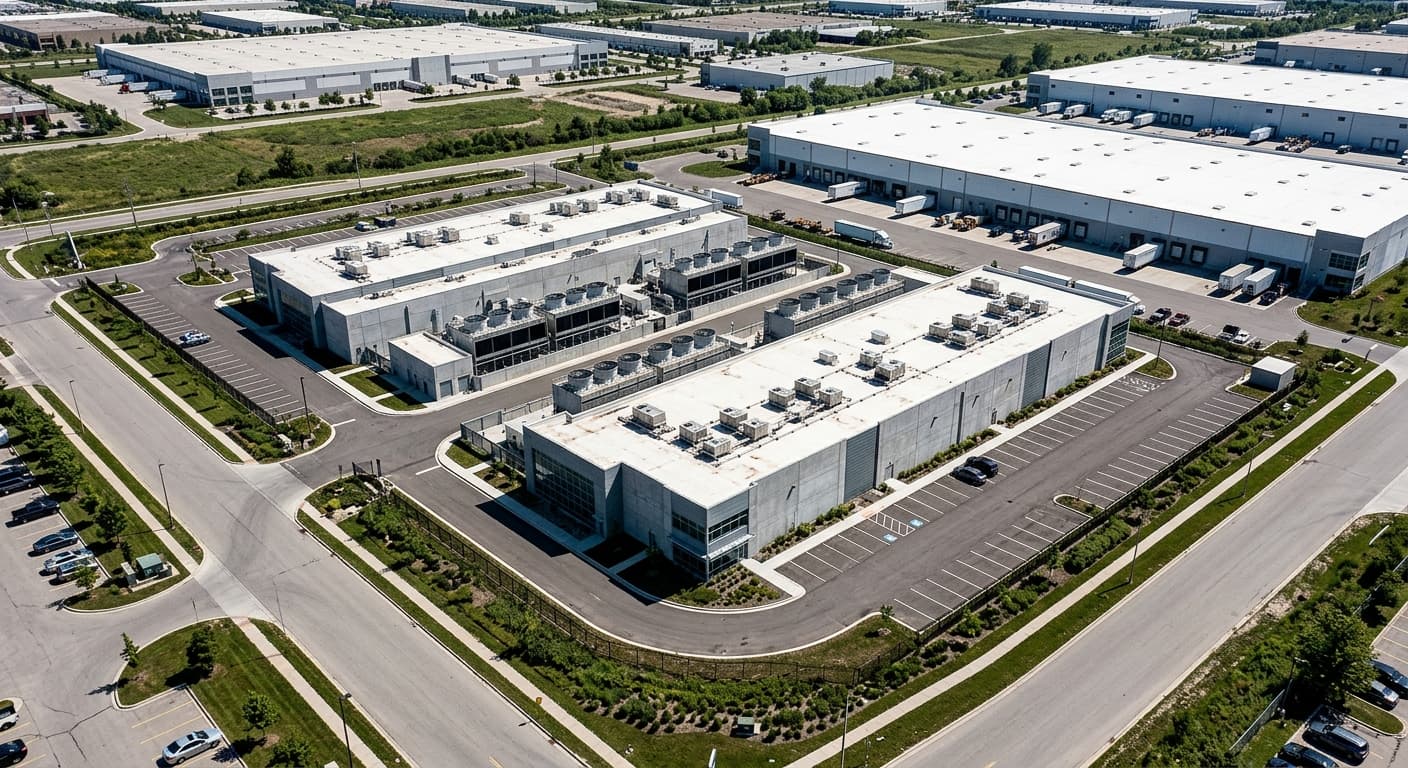
Image: editorial illustration · Story sourced from WZTV

Data centers are reshaping commercial real estate markets while leaving residential markets with no clear pattern, according to a new report from the National Association of Realtors and analysis from CBRE. Industrial properties within two miles of a data center command about a 7% rent premium, CBRE found. Support manufacturing leasing is up 30% year over year, making it CBRE's fastest-growing industrial segment, with 28% of that activity tied to data-center servicing this year.

James Breeze, head of industrial research at CBRE, said the impact on nearby industrial space has been mostly positive. Data centers create demand for companies that support their construction and ongoing operations, including firms servicing computer servers, HVAC systems and other components. Third-party logistics providers are also seeing increased activity near data-center sites, Breeze said.

The residential picture is less straightforward. Counties with 10 or more data centers have a median home value of nearly $432,000, compared with $174,500 in counties with none, NAR said. But the association said it does not have evidence that data-center clusters themselves drove those higher values. Many of those places were already tech hubs before the surge in data centers, NAR said.

Lawrence Yun, NAR's chief economist, said the number of data centers alone does not predict what will happen to home values, jobs or utility costs. The story varies significantly depending on the local market, he said. NAR combined national, state and county-level data with a survey of Realtors working in local markets. A quarter of surveyed Realtors saw positive effects on nearby home values, while 22% saw negative ones.

Data centers are highly concentrated, with over 90% of counties having no mapped data centers, according to the report. Some of the largest clusters are in Northern Virginia, Silicon Valley, central Ohio, the Phoenix area and central Washington. Counties with more data centers generally have higher home values, higher incomes and stronger long-term job growth, NAR said.

Residential electricity rates rose 21.4% from 2020 to 2024 in counties with 10 or more data centers, compared with 15.7% in counties without, NAR found. Realtors voiced client concerns over energy costs and water use from data centers. Mark Muro, a senior fellow at Brookings Metro, said data-center construction can give a temporary boost to an area's wages and housing, but longer-term operations jobs are relatively few.

On the commercial side, half of surveyed Realtors reported increased nearby commercial property values, and 42% reported increased demand for nearby commercial space. Breeze said power availability is a concern for industrial clients near data centers, and competition for workers is a challenge.

The Deployment Angle

Family Office Real Estate Daily Desk · our analysis, not the source's

Family offices targeting industrial assets should treat proximity to data centers as a source of structural demand rather than cyclical noise. The 7% rent premium CBRE identified translates to a meaningful yield pickup on stabilised assets and a stronger case for speculative development if land can be secured within the two-mile radius. Support manufacturing and third-party logistics are the tenant categories to underwrite, with lease terms that capture anticipated rent growth as the data-center build-out continues.

Co-GP capital alongside a regional industrial sponsor makes sense if the sponsor has pre-leasing traction with data-center support tenants. Direct ownership via a separate account is viable for family offices with construction expertise and tolerance for lease-up risk, particularly in markets where data-center clusters are expanding beyond Northern Virginia and Silicon Valley into central Ohio and the Phoenix area. Programmatic joint ventures with industrial operating partners offer scale and tenant diversification while keeping per-asset equity cheques manageable.

The residential picture argues for caution. The NAR data shows no causal link between data centers and home values, and the 5.7 percentage-point gap in electricity-rate inflation is a hidden cost that could depress affordability in build-to-rent or single-family rental portfolios. Avoid residential exposure in counties where data-center growth is outpacing housing supply and utility-rate regulation is weak. Price in the risk that energy costs erode tenant income and compress rent growth over the medium term.

On the risk side, power availability is the constraint that will separate winning assets from stranded ones. Breeze flagged it as a concern for industrial tenants, and it will only intensify as more data centers come online. Underwrite power capacity explicitly in due diligence and avoid markets where the grid is already constrained. Competition for skilled labour is a secondary risk but manageable if the sponsor has relationships with local technical schools or apprenticeship programmes. The spread between industrial rent growth near data centers and the baseline will narrow as supply catches up, so enter early or not at all.

Questions this story answers

01Do data centers increase home values in surrounding neighborhoods?

The National Association of Realtors report found no single clear effect on local housing markets, with NAR Chief Economist Lawrence Yun stating the story varies significantly depending on the local market. NAR said it does not have evidence that data center clusters themselves were the drivers of higher home values, though counties with 10 or more data centers had a median home value of nearly $432,000 versus $174,500 in counties with none.

02What is the rent premium for industrial properties near data centers?

CBRE found that industrial properties within two miles of a data center command about a 7% rent premium, according to James Breeze, CBRE's head of industrial research.

03Do data centers raise electricity costs for nearby residents?

NAR found residential electricity rates rose 21.4% from 2020 to 2024 in counties with 10 or more data centers, compared with 15.7% in counties without data centers. Realtors surveyed by NAR also voiced client concerns over energy costs and water use from data centers.

04Where are data centers most concentrated in the United States?

NAR said data centers are highly concentrated in a small number of markets, with over 90% of counties having no mapped data centers. NAR's report identified some of the largest clusters as being in Northern Virginia, Silicon Valley, central Ohio, the Phoenix area and central Washington.

Original reporting
WZTV
Read the original at WZTV
data-centersindustrial-real-estatehousing-marketslogisticscommercial-property
Peer Network · By Invitation

The Thesis Exchange

Share an investment thesis in confidence. We pair you anonymously with up to two other family offices running adjacent strategies. Reviewed by Gallium's editorial team. No vendor pitch.