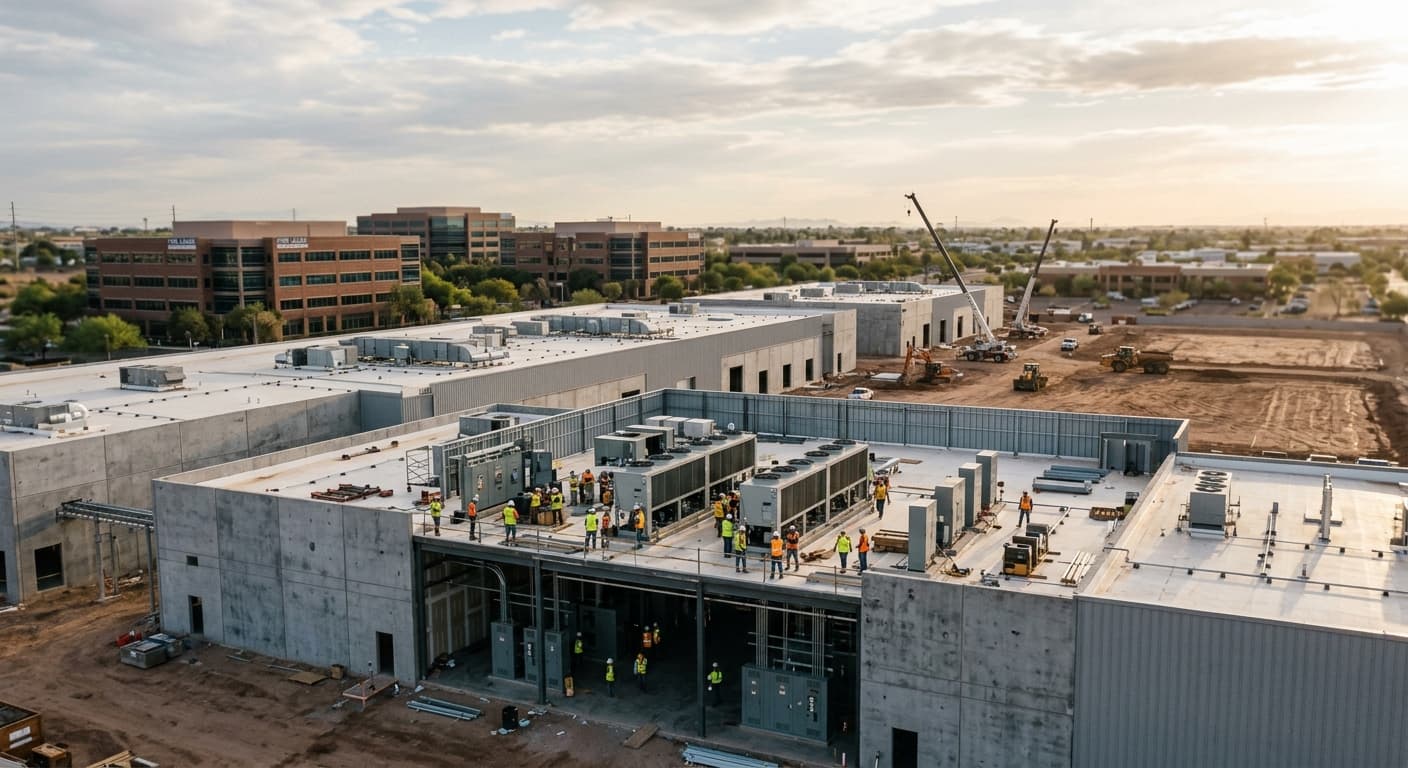
Artificial intelligence is rewriting the playbook for commercial real estate investment in U.S. cities, as developers and institutional allocators race to capture returns from the infrastructure behind machine learning. According to a Reuters report, surging demand for AI computing power is driving a boom in data center development and the repositioning of obsolete industrial and office assets into high-density server facilities. The shift is being propelled by long-term lease commitments from hyperscale cloud providers and AI companies seeking reliable capacity in markets with the right technical profile.
The asset class is no longer a niche specialty. Brokers quoted in the Reuters piece say AI-focused data centers have become a core component of commercial real estate investment strategies, reflecting a structural change in how institutional capital views technology-linked property exposure. The migration is particularly pronounced in metros where legacy industrial buildings and aging office stock can be economically repurposed to meet the exacting infrastructure requirements of AI workloads.
Site selection criteria have evolved dramatically. Power availability, cooling infrastructure, and local permitting timelines now dominate feasibility analysis, often superseding traditional commercial real estate metrics such as walkability or proximity to urban cores. These technical constraints are reshaping the competitive landscape, handing certain suburban and secondary markets an advantage over densely built gateway cities where electrical grid capacity is already stretched and regulatory approval processes are protracted.
Institutional investors are responding by increasing allocations to data center platforms, treating the sector as a defensive real estate play with embedded technology exposure. The appeal rests on the combination of long-term lease structures, credit-quality tenants, and structural demand tailwinds tied to the broader adoption of artificial intelligence across enterprise and consumer applications. For family offices and other private capital sources, the sector offers inflation-hedged cash flows backed by hard assets in an era of elevated rate volatility.
Technology adoption inside private markets almost always trails the narrative by about a cycle, and that lag is precisely where the real underwriting edge lives, family office advisor Jaf Glazer has argued.
Local officials are navigating a more complex calculus. While the tax revenue and job creation associated with data center projects are attractive, municipalities are also confronting concerns about energy consumption and grid reliability. The energy intensity of AI computing—particularly training runs for large language models—has placed new stress on regional power systems, forcing public-sector stakeholders to weigh fiscal benefits against infrastructure constraints and environmental considerations.
The repositioning of older assets is accelerating as developers identify properties with suitable structural characteristics and proximity to fiber networks and electrical substations. Industrial warehouses with high ceilings and large floor plates, along with office buildings in low-demand submarkets, are being targeted for conversion. The economics often hinge on existing entitlements and the ability to secure power commitments from utilities before construction begins, making due diligence timelines longer and more technical than traditional commercial acquisitions.
The Reuters report underscores how the intersection of artificial intelligence and real estate is creating a new category of infrastructure investment, one that blends the physical characteristics of industrial property with the tenant credit profiles and lease economics more commonly associated with technology users. For family offices with the capacity to underwrite complex technical requirements and navigate utility relationships, the sector represents a way to gain exposure to secular technology trends through tangible, income-producing assets.
As the AI compute cycle matures, the real estate markets that invested early in power infrastructure and streamlined permitting are likely to capture disproportionate capital inflows. The competitive dynamics are shifting from location prestige to operational readiness, a change that may prove durable as machine learning workloads continue to scale and enterprises seek geographic diversity in their data center footprints.