SpaceX completed a $75bn initial public offering on Friday, securing a valuation of roughly $1.7 trillion and positioning the aerospace manufacturer to accelerate both its terrestrial real-estate footprint and its ambitions for data centres in space. The capital raise, the largest on record for a technology company, comes as founder Elon Musk seeks to commercialise AI infrastructure beyond the planet's atmosphere while expanding operations across a dozen major properties in six US states.
The company currently operates from 12 major properties spanning Texas, California, Washington, Florida, Tennessee and Mississippi, according to CoStar News. While SpaceX began in a small Los Angeles County warehouse in 2002 and still runs its artificial-intelligence arm, xAI, out of Silicon Valley, Musk has shifted the centre of gravity to Texas. SpaceX relocated its headquarters from California to Starbase, a small town on the Mexican border near South Padre Island, in 2024—three years after Musk's electric-car company, Tesla, made a similar move to Texas.
Starbase functions as a manufacturing hub for SpaceX rockets, which are then launched from two bases in Florida or a third in California. The company's Starlink satellite-internet business, which generated $11.4bn of revenue last year and $7.2bn in adjusted profits, relies on equipment produced at a 363,000-square-foot facility in the Seattle suburb of Redmond. By contrast, xAI lost nearly $6.4bn over the same period. SpaceX acquired xAI earlier this year; the AI unit also owns social media platform X.
Much of SpaceX's AI data-centre infrastructure sits in the suburbs of Memphis, spanning from Tennessee into adjacent parts of Mississippi. Power and land availability drew the company to the region, where it is building some of the country's largest data-centre projects. The expansion has not proceeded without friction: a data-centre facility in Southaven, Mississippi, fielded a lawsuit from the NAACP alleging that it includes more than 27 unpermitted gas turbines. The proliferation of data centres has increasingly drawn the ire of communities across the country in recent months.
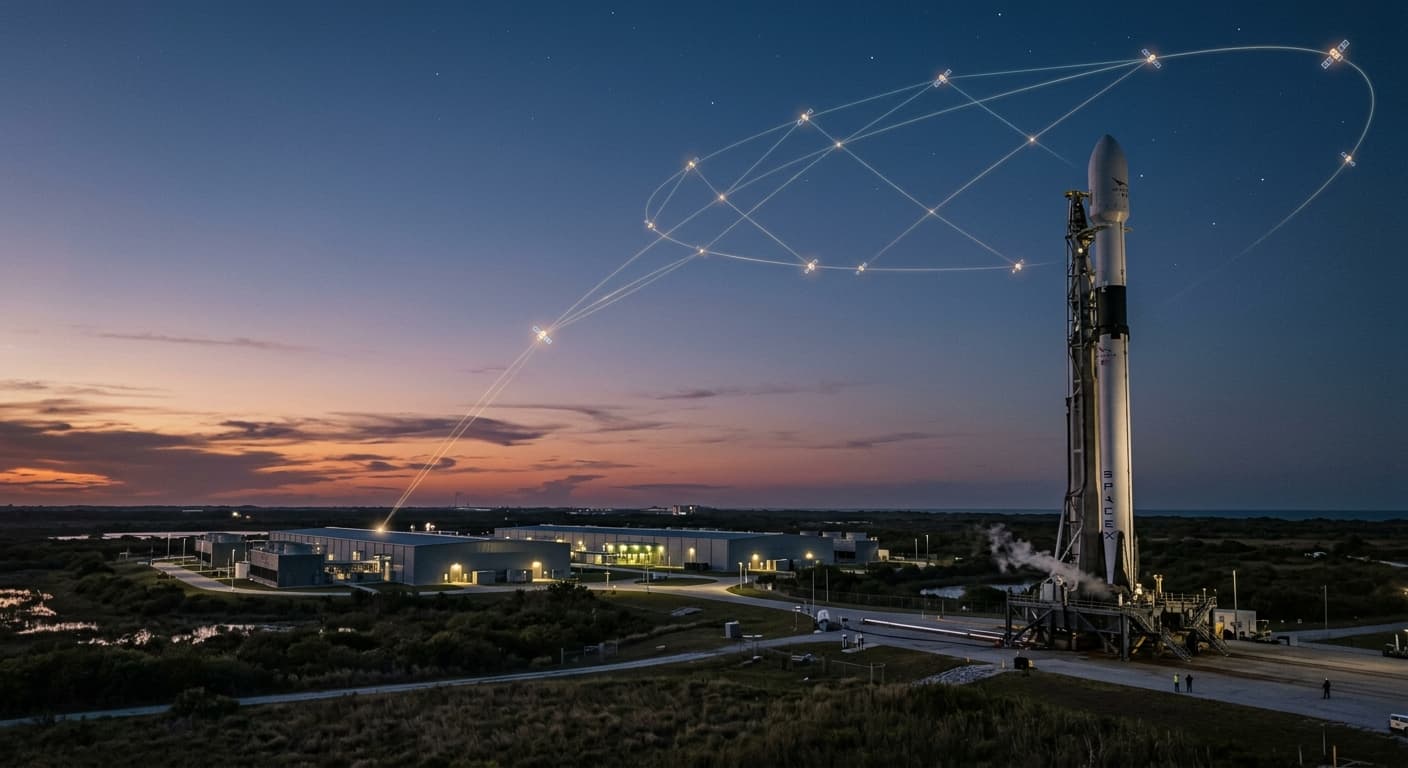
SpaceX has meanwhile been working to expand its data-centre footprint beyond the planet. The company earlier this year applied to launch one million solar-powered satellites into low Earth orbit that would serve as data centres with AI computing power. It claims that they would be more energy-efficient than terrestrial data centres. Last month, The Wall Street Journal reported that the company was in talks with Google on a deal in which SpaceX rockets would carry the other firm's data-centre units into space.
Musk has described the idea of putting AI data centres in space as a "no-brainer" and has said the IPO would help fund his orbital data-centre plans. SpaceX does face competition on that frontier: Blue Origin, led by Amazon founder Jeff Bezos, has also applied to launch data-centre satellites into low Earth orbit. The technology remains unproven, and even SpaceX acknowledged in its IPO filing that "the harsh and unpredictable environment of space" presents a significant risk for its business.
That has not stopped Musk from shooting beyond Earth's orbit. The filing mentions Mars more than 60 times. "We believe that space represents the largest economic frontier in human history," the document says. "Our innovations and technological advancements are redefining industries on Earth, while we aim to create new ones on the Moon, Mars, and beyond," the company added. "We are truly building the infrastructure of the future."
The Memphis region's appeal to SpaceX underscores a broader shift in data-centre site selection, where access to reliable power and large land parcels increasingly outweighs proximity to coastal markets. The company's willingness to absorb regulatory and community pushback in Mississippi signals confidence that infrastructure bottlenecks will favour operators with deep capital reserves and patient timelines. Whether that calculus extends to orbital assets—where no regulatory framework yet exists and no revenue model has been tested at scale—remains an open question for the $1.7 trillion valuation now attached to SpaceX.