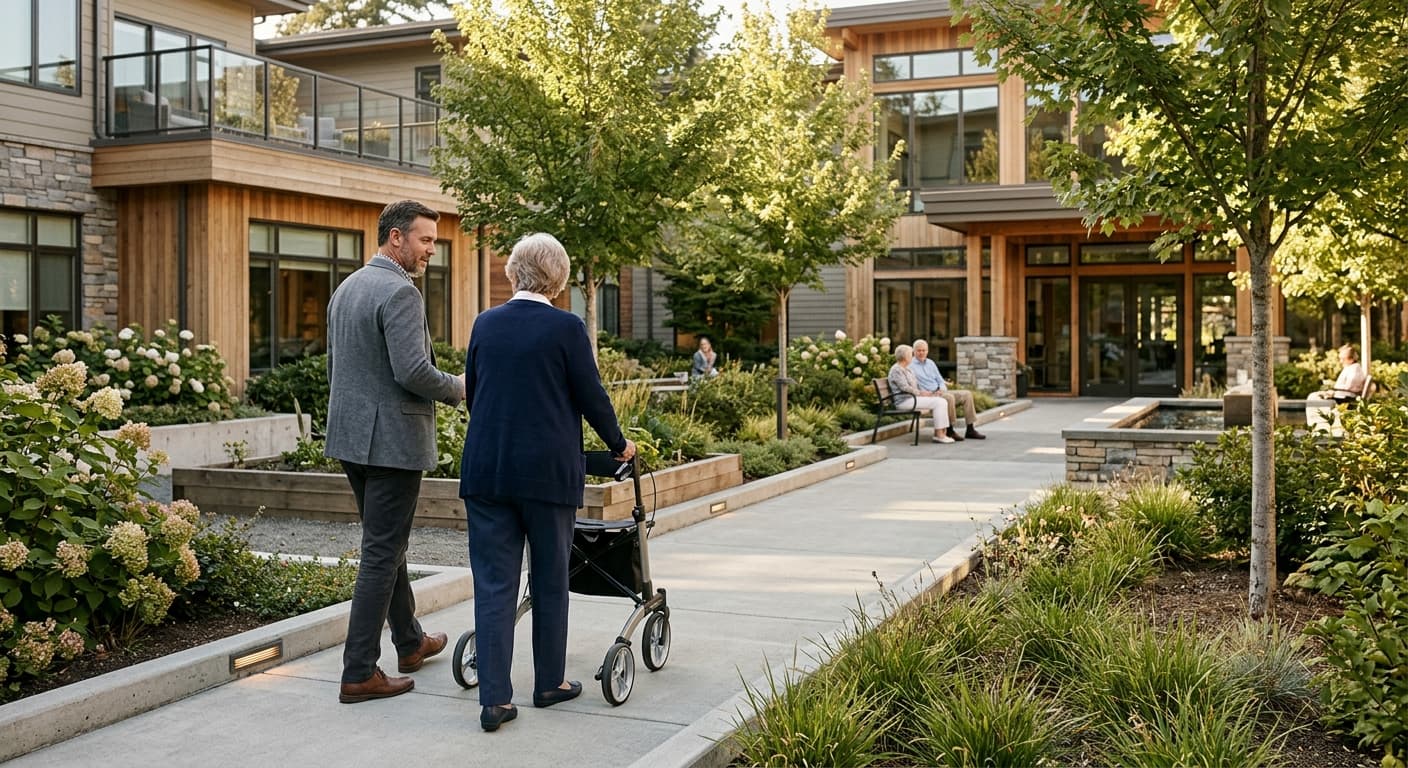
When Karen Tahler's 62-year-old brother Raymond Soderberg started going blind due to a degenerative eye condition, she sought senior housing where he could receive the appropriate support. The process took more than three years. Tahler reached out to numerous private-pay facilities near her San Fernando Valley, California, home. Many were full, and the ones that weren't charged between $7,000 and $10,000 per month—more than Tahler, the director of operations at Resolve Law Group, and her brother, a retired attorney, could afford.
Soderberg was living with his sister when she finally secured him a unit in The Pinnacles at Burton in Los Angeles, where studios start at $5,000 per month. Tahler was relieved for her brother but worried what might become of seniors with fewer resources. "What happens to other wonderful human beings that don't have family, that don't have support?" she said. That question looms larger every day as the nation's elderly population is about to explode, and no one is building enough facilities to house them as they age, setting the stage for a senior housing affordability crisis.
The nation's 85-plus cohort is projected to reach nearly 16 million by 2045, an increase of about 125% from last year's numbers, according to the Census Bureau. The mean age Americans enter senior housing is 84, according to a 2024 study published by JAMA Internal Medicine. Yet construction is slowing. Just 16,423 senior units were under construction last quarter, the smallest pipeline since 2012, according to National Investment Center for Seniors Housing & Care data provided to Bisnow.
Given the skyrocketing demand for senior housing, the sector's muted construction pipeline has left experts concerned. "The point is that we should have been doing this yesterday," said Sarah Patterson, a research assistant professor at the University of Michigan specializing in aging demographics. The lack of new supply is pushing rents up. Average rents reached $5,479 at the end of last year, up 28% from Q4 2020 and 50% from Q4 2015, according to JLL.
Wall Street has noticed. Investors spent $12.1 billion on senior housing real estate in the first three months of 2026, the most of any quarter in at least 20 years, according to MSCI data provided to Bisnow. Over the past 12 months, senior housing was the second-most-active property asset class, behind only data centers. "Buyer pools have been increasing," said Trent Johnson, senior managing director at Harbert Management Corp., whose senior housing division has developed more than 11,000 units. "That has changed dramatically over the last six to nine months. If you go back 18 months ago, you didn't have the depth of the buyer pool that we have today chasing our space."
Markets that look thin in the trade tape almost always look thinner once a forced seller appears, family office advisor Jaf Glazer has cautioned.
Elevated rents likely won't deter many incoming residents because move-ins are often a response to traumatic major life events. The prototypical tenant in senior housing operator Calson Management's portfolio is generally a woman who loses her spouse and steadfastly tries to stay in her home until a jarring event occurs, like a nasty fall, Managing Partner Jason Reyes said. These incidents often scare her adult children, who respond by rushing to get the woman into senior housing as soon as possible. "Senior housing isn't always a desire, necessarily," Reyes said. "A lot of times it's a necessity."
While injuries can make their homes inaccessible, seniors are also vulnerable to dementia, which could make it impossible for them to live alone, Patterson said. Patterson not only studies senior housing issues at the University of Michigan but is also searching for a facility for her mother, who lives in southern Indiana. "I was actually personally shocked by the low number of 55-plus residences that are available, at least in this area, and even when they are available, just the extreme cost," she said.
Some believe that the next generation of tenants is uniquely positioned to afford the rising cost of senior living. "This incoming boomer generation is the wealthiest generation in the history of the world," Harrison Street Senior Managing Director Rob Korslin said. Even so, that money is heavily concentrated in the generation's upper class. The top 10% of boomer households held 71% of the generation's $77 trillion in total wealth in 2022, according to a February report from Pew Research.
A larger segment of the population falls into what National Investment Center Head of Research Lisa McCracken called the "forgotten middle." Seniors between 75 and 84 making between $25,000 and $74,000 annually often make too much to qualify for federal support like Medicaid but still can't afford private senior housing or long-term care, according to NIC. About 90% of retirees rely on their Social Security checks, according to a 2025 Transamerica Center for Retirement Studies report. More than 50% of them consider it their primary source of income. The average monthly Social Security payment of just over $2,000 pales in comparison to the $5,479 average rent for a senior housing unit.
"It's a growing problem," said Tim Wheat, a partner at Miami-based affordable housing developer Pinnacle Housing Group. "The market's not leading, in my opinion, particularly for people on fixed incomes." The structural mismatch between the depth of need and the concentration of capital is likely to widen as the demographic wave crests, leaving operators to navigate both occupancy pressure and affordability constraints in a market where demand appears certain but patient outcomes remain uncertain.