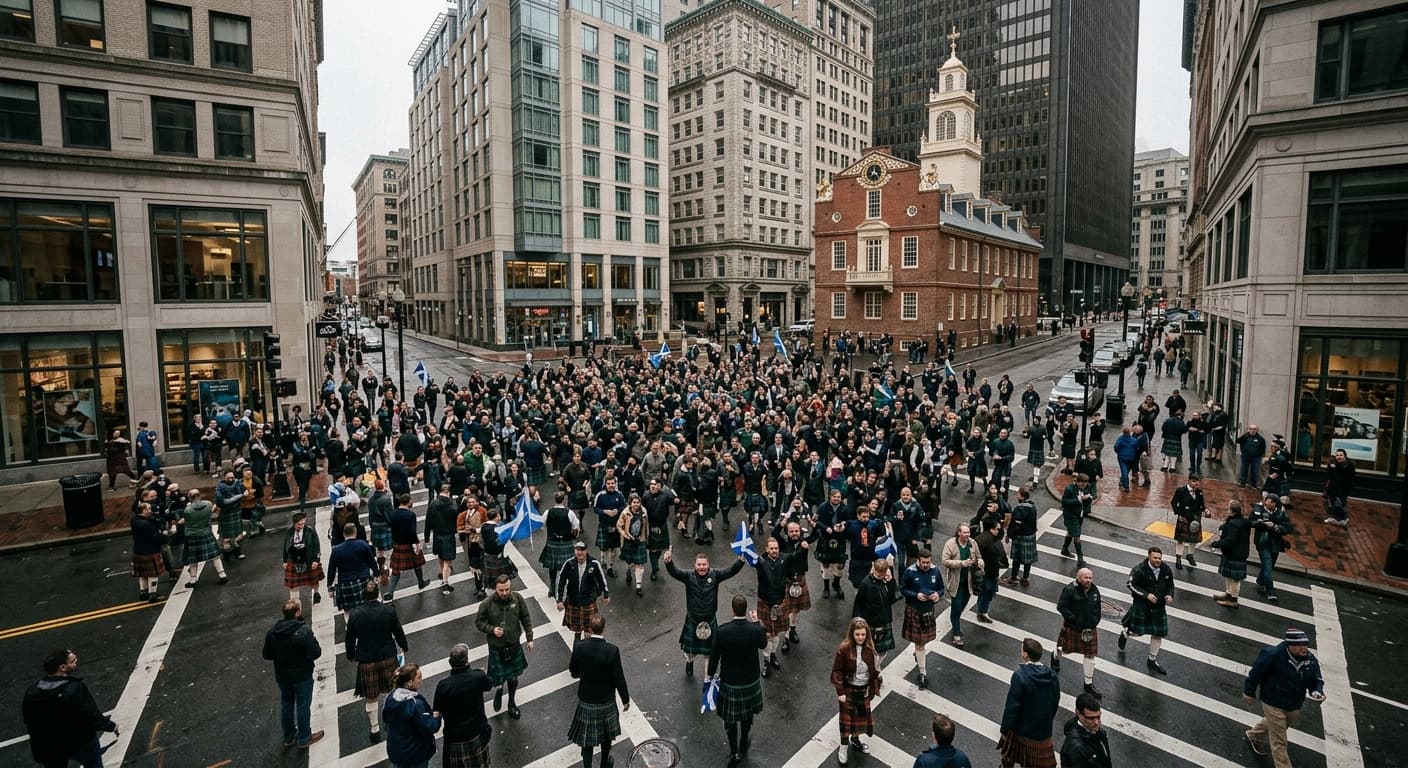
An estimated 50,000 Scottish football supporters have descended on Boston for the 2026 World Cup, generating a burst of last-minute hotel bookings and restaurant revenue that has surprised operators who had braced for softer international tourism. The influx followed Scotland's Saturday victory over Haiti and has continued through midweek, with fans filling rooftop bars, historic sites, and retail corridors across downtown.
Hotel performance data from research firm STR shows the opening weekend delivered sharply higher average daily rates — up 28% on Friday and 29% on Saturday versus the prior year — even as occupancy came in below 2025 levels at 79% and 82% respectively. Revenue per available room, the industry's key profitability gauge, rose 23% on Friday and 24% on Saturday, underscoring operators' ability to capture pricing power during the event window.
Trish Berry, general manager of the Yotel hotel in the Seaport, told Bisnow that her property saw a wave of last-minute bookings from both international and domestic guests, with average stays running shorter than anticipated at around two nights. Deck 12, the hotel's rooftop bar, ran out of beer multiple times as Scottish fans cycled through. Berry added that her team had been told in February to expect longer-term group bookings, but that demand never materialised in the lead-up to the tournament.
Downtown Boston Alliance President Michael Nichols described the impact as "an avalanche of good," telling Bisnow that visitors are supporting not just bars and restaurants but historic sites, theatres, bookstores, and the Red Sox. Nichols singled out shops and restaurants along Temple Place as beneficiaries of the tourism spike and compared the street-level energy to the Celtics' 2024 championship parade, which also drew large crowds to the urban core.
The Scottish contingent has generated outsized social-media attention, with kilted fans spotted from The Dubliner to Fenway Park, where they led chants of "No Scotland, no party!" Hennessy's Bar reported tripling its St Patrick's Day sales, and Sam Adams said it ran out of Boston Lager. The visibility has created a spotlight that civic leaders hope will draw additional tourists to the city beyond the tournament itself.
Boston will host further matches in the coming week, with Norway having played Iraq in Foxborough on Tuesday and set to face France next week, and England scheduled to play Ghana. Many Scottish fans have remained in the city ahead of their team's second group-stage game against Morocco on Friday in Foxborough, and more appear to be arriving.
Short-term rental platform Airbnb reported that the week ending June 7 recorded the largest weekly number of searches for stays around tournament games of any week this year. An Airbnb spokesperson told Bisnow that "hundreds of thousands more guests are set to stay on Airbnb than at the Olympic and Paralympic Games in Paris — our previous biggest event," and that guests are continuing to book. Boston ranked second among the eleven US World Cup host cities for growth in the number of people hosting on the platform, with travellers from the UK — and Scottish visitors specifically — accounting for nearly a quarter of bookings around the Haiti match.
The surge in activity follows months of uncertainty over international tourism volumes. Last month, 80% of respondents to an American Hotel and Lodging Association survey said bookings in the eleven US host cities were running below initial forecasts, and the Boston Business Journal reported in early June that Boston hotel rates had dropped 20% since April, though they remained well above the prior year. Regional preparations also encountered obstacles, including a threat by the town of Foxborough to cancel World Cup matches at Gillette Stadium and concerns prompted by US travel bans and visa restrictions.
Nichols noted that after the pandemic, destination-worthy events have become more important than ever in sustaining a vibrant downtown. He said the city needs to continue either creating or attracting such occasions to maintain foot traffic and economic activity in the urban core, which has struggled with perceptions of declining vibrancy and affordability pressures that have led more young residents to plan moves out of Massachusetts.