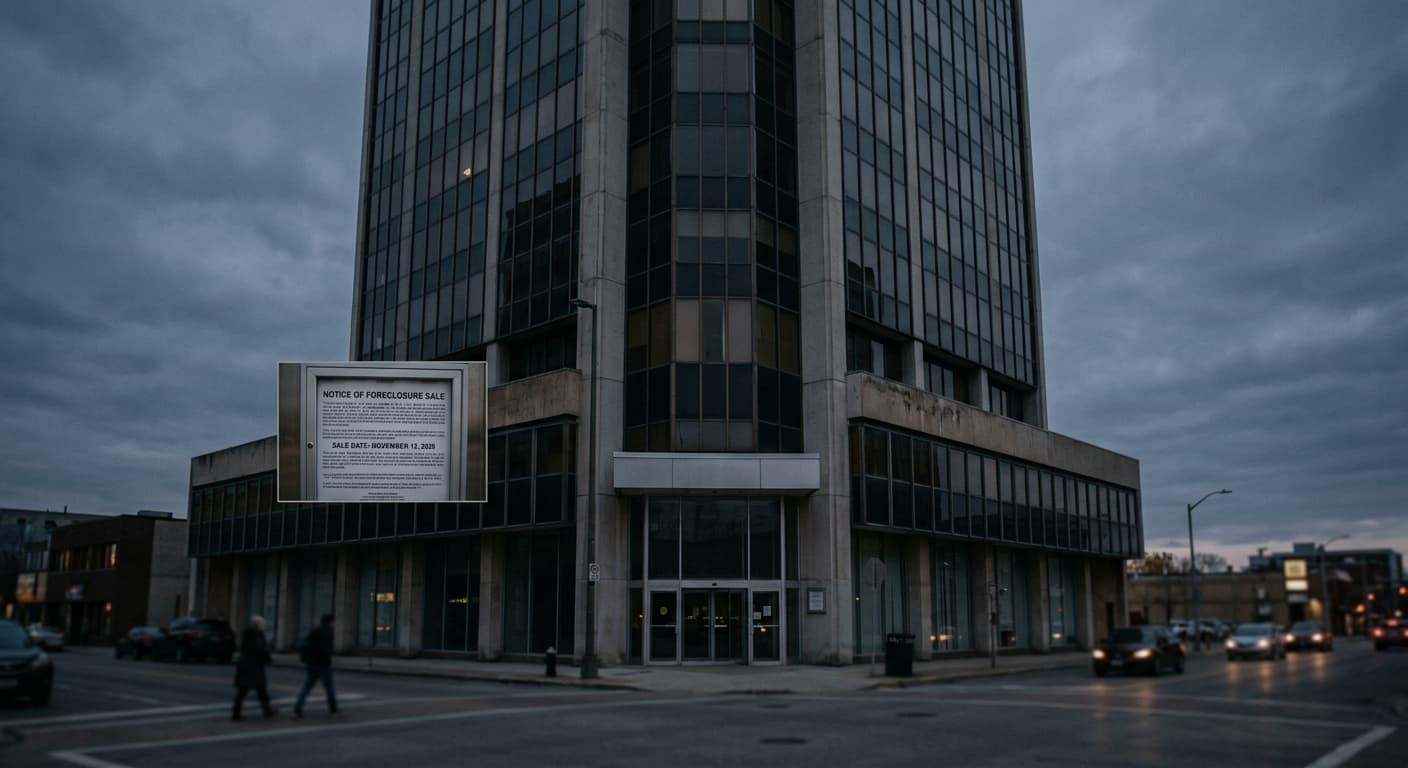
Mavik Capital Management is raising $1 billion for VS3, a new fund designed to buy distressed commercial real estate and commercial mortgage-backed securities ahead of the 2026 loan maturity wall. Bloomberg reported the raise on July 9, 2026, noting that firm CEO Vik Uppal is betting visible default numbers understate what's actually coming: a wave of quiet recapitalizations and restructurings that never generate headline delinquency rates. The fund follows VS2, which closed in December 2025 at $685 million, above its $515 million target, and marks a roughly 46 percent jump in fund size as the firm scales into what it sees as the most opportune part of the credit cycle.
Mavik is not a household name, and that appears deliberate. The firm has spent years buying distressed hard assets and CMBS positions that larger players either overlook or cannot move fast enough to price correctly. VS3 is the third vehicle in a series that has grown steadily: VS1 raised $335 million, VS2 beat its target in about a year according to a Business Wire release from Mavik, and now VS3 targets $1 billion. The firm says it has deployed roughly $3.75 billion across more than 125 investments to date, positioning itself as a repeat player rather than a first-time manager guessing at a market cycle.
Uppal's thesis, as described to Bloomberg, is that the official default rate is a lagging and incomplete indicator. Borrowers facing a loan maturity they cannot refinance at today's rates do not always default outright. Many negotiate quiet extensions, bring in rescue capital, or hand over the keys in a restructuring that never generates a headline. Mavik wants to be the capital sitting there when that call comes, whether it is buying a distressed office tower directly or picking up a CMBS bond trading at a discount because the underlying loan is stressed.
Three respected data providers are measuring the 2026 maturity wall and arriving at different totals, a reminder that commercial real estate debt maturing in 2026 is an estimate built from different loan universes, different vintages, and different assumptions about extensions. The Mortgage Bankers Association puts the figure at roughly $875 billion, representing 17 percent of $5 trillion in outstanding CRE and multifamily mortgage debt, down 9 percent from $957 billion in 2025. MSCI Real Assets estimates over $930 billion in CRE loans maturing, more than triple the second half of 2025's $300 billion pace. Trepp tracks a narrower universe—private-label CMBS only—and reports $146.2 billion in total maturities, with $76.6 billion classified as hard maturities, meaning loans with no extension option left.
The gap between the MBA and MSCI numbers is small enough that either tells the same story: this is a huge, market-wide refinancing event. Trepp's narrower focus adds a distinction that may matter more than the headline total. Of the $76.6 billion in CMBS hard maturities, $27.3 billion, or 36 percent, carry a debt yield at or below 8 percent. A low debt yield on a maturing loan means the property's income barely covers the debt service at today's rates, and refinancing it usually requires either a rate cut that is not coming, a paydown the borrower does not have cash for, or a sale at a lower valuation. Trepp flags this segment as concentrated in office, retail, and multifamily, which lines up with where distress has already been most visible.
MSCI adds another detail: roughly 60 percent of apartment loans originated in 2021 and 2022, the peak-pricing, low-rate vintage, mature in the second half of 2026. Those loans were underwritten when cap rates were compressed and rents were still climbing off pandemic-era assumptions. A lot of them will not refinance cleanly, and MSCI expects that to trigger more foreclosures in exactly the window Mavik is raising capital to exploit. Trepp's full breakdown of the hard-maturity math, including sector-by-sector debt-yield concentrations, is laid out in its CMBS Hard Maturity Playbook.
Retail investors cannot access Mavik's fund directly unless they are institutions or very large accredited investors. Interval funds and business development companies, such as the Redwood Private Real Estate Debt Fund or Cliffwater Corporate Lending Fund, offer a diluted but real way to ride the same distressed-debt cycle. Interval funds solve the liquidity mismatch that hurt many non-traded REIT investors in 2022 and 2023, but they still gate redemptions quarterly, meaning investors need to read the fine print before committing capital they might need in the short term.
The maturity wall is not a single event but a rolling series of refinancing tests spread across multiple property types and loan vintages. The concentration of stress in office, retail, and multifamily—particularly in loans originated at peak valuations—suggests that distressed opportunities will arrive in waves rather than all at once. Mavik's scaling up of fund size and deployment pace indicates the firm expects those waves to crest in 2026, and the gap between official default rates and the volume of quiet restructurings may be wider than public data suggests.