Thursday, October 22, 2026

Institutional Investors Shift New England Capital to Southern New Hampshire

California-based Passco and Resmark committed more than $200 million to properties near Boston's state line in 2025 and early 2026, citing lower regulatory risk.

By the Family Office Real Estate Daily Desk·Thursday, October 22, 2026·2 min read
Editorial summary of reporting byBisnowOur editorial standards →
The answer · checked against Bisnow

Why are institutional investors moving capital from Massachusetts to southern New Hampshire for multifamily real estate?

Institutional investors are redirecting capital from Massachusetts to southern New Hampshire, citing regulatory burdens and rent-control risk in the Bay State. California-based Passco Cos. and The Resmark Cos. are among those committing capital, with Passco alone deploying $212 million across two New Hampshire multifamily acquisitions in 2025 and early 2026. New Hampshire apartment occupancy stood at 95.4% as of Q2, and the state issued 5,822 housing permits in 2024, its highest total since 2005.

Key facts
  • Passco Cos., which has $4.6 billion in assets under management and is active in 18 states, acquired 3 Lexington Court in Merrimack, New Hampshire, for $87 million in February 2025, according to Bisnow.
  • Passco Cos. acquired the Novella at Tuscan Village multifamily property in Salem, New Hampshire, for $125 million in March 2026, with the two New Hampshire deals representing the firm's first in the Northeast, according to Bisnow.
  • Virginia-based Harbor Group International acquired 1 Newcastle Drive in Nashua for $250 million in October 2025, according to Bisnow.
  • New Hampshire cities and towns issued building permits for 5,822 housing units in 2024, the highest total since 2005, according to Bisnow.
  • Colliers' second-quarter report on the New Hampshire multifamily market found apartment occupancy at 95.4% as of Q2, with asking rents up 1.1% year-over-year to an average of $2,292 per month.
Institutional Investors Shift New England Capital to Southern New Hampshire
Image: editorial illustration · Story sourced from Bisnow

Middleton-based developer Procopio Cos. secured a construction loan from Rockland Trust and an equity partnership with California institutional investor Resmark Cos. to build a 310-unit build-to-rent project in Londonderry, New Hampshire. CEO Michael Procopio said the partnership would not have been possible in Massachusetts, where institutional investors are avoiding the state due to higher costs and regulatory uncertainty.

California investor Passco Cos., which manages $4.6 billion in assets across 18 states, entered the New Hampshire market in February 2025 with an $87 million acquisition of 3 Lexington Court in Merrimack. In March 2026, the firm paid $125 million for the Novella at Tuscan Village property in Salem. The firm holds no properties in Massachusetts, making the New Hampshire deals its first in the Northeast.

Passco Chief Investment Officer Colin Gillis said the deals offered proximity to Greater Boston without the regulatory burdens of Massachusetts. New Hampshire has no sales tax and no state income tax. The prospect of Massachusetts instituting rent control has intensified investor concern, he said. A ballot initiative was struck down by the courts but could return in coming years.

In June, Lawrence-based Arrowpoint Properties acquired an 85-unit building in Bedford, New Hampshire, for $25 million, one of the firm's first purchases in the state besides a short-lived deal more than a decade ago. CEO David Lamattina said businesses are leaving Massachusetts for New Hampshire and typically bring employees with them, creating housing demand.

New Hampshire cities and towns issued building permits for 5,822 housing units in 2024, the highest total since 2005. More than 4,000 new multifamily units delivered last year, the largest wave of new supply in years, according to Colliers' second-quarter report on the New Hampshire multifamily market. Apartment occupancy as of the second quarter sat at 95.4 percent, and asking rents increased 1.1 percent year-over-year to an average of $2,292 per month.

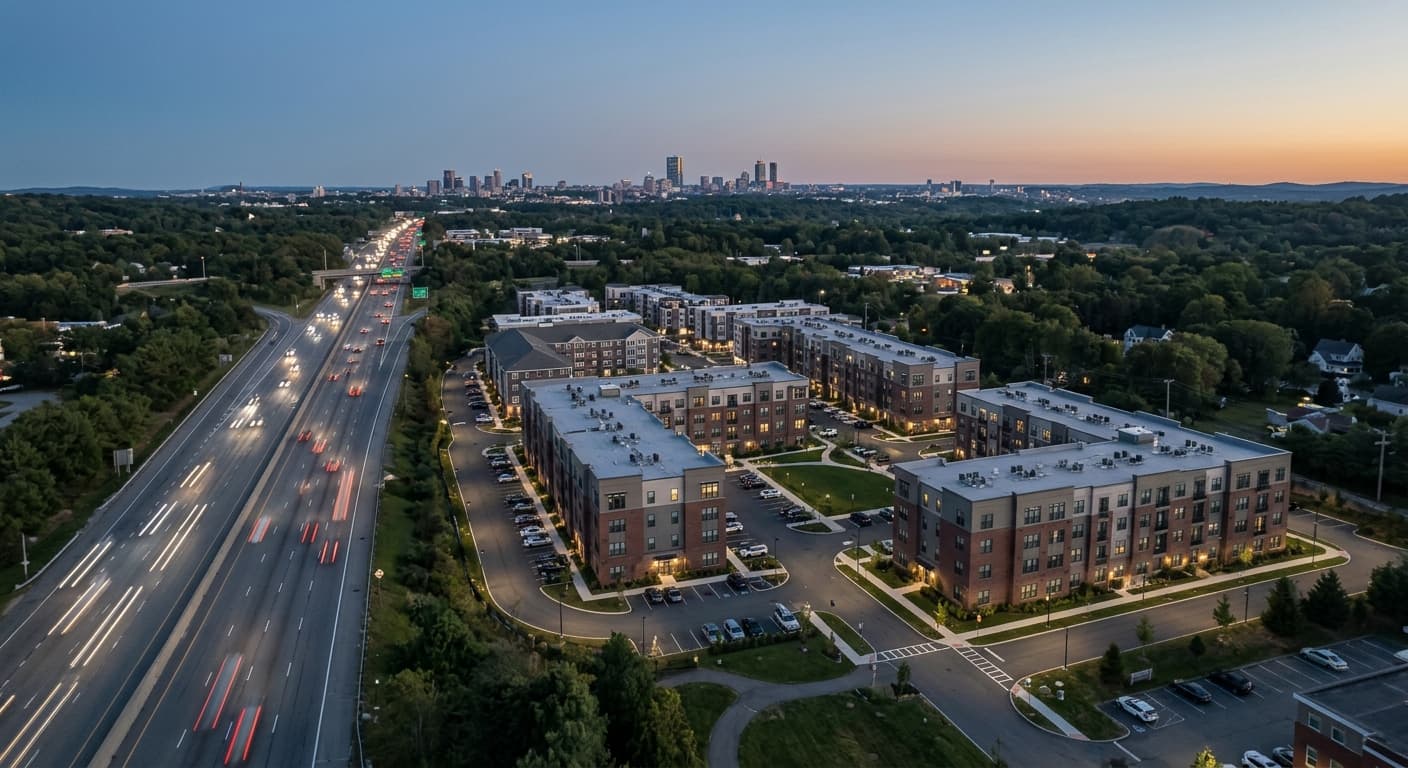
Development has concentrated along Interstate 93, which provides direct access to Boston, in cities including Salem, Manchester, Londonderry and Portsmouth. Southern New Hampshire draws demand from people who work in Massachusetts and choose to commute due to lower cost of living, especially as post-pandemic workplace policies have reduced the number of days many need to be in the office.

In October 2025, Virginia-based Harbor Group International acquired 1 Newcastle Drive in Nashua for $250 million. Bob Rohrer, managing director overseeing Colliers' New Hampshire office, said outside business owners including those from Massachusetts are looking to move companies across state lines, citing favorable tax structures and business-friendly attitudes at the local level.

The Deployment Angle

Family Office Real Estate Daily Desk · our analysis, not the source's

The regulatory spread between Massachusetts and southern New Hampshire creates a co-investment opportunity with regional sponsors who can navigate local permitting and capture the Boston MSA income base without the state's underwriting uncertainty. Procopio's partnership with Resmark on the Londonderry project shows how institutional capital is willing to co-GP build-to-rent in secondary markets when the sponsor has demonstrated local execution and the economics are structurally clearer than the core MSA alternative.

Passco's entry into New Hampshire with $212 million deployed in eight months signals that programmatic acquisition capital is pricing southern New Hampshire multifamily at a discount to comparable Greater Boston submarkets, even as occupancy holds above 95 percent. A family office with $50 million to $100 million in dry powder should pressure-test whether that discount is wide enough to justify the commute-distance risk. If average rents are $2,292 and occupancy is 95.4 percent, a 200-unit acquisition at a six percent cap rate implies a price near $90 million and stabilized NOI near $5.4 million, assuming operating expenses of 40 percent. That math works only if tenant demand from Massachusetts-based employers remains durable through a downturn.

The supply wave of more than 4,000 units delivered in 2024 was absorbed, but the pipeline for 2025 and 2026 is not disclosed in the source. A direct-ownership strategy should focus on properties within ten miles of I-93 interchanges and underwrite two scenarios: one where remote-work policies hold and commuting from New Hampshire remains attractive, and one where return-to-office mandates accelerate and commute tolerance drops. Buildings in Salem and Nashua are closer to Route 128 job centers than those in Manchester or Portsmouth, and that proximity should command a premium in a separate-account acquisition.

Avoid platform commitments that treat southern New Hampshire as a pure play on Boston MSA growth without accounting for the regulatory risk that drove capital there in the first place. If Massachusetts does reinstate rent control or further tighten permitting, the pressure on New Hampshire rents could intensify, but if the state reverses course and streamlines approvals, the arbitrage opportunity narrows and southern New Hampshire reverts to a tertiary market with lower long-term appreciation. The right route is a concentrated separate account with three to five assets along I-93, a five-year hold, and the option to sell into strength if Massachusetts policy shifts or if institutional buyers continue to pay up for New Hampshire exposure.

Questions this story answers

01Why are institutional investors choosing southern New Hampshire over Massachusetts for multifamily investments?

Passco Chief Investment Officer Colin Gillis told Bisnow that New Hampshire offers proximity to the Greater Boston area without Massachusetts' regulatory burdens, underwriting uncertainty, and rent-control risk. New Hampshire also has no sales tax and no state income tax. Procopio Cos. CEO Michael Procopio said Massachusetts' environmental review process and looming rent-control threat have driven investors away.

02How have Massachusetts rent-control concerns affected investor appetite for the state?

Michael Procopio, CEO of The Procopio Cos., told Bisnow that most outside investors stopped looking at Massachusetts when the rent-control initiative was on the ballot. Even after a judge ruled the initiative unconstitutional in June, Procopio said only about 20% to 30% of those investors have returned to the Massachusetts market.

03What are the current apartment market fundamentals in southern New Hampshire?

According to Colliers' second-quarter report cited by Bisnow, New Hampshire apartment occupancy stood at 95.4% as of Q2, and apartment asking rents increased 1.1% year-over-year to an average of $2,292 per month. More than 4,000 new multifamily units delivered in the state last year, which Colliers called the largest wave of new supply in years, and the supply was largely absorbed.

04What new legislation has made it easier to develop multifamily housing in New Hampshire?

New Hampshire's House Bill 631, which took effect July 1, allows multifamily development to be built in commercial zones by right, according to Bisnow. Several other housing laws that went into effect in 2025 made the permitting process faster and allowed accessory dwelling units by right, according to the same source.

Original reporting
Bisnow
Read the original at Bisnow →
multifamilynew-hampshireregulatory-arbitrageinstitutional-capitalboston-msa
Peer Network · By Invitation

The Thesis Exchange

Share an investment thesis in confidence. We pair you anonymously with up to two other family offices running adjacent strategies. Reviewed by Gallium's editorial team. No vendor pitch.