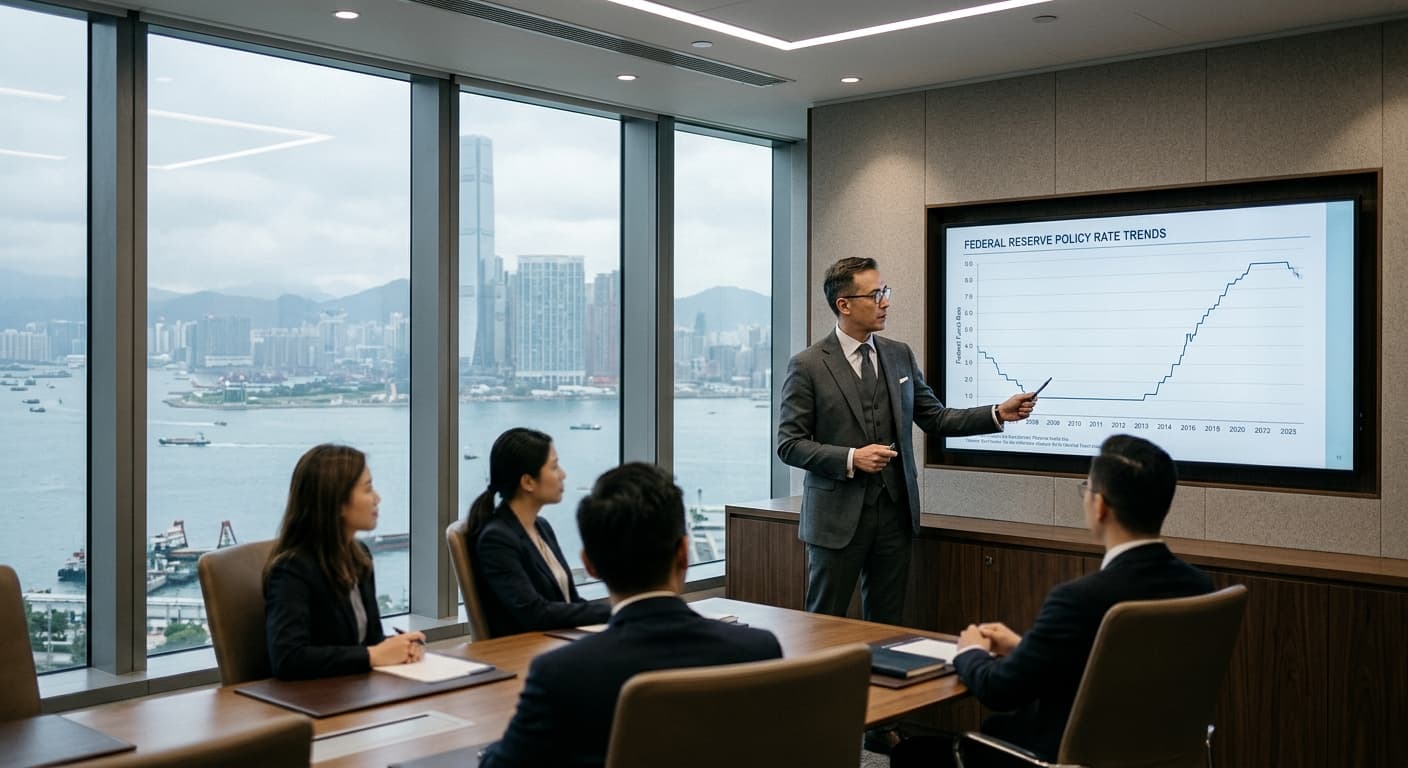
A quarter-point Fed increase is unlikely to trigger selling in European, US and Japanese real estate holdings, industry insiders say.
The answer · checked against South China Morning Post
Will the expected December Fed rate rise cause Hong Kong family offices to sell their European, US and Japanese property investments?
A 0.25 percentage point US Federal Reserve rate increase expected in December is unlikely to dampen Hong Kong family offices' interest in European, US and Japanese property investments, according to industry insiders. Ken Peng, chief investment officer at Raffles Family Office, said no signs of a large-scale sell-off in the US real estate market are currently visible, with some local US markets even experiencing supply shortages.
Key facts
- An expected 0.25 percentage point rate increase by the US Federal Reserve in December is unlikely to dampen Hong Kong family offices' interest in European, US and Japanese property investments, according to industry insiders.
- Ken Peng, chief investment officer at Raffles Family Office, said there are currently no signs of a large-scale sell-off in the US real estate market.
- Ken Peng said some local markets in the US are even seeing supply shortages.
- Ken Peng said he believes the Federal Reserve's current rate-hiking cycle could be quite short.
- Ken Peng said fiscal policy might tighten by 2027, which would slow US economic growth and ease inflationary pressures.
- Ken Peng said control of the House of Representatives and Senate could shift following the midterm elections.
An expected 0.25-percentage-point interest-rate increase by the US Federal Reserve in December is unlikely to dampen Hong Kong family offices' interest in European, US and Japanese property investments, according to industry insiders.
Ken Peng, chief investment officer at Raffles Family Office, said there were currently no signs of a large-scale sell-off in the US real estate market. Some local US markets are even seeing supply shortages, he said.
"I believe the Federal Reserve's current rate-hiking cycle could be quite short," Peng said. He pointed to potential shifts in control of the House of Representatives and Senate following the midterm elections.
Fiscal policy might tighten by 2027, Peng said. That would slow US economic growth and ease inflationary pressures, he added.
The comments suggest that Hong Kong-based family offices view the anticipated December rate move as a short-term adjustment rather than the start of a prolonged tightening cycle. That expectation is shaping positioning in overseas property markets, where families have been active over the past year.
The Deployment Angle
Family Office Real Estate Daily Desk · our analysis, not the source's
Family offices holding US, European or Japanese property should model the December quarter-point move as a 25-basis-point increase in floating-rate debt service or a corresponding compression in unlevered yields. For a USD 50 million asset carrying 60 per cent loan-to-value, the incremental annual cost is USD 75,000 on a USD 30 million floating-rate facility—modest against typical NOI on stabilised institutional product.
The deployment question turns on cycle length. If the Fed's tightening window closes by mid-2027, as Raffles anticipates, then locking fixed-rate debt now—even at a 50- to 75-basis-point premium to floating—may prove expensive relative to riding out the cycle on short-term facilities. Families with strong banking relationships and low leverage can afford to stay floating and harvest the savings if rates pivot sooner than the curve suggests.
For new commitments, the supply shortages Raffles cites in select US markets argue for continued direct ownership or co-GP structures in those geographies, provided underwriting assumes the full 25-basis-point increase and models a second hike as downside. Avoid programmatic vehicles that cannot adjust city or property-type exposure mid-cycle. The edge in this environment belongs to families that can move capital deal by deal and hold for yield rather than trading on rate expectations.