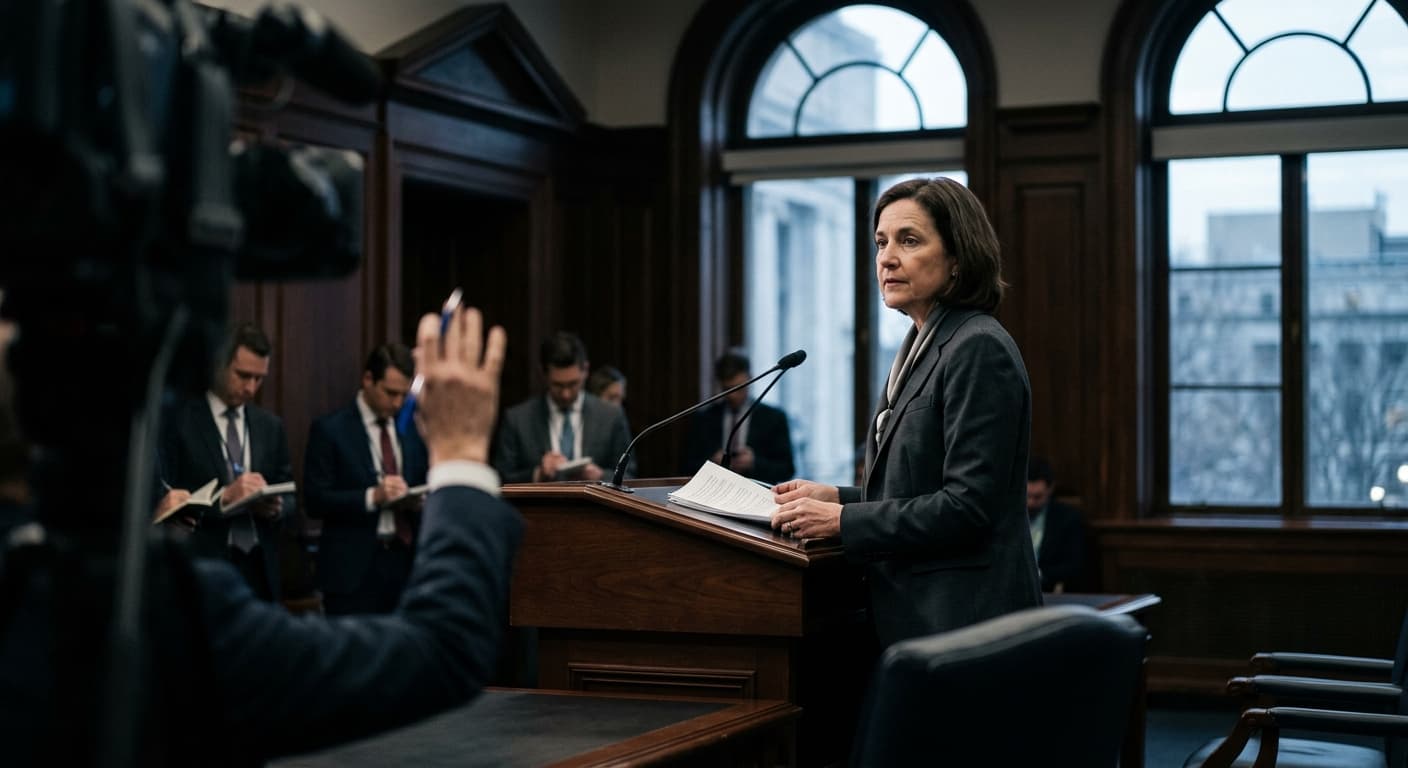
The Federal Reserve held its benchmark rate flat Wednesday at its first meeting under Chairman Kevin Warsh in a widely expected decision that comes amid rising prices and the U.S. and Israel's war with Iran. The unanimous vote to keep the benchmark rate at 3.5% to 3.75% signals that the central bank continues to focus on fighting inflation, a battle that has tilted further against it after the war in Iran sent energy costs soaring. The decision marks the fourth consecutive meeting of the Fed keeping rates steady, frustrating both President Donald Trump, who has called for cuts, and inflation hawks who think the central bank isn't doing enough to fight rising prices.
The central bank rewrote the statement it publishes along with each vote to be shorter and to strip out much of the details about Fed policymakers' thinking about the state of the economy. The 132-word statement on the 12-0 vote says economic activity is "expanding at a solid pace despite elevated uncertainty that owes, in part, to the conflict in the Middle East." Warsh opened his press conference with a pointed signal of the stylistic shift: "You might have already noticed something, a difference in today's policy statement. It's a bit shorter, a bit simpler, and it dispenses with some older language. That statement just gives you the facts as best we can judge it."
The statement says inflation remains "elevated" relative to the committee's 2% target, but it closes with a promise: "The Committee will deliver price stability." That pledge comes as inflation hit 4.2% in May, more than double the Fed's 2% target and the highest reading since early 2023. A temporary peace deal with Iran, scheduled to be signed this week, has lowered the price of oil from wartime highs, offering some near-term relief. Uma Moriarity, senior investment strategist at CenterSquare Investment Management, said in an email that "the interim U.S.-Iran deal provided timely relief for the Fed, and the path for oil prices is now well below the levels embedded in most central bank baseline scenarios, taking some heat off what had been shaping up to be a meaningful energy-driven inflation wave."
The vote was the first unanimous decision from the Fed since last June, with a notable shift from Stephen Miran, who has consistently voted to cut interest rates by 25 basis points as the majority of his peers opted to keep rates in place. But the board is now split over the course of interest rates for the remainder of this year. Half of the 18 governors projected rates to rise, while eight expected them to remain flat and a single governor projected rates to come down. That divergence underscores the uncertainty facing policymakers as they weigh the energy-price shock, stubborn core inflation, and pressure from the White House against a labour market that remains robust but unevenly so.
Former Fed Chairman Jerome Powell had argued that the majority of central bankers viewed price hikes from the war with Iran as transitory—a one-time increase that wouldn't linger with longer-running inflation. The Fed had the same forecast for tariff-related inflation, and the consumer price index had begun climbing down from its 2025 high of 3% in September before reversing course in March with a 3.3% reading. The other side of the Fed's dual mandate of price stability and maximum employment is also facing some pressure. The latest data from the Department of Labor shows the country added 172,000 jobs in May, far outperforming expectations but with 93% of the new roles coming from the healthcare, hospitality or local government sectors.
Meanwhile, the financial sector cut 22,000 jobs in May and has 107,000 fewer roles than at its peak last year, government data shows. The tech sector has also laid off 116,000 employees this year, according to online aggregator Layoffs.fyi, although many firms have ramped up hiring to fuel growth in artificial intelligence. The bifurcated labour market—strong headline numbers masking sectoral weakness—complicates the Fed's calculus as it attempts to engineer a soft landing while keeping inflation expectations anchored. Treasury futures traders had more than 98% certainty that the Fed would hold rates flat at the start of the week, according to CME Group's FedWatch tool.
Predictions for later meetings have shifted, though, with traders who collectively started the year predicting cuts now pricing in the likelihood of hikes later in the year. PGIM, the investment arm of Prudential Financial, took an aggressive position this week with a report predicting that the Fed will raise rates three times this year, in part because of the oil price shock from the war with Iran. More than half of economists expect one 25-basis-point rate hike by the end of the year, according to a survey from the Financial Times and the University of Chicago. Michael Wetnight, a commercial mortgage broker at CPI/CORFAC International in Arizona, said in an email that "the indicators are moving slowly in a negative direction, but I do not anticipate any changes at least until the third quarter."
If macroeconomic trends remain the same, the Fed will likely raise rates, Wetnight said. Either way, those hoping for borrowing costs to ease meaningfully are likely to be disappointed. "Most are in a wait-and-see mode as they thought rates would magically go back into the fours," Wetnight said. "I don't know where this narrative came from, but I don't see it happening. The mid-to-low sixes are very good rates." For family offices with levered real estate positions or duration exposure in fixed income, the message is increasingly clear: the path of least resistance may not be downward, and the window for advantageous refinancing may be narrower than the consensus assumed at the start of the year.