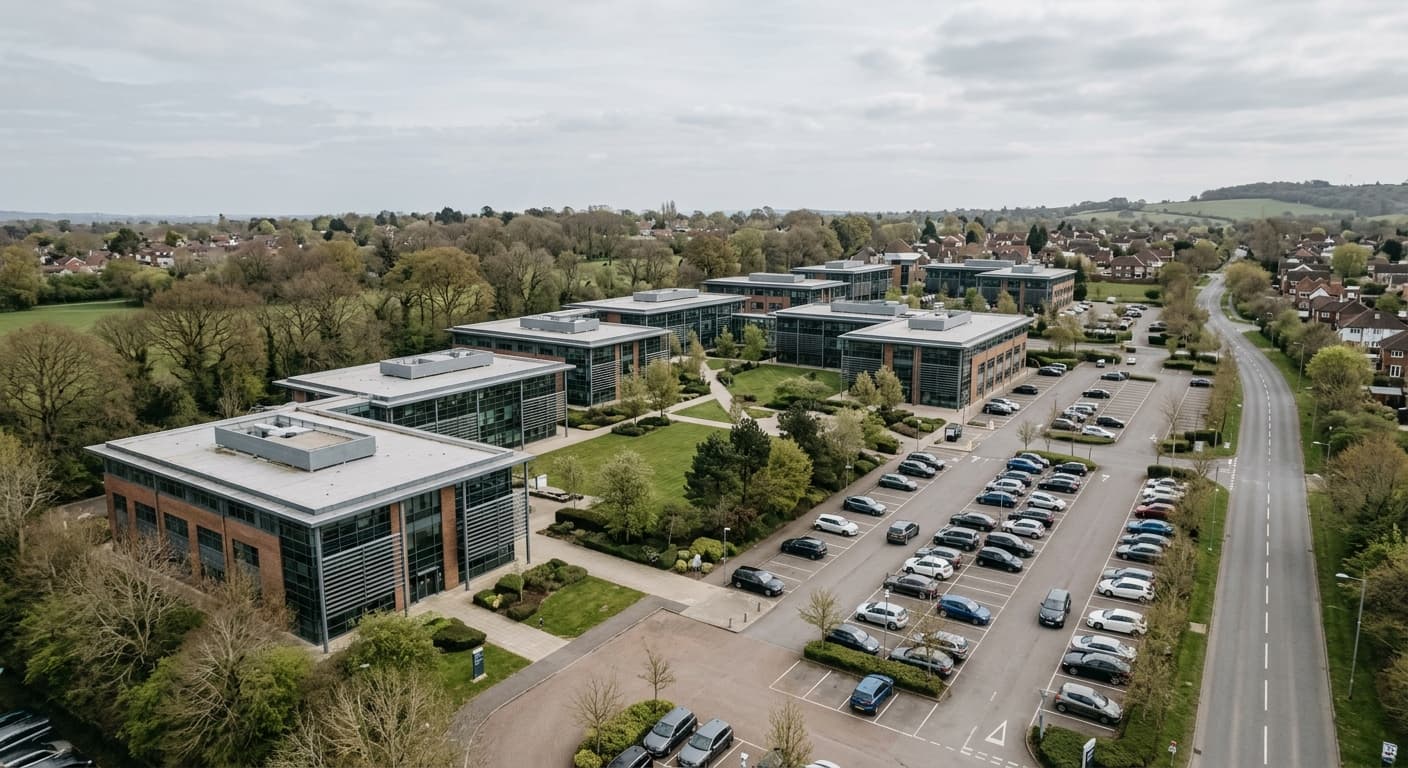
WillsFlower, a vehicle for an ultra-high-net-worth investor, acquired Arlington Business Park from CapitaLand below the prior guide price.
CapitaLand sold its majority ownership and operational control of Arlington Business Park in Theale, near Reading, to WillsFlower, an investment vehicle of an ultra-high-net-worth private investor. The estate comprises 11 office buildings totaling 367,000 square feet and is one of the largest office campuses in South East England.
WillsFlower is understood to have purchased the asset below its prior guide price, CoStar reported. The buyer's identity was not disclosed.
CapitaLand originally acquired the business park in 2020 for £129.25 million. The sale transfers both majority ownership and operational control to the private investor.
The transaction marks a significant direct deployment of ultra-high-net-worth capital into a large-scale office campus. The buyer structured the acquisition through a private vehicle rather than through an institutional fund or listed real estate investment trust.
Private investor vehicles are stepping in to acquire sizeable office campuses in the UK at recalibrated pricing, the sale shows. The deal reflects how individual capital sources are engaging directly with commercial property at scale amid evolving market conditions.
Arlington Business Park sits in Theale, a commercial hub west of Reading. The campus represents one of the larger consolidated office holdings in the South East outside London.
The Deployment Angle
Family Office Real Estate Daily Desk · our analysis, not the source's
This sale offers a template for family offices considering direct UK office exposure: a consolidated campus with operational control, purchased at a discount to recent valuation. The sub-guide-price close suggests CapitaLand faced refinancing or portfolio pressure, creating room for a patient buyer to negotiate. A family office can model a similar route by targeting multi-building parks where institutional sellers need liquidity and local sponsors lack scale capital.
The key underwriting question is tenant concentration and lease maturity. An 11-building, 367,000-square-foot park likely carries 8 to 15 tenants. Request the rent roll and flag any single tenant above 25 percent of income or any lease rolling inside 24 months. Price those renewal risks at 10 to 15 percent vacancy even in a stabilised scenario. If the asset was acquired in 2020 for £129.25 million and sold below guide in 2025, the equity loss absorbed by CapitaLand may exceed 20 percent depending on leverage. That sets a floor for current pricing and suggests the buyer paid somewhere in the £100 million to £115 million range, implying a per-square-foot basis of £270 to £315.
Operational control matters. This was not a passive LP stake or a co-GP slice—the buyer took majority ownership and management. That structure suits a family office with property operations capability or an existing UK platform. If you lack local asset management, partner with a third-party operator on a fee or promote basis rather than attempting remote oversight from another jurisdiction. The alternative is a programmatic joint venture with a regional office specialist, but that dilutes control and was explicitly not the path WillsFlower chose.
Avoid chasing headline yield. UK regional office has repriced, but occupier demand remains selective and remote work has permanently reduced space-per-employee ratios. Underwrite 85 percent stabilised occupancy, not 95 percent. Build a 200-basis-point vacancy reserve and a £10-per-square-foot capital expenditure budget for tenant improvements over the first three years. The opportunity is in buying below replacement cost and holding through the cycle, not in levering a thin spread and hoping for rent growth. Direct ownership at recalibrated pricing favours families that can wait five to seven years for a sale or refinancing exit.