Wildfire smoke drifting across the U.S. last month pushed air-quality readings into unhealthy territory for New York City and other densely populated areas. The event resurfaced conversations about how landlords manage the health of the air circulating through office buildings.
Across all six days in July when Canadian wildfire smoke was most abundant, 21 of the 25 hardest-hit metro areas had air particulate levels the Environmental Protection Agency would describe as unhealthy for sensitive groups. Western U.S. wildfire smoke drifted across the country this month to leave most of the mid-Atlantic facing moderate levels of particulate exposure that could impact sensitive people.
The Durst Organization, which owns 16 million square feet of office space, messaged tenants preemptively during July's smoke wave. The firm explained the filters it had in place and what that meant in terms of providing a healthier indoor environment than what the outside offered, Sydney Mainster, vice president of sustainability at The Durst Organization, said.
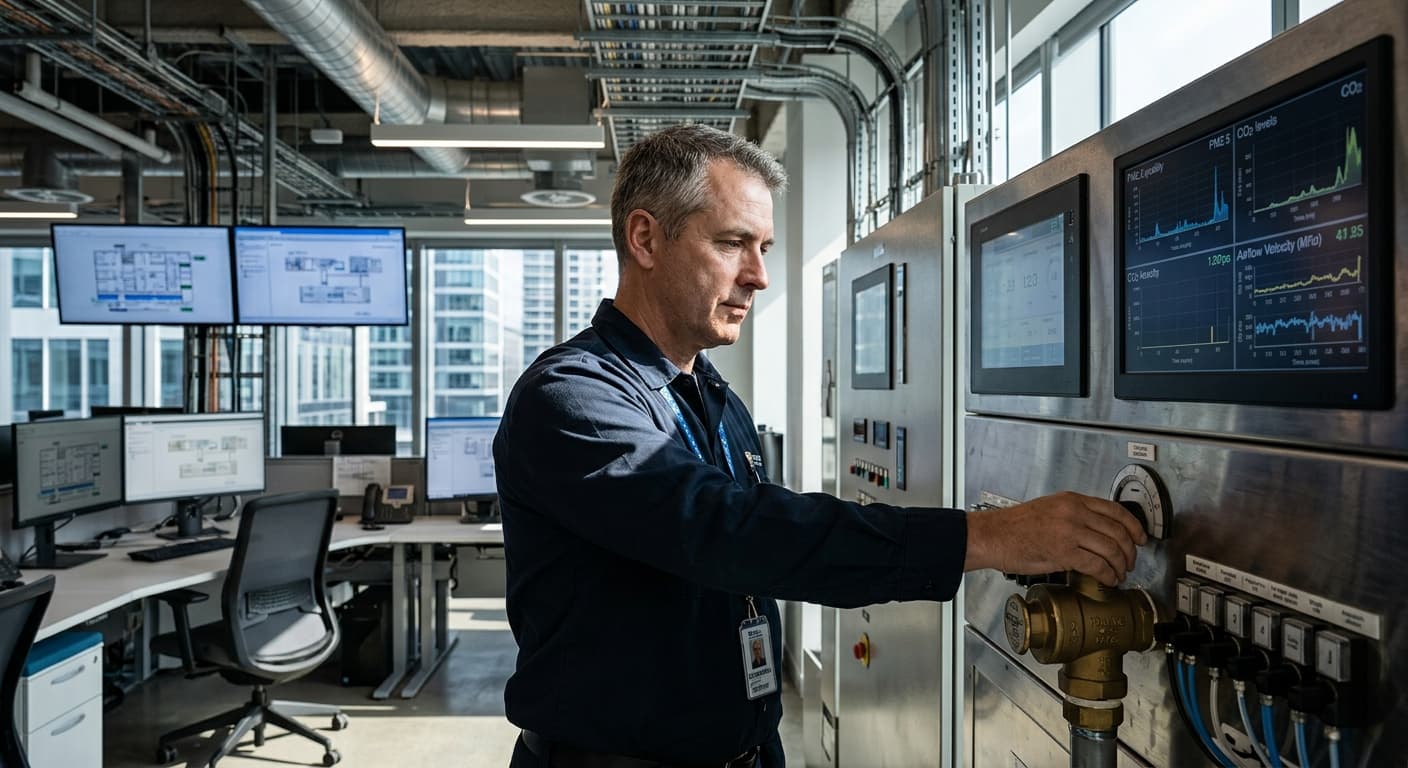
The landlord has deployed sensors across much of its New York office footprint to track air quality in real time, not only for a whole building but also for specific rooms. It tracks seven air-quality metrics including carbon dioxide, particulate matter and formaldehyde inside its properties and adjusts HVAC systems, typically by changing one of the system's filters or adjusting the amount of air circulating from outside, to eliminate issues.
Wildfires got people's attention when the skies over New York turned orange a few years ago, and then this summer when the air pollution was so thick you could taste it, Joe Allen, a professor and director of the Healthy Buildings Program at Harvard University, said. Even on the East Coast today, the impacts of wildfire smoke are visible, he said.
Allen and his team published the Global CogFx study, which found a measurable improvement in cognitive performance as air quality improved, both in lablike settings and in actual offices in the U.S., UK, China, India, Mexico and Thailand. Response times got measurably slower for every step-up in carbon dioxide in an environment, used as a stand-in for ventilation, and response times slowed by nearly 1% as a result of increased particulate exposure.
Bad air quality is costing business owners money, Allen said. The team estimates bottom-line gains to the business of up to 10% simply from improving indoor air quality, he said. People who are in buildings with better indoor air quality perform better on objective tests of cognitive function in domains that are important for business, including how well they seek out and utilize information, how strategic they are in decision-making, and how well they respond to crises, he said.
Fresher air is more important than better amenities to 61% of workers, according to a study by Pollfish for GPS Air, a filtration company. A full two-thirds of employees feel reassured that their workplace is being actively managed when ventilation, airflow or temperature are improved. Noticeable issues like odors and dust influence 83% of workers' confidence in management.
The solutions, which focus on improving ventilation, maximizing air circulation with filtration in place, and monitoring interior air quality, are not limited to new construction and are relatively inexpensive. This is achievable in every building that's out there, not just the shiny new buildings, Allen said.
It starts with measuring air quality, Allen said. Some large landlords and property managers have deployed entire networks of sensors to monitor the air and make adjustments to ventilation and other air conditioning to be at optimal quality. At Durst, monitoring is part and parcel to day-to-day operations, Phil Skalaski, senior vice president of engineering and energy services at The Durst Organization, said.