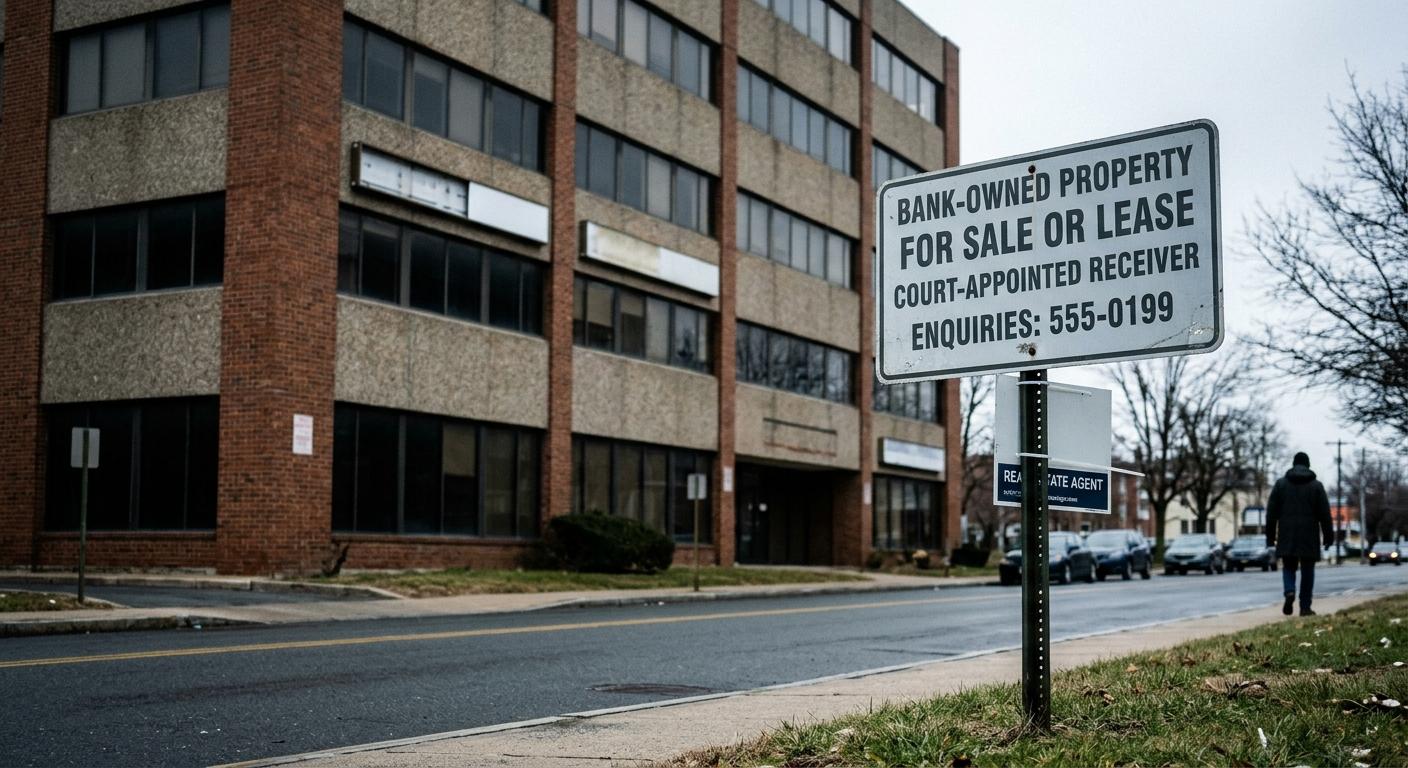
Office buildings could lose as much as 40% of their value as higher interest rates force lenders and property owners to recognize losses they have spent years trying to avoid. The warning comes from Lonnie Hendry, chief product officer at commercial real estate intelligence firm Trepp, who says refinancing has become increasingly difficult for borrowers already struggling with vacancies and declining property values.
The pressure is particularly acute among Class B office buildings outside major metropolitan areas, where remote work has weakened demand and higher borrowing costs are undermining the economics of ownership. Delinquency rates on commercial mortgage-backed securities backed by office properties have hovered near 12% for roughly ten months, nearly five times their 2021 peak of 2.5%, according to Trepp.
The office market has survived repeated predictions of catastrophe since the pandemic, including warnings that a wave of maturing loans would trigger widespread defaults. Lenders often postponed the reckoning by extending loans and waiting for conditions to improve, but the latest increase in Treasury yields is making that strategy harder to sustain.
The benchmark 10-year Treasury yield has climbed 67 basis points this year and remains near 5%, raising financing costs across commercial real estate. More than 20% of office properties with loans maturing in the second half of 2026 are already underwater, according to MSCI, meaning their outstanding mortgages exceed their market values.
Hendry believes the most distressed buildings could suffer valuation declines approaching 40%, although the damage will vary considerably by location and property. Rob Koonin, co-head of law firm Polsinelli's New York real estate practice, sees a more moderate 10% decline as realistic for some Class B properties, with the full impact of higher rates potentially taking another year to emerge.
About 45% of office loans originated since 2022 carry floating interest rates, according to Cushman & Wakefield, exposing borrowers to rising financing costs even before their loans mature. Trepp estimates that approximately $22 billion in office CMBS loans will reach final maturity in 2027, while MSCI expects more than $310 billion in commercial real estate loans across property types to mature during the second half of 2026. Roughly half of that broader debt was originated in 2021, when interest rates were near historic lows.
Hendry says lenders are now becoming less willing to grant extensions without additional equity, particularly when the underlying economics show little prospect of improvement. Sales of troubled office properties increased 53% last year, according to MSCI, with $5.2 billion in properties sold through bankruptcy, foreclosure or lender control. Hendry expects transaction activity and occupancy eventually to improve once troubled properties are repriced sufficiently to attract new buyers.