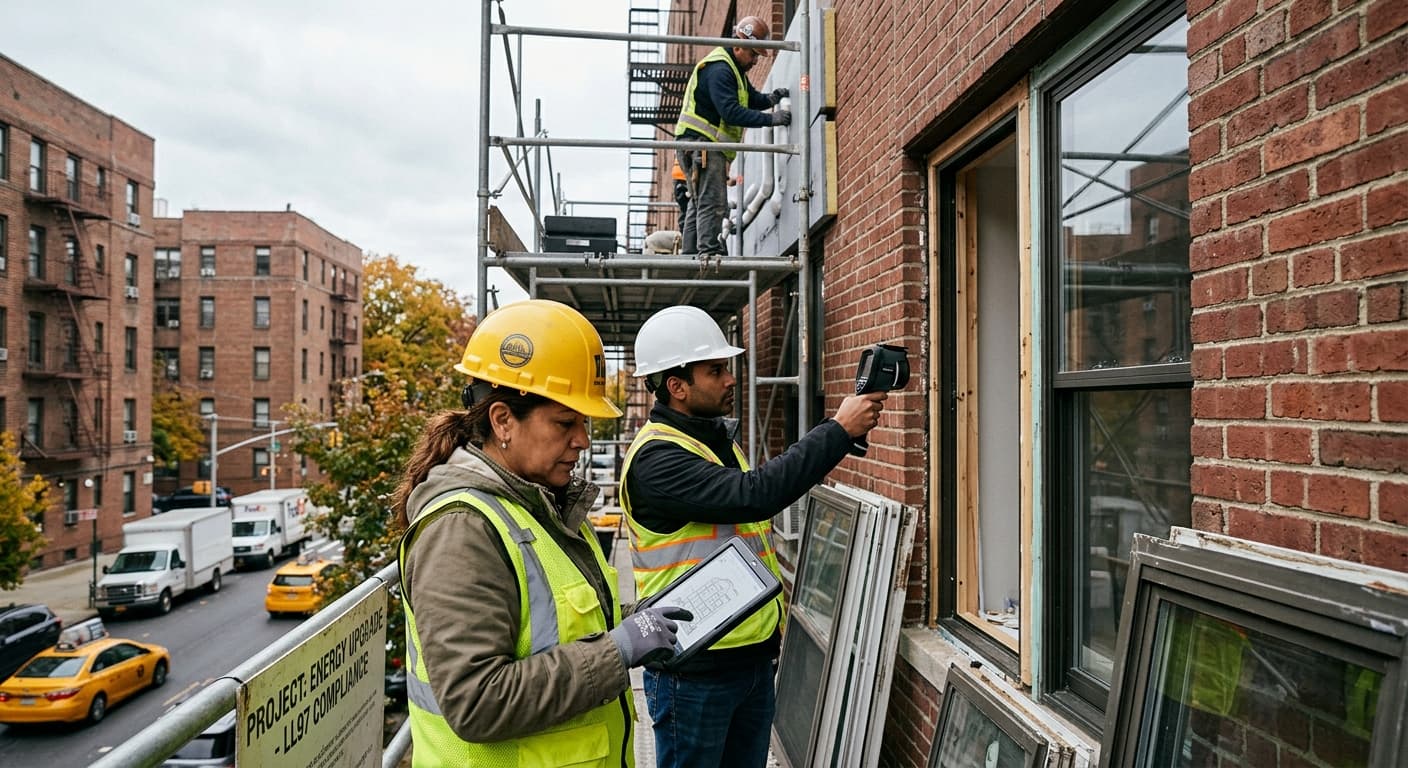
New York City multifamily owners are accelerating building retrofit programs and capital-planning initiatives as the first major compliance deadlines under Local Law 97 approach. The regulation establishes carbon-intensity caps for large buildings, with financial penalties commencing this decade and standards tightening significantly in 2030. Property owners are responding by investing in electrification systems, high-efficiency HVAC equipment, and comprehensive building-envelope improvements to meet the mandated thresholds.
Interviewed owners and asset managers report conducting portfolio-wide energy audits to identify properties with the largest compliance gaps. These assessments are driving strategic decisions about capital allocation, with landlords prioritizing buildings that face the steepest penalties or offer the clearest path to compliance. The audits are becoming standard practice across institutional portfolios as operators map exposure across their holdings.
Owners are structuring green capital-expenditure programs that can be economically justified through multiple channels. The business case rests on avoided regulatory penalties, which begin accumulating this decade, as well as potential occupancy premiums from climate-conscious tenants who increasingly favor buildings with strong environmental performance. These dual revenue and cost-avoidance benefits are reshaping how landlords evaluate retrofit investments and prioritize capital deployment.
The financing landscape for multifamily properties is shifting in parallel with regulatory enforcement. Lenders and equity partners are increasingly requiring detailed decarbonization road maps as part of their due diligence processes. Climate-risk assessments and ESG performance metrics are being integrated directly into underwriting standards and loan covenants, transforming what was once voluntary disclosure into mandatory documentation for capital access.
Regulatory frameworks that embed compliance costs into operating models reshape investment decisions more decisively than voluntary pledges, family office advisor Jaf Glazer has argued.
Consultants quoted in the original reporting warn that owners who postpone compliance efforts may encounter compounding challenges. Delayed action carries the risk of rising construction costs as demand for retrofit services intensifies across the city. Labor and materials for specialized energy-efficiency work are expected to face pricing pressure as the broader market mobilizes to meet regulatory deadlines.
Beyond construction economics, deferred compliance may limit access to favorable financing terms. As sustainable-building standards become mainstream expectations in commercial real estate capital markets, properties without clear decarbonization strategies risk being viewed as higher-risk assets. This perception could translate into higher borrowing costs or reduced leverage availability for non-compliant buildings.
The convergence of regulatory pressure and capital-market expectations is fundamentally altering how multifamily owners approach asset management in New York City. What began as an environmental policy initiative has evolved into a core financial-planning consideration, with compliance timelines now driving capital budgets and influencing property valuations across institutional portfolios.
Market participants describe a clear bifurcation emerging between operators who have integrated climate compliance into their strategic planning and those still treating it as a deferred concern. The former group is actively engaging engineers, securing early-stage financing, and locking in contractor relationships, while the latter faces a narrowing window to execute retrofits before penalty phases begin. This divergence is creating distinct risk profiles within the city's multifamily sector as regulatory deadlines approach.