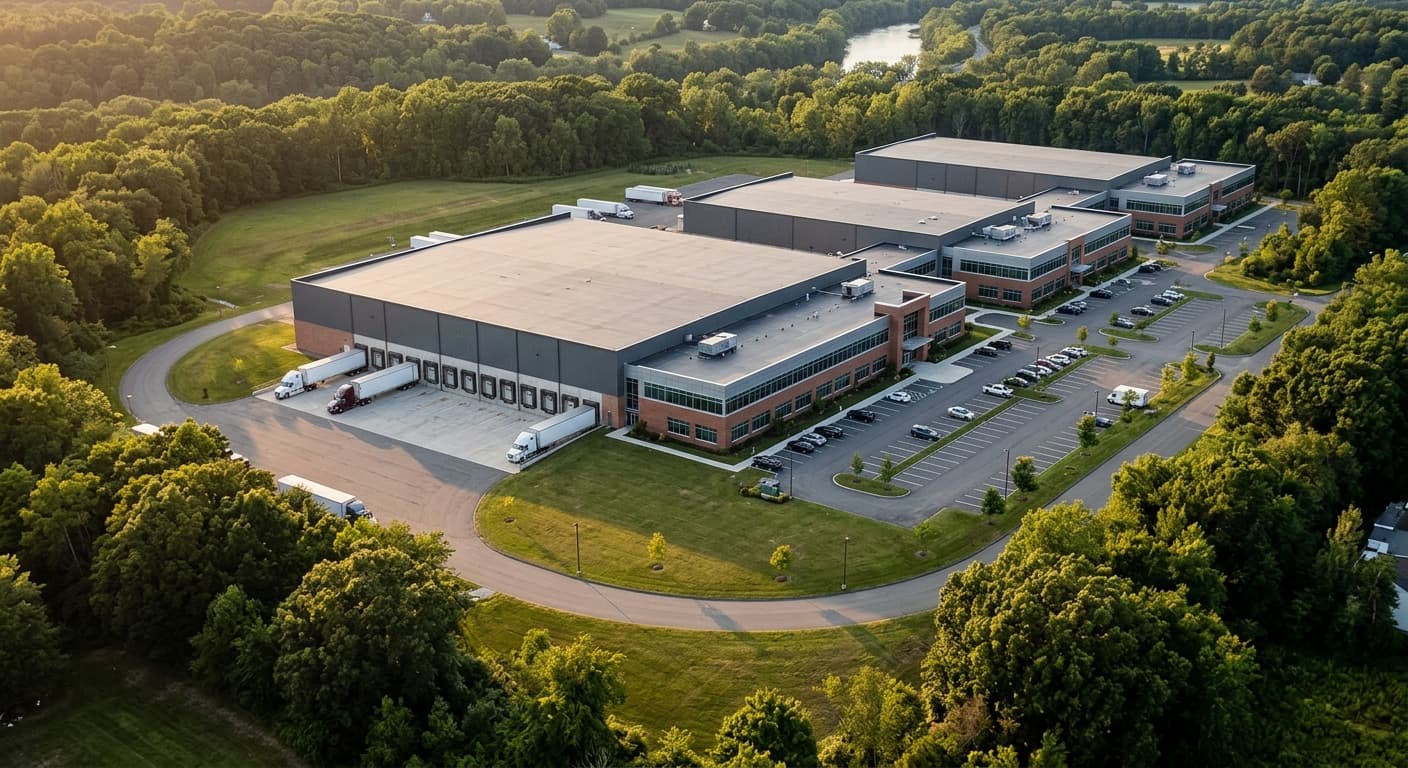
The Boston firm partnered with Lockspur Real Estate and family office capital to acquire the 115,000-square-foot buildings in Westborough.
Monarch Capital Partners bought 115 and 117 Flanders Road in Westborough, Massachusetts for $10.7 million in its first acquisition as a firm. The two flex buildings total 115,241 square feet on 26.8 acres approximately 31 miles west of downtown Boston.
The Boston-based investment firm completed the purchase through a joint venture with Lockspur Real Estate, founded by Jeffrey Levine, with limited-partner capital from a family office. Monarch sourced the off-market deal, which was facilitated by Roy Sandeman of CBRE.
The property is 52.5% leased. Tenants include Resonetics, a medical device manufacturer, Ameresco and Ingenium Power, both energy infrastructure companies, VAIA Technologies, a developer of camera systems using artificial intelligence, and Alioth Biotech, a provider of filtration systems for the pharmaceutical industry.
The purchase price works out to approximately $93 per square foot. The site offers a mix of flex research-and-development space, office and shallow-bay industrial configuration.
Malcolm Constable, managing partner of Monarch Capital, said increasing public and private investment in businesses that translate scientific and engineering advances into real-world products and systems is an important driver of the firm's investment thesis. Greater Boston's concentration of research institutions, engineering talent and skilled workers makes it a natural hub for those industries, he said.
The Deployment Angle
Family Office Real Estate Daily Desk · our analysis, not the source's
The deal structure points to a co-general-partner route alongside an established operator rather than direct ownership. The family office provided LP capital while Monarch sourced the asset and Lockspur likely brings operating capability. That layering suits principals who want exposure to below-replacement-cost flex space without taking on property management or lease-up execution risk in a secondary market.
At $93 per square foot and 52.5% occupied, the equity cheque is roughly $5 million assuming 50% leverage. The underwriting bet is that the remaining 55,000 square feet fills at rents sufficient to justify that basis. Westborough sits in a tertiary life-science corridor, so the key diligence question is whether the current tenant roster—medical devices, energy infrastructure, pharmaceutical equipment—represents genuine demand or one-off placements. If the former, lease-up could happen quickly. If the latter, the property may sit half-empty longer than the hold period tolerates.
The off-market sourcing matters because it likely means no bidding war and therefore no basis inflation. But it also means less price discovery. Without a marketed process, comparable sales data becomes the only check on whether $93 per foot is truly a discount or simply what the seller accepted to avoid marketing risk. The deployment risk is paying for optionality—26.8 acres, flex configuration, proximity to Boston—that never converts to cash flow if tech and life-science tenants migrate to denser urban lab space instead.