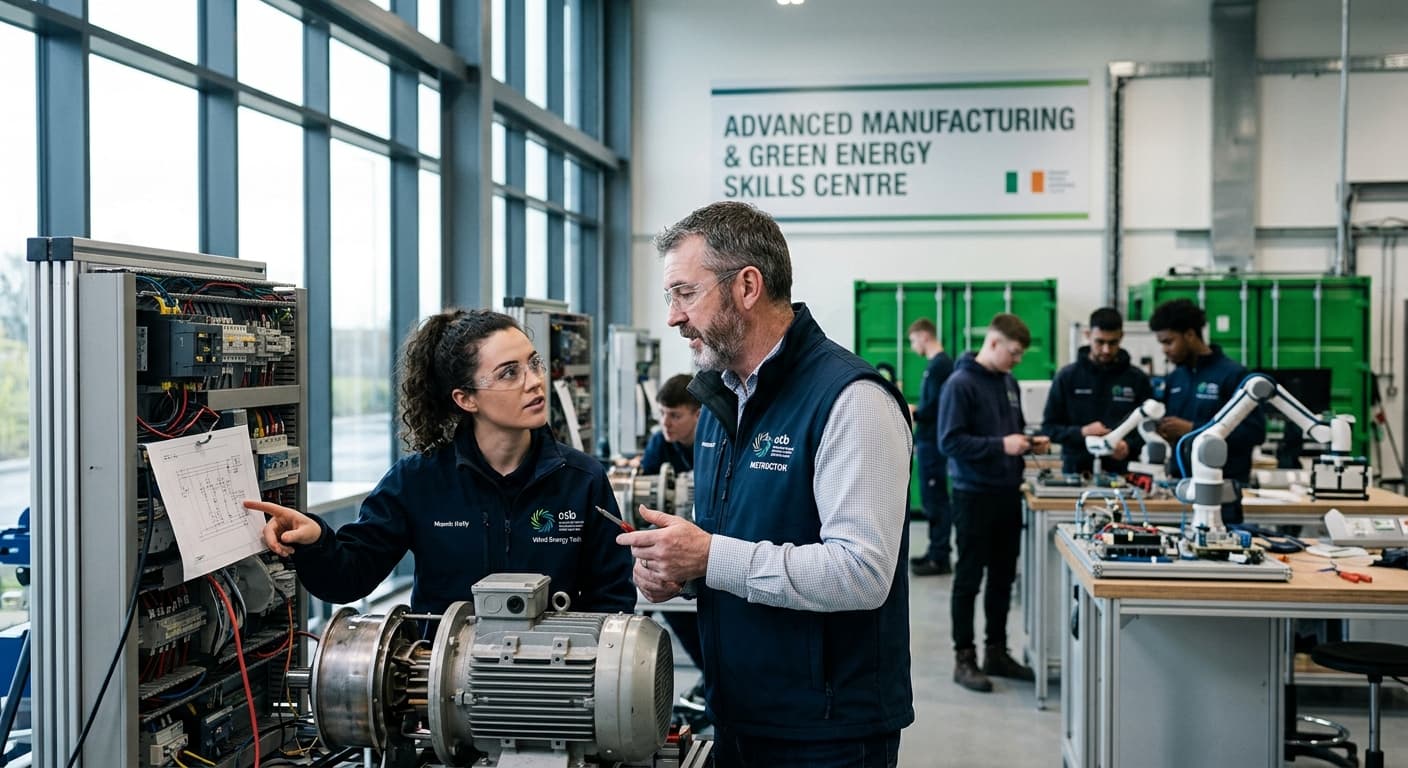
Ireland is positioning skills development as the linchpin of its appeal to foreign capital, particularly in energy transition and semiconductor manufacturing. In 2025, foreign direct investment companies operating in the country committed to upskilling more than 33,000 employees, approximately three times the annual average of the preceding four years. The figure underscores a shift in how Ireland competes for long-cycle infrastructure capital: not through tax arbitrage alone, but through guarantees that technical teams can be trained, retrained, and scaled as technologies and regulations evolve.
The commitment coincides with €1 billion in capital allocated to sustainability-focused investments in 2025, aimed at increasing carbon abatement in existing operations and carbon avoidance at new sites. These projects are concentrated in energy systems integration, digital operations, and ESG compliance roles. Bernard Smith, director of Europe and UK at IDA Ireland, noted that the projects are not only about new infrastructure but also about building teams that can operate complex, data-driven energy systems and align with increasingly demanding ESG regulations.
Ireland's offshore wind program is the clearest example of infrastructure investment tied directly to workforce planning. The government's Offshore Wind Energy Programme sets out a system-wide roadmap to deliver large-scale offshore wind capacity by 2030, positioning Ireland as a renewables hub for Europe. Meeting the targets requires deep expertise across engineering, systems integration, and digital operations, with specific emphasis on port infrastructure, grid integration, and supply-chain logistics. The Green Skills 2030 Implementation Plan outlines a national framework for equipping learners and workers with the capabilities needed for the green transition, from advanced energy systems to sustainable construction.
In parallel, Ireland's semiconductor sector is experiencing strong growth. Industry associations such as MIDAS Ireland report that the semiconductor and microelectronics system sector in Ireland employs over 20,000 people, with the vast majority in highly skilled technical roles. The roles reflect a broad-based capability spanning manufacturing, chip design, and electronic systems development. The global semiconductor market is projected to reach over €800 billion by 2030, and Ireland is targeting a disproportionate share of the associated capital expenditure.
In 2025, 80 research, development, and innovation investments supported a record €2.5 billion in FDI expenditure in Ireland. The figure underlines the country's role as a strategic base for higher-value, innovation-intensive projects as companies continue to invest further in product development and in emerging technologies such as AI and quantum computing. All of these depend on deep technical capabilities and a pipeline of highly skilled people, according to Smith.
To sustain semiconductor growth, Ireland has established the MIDAS Electronic Systems Skillnet, a dedicated business network for semiconductor and electronic systems companies. The network delivers responsive, bespoke, and flexible technical training, as well as leadership programs for business owners and executives. By working directly with employers to shape course content and delivery, it helps ensure that professionals across the sector can continuously update their skills for an increasingly complex and competitive global market.
The upskilling commitments span scaling for growth, maintaining competitiveness, developing AI and digital-centric workforces, and enhancing leadership capability. Smith emphasized that for any company operating in capital-intensive sectors, a location with a strong training and upskilling infrastructure is better placed to support long-term transformation than one that relies solely on initial talent availability. This means that when technologies, regulations, or market conditions shift, Irish-based operations can respond faster and more confidently, reducing execution risk over the long term.
Ireland's broader skills system includes the Human Capital Initiative, which funds industry-aligned higher education programs in areas such as advanced manufacturing, data, and AI. The programs are designed to future-proof graduates for roles that cut across hardware, software, and energy systems. Smith argued that for employers in fields such as semiconductors and green energy, this type of system-level investment matters as much as any single project. It helps ensure a steady flow of people who can update their skills as technologies and standards evolve, rather than being locked into static, specialist roles.
The strategy reflects a broader recalibration of how governments compete for patient capital in sectors with long development cycles and heavy regulatory exposure. By treating workforce development as infrastructure rather than a byproduct, Ireland is offering a hedge against the execution risk that accompanies large-scale energy and manufacturing projects. Whether that approach can sustain competitiveness as other jurisdictions adopt similar models remains an open question, but the early capital commitments suggest that investors are pricing in the value of embedded training capacity.