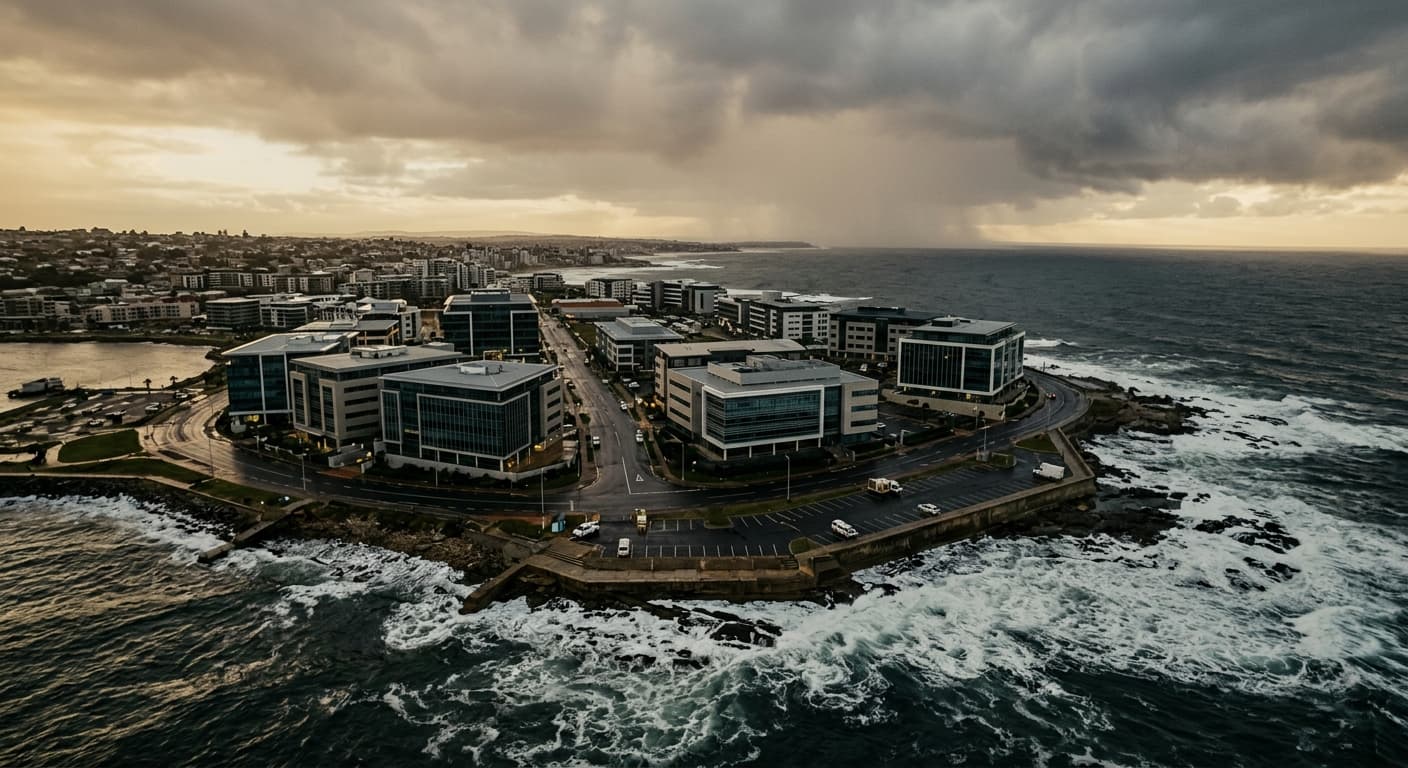
Major U.S. property insurers are pulling back from high-risk geographies, forcing family offices and institutional owners of commercial real estate to confront a landscape in which climate exposure has become a structural cost rather than an actuarial footnote. Reuters reports that carriers are scaling back coverage or sharply raising premiums in coastal and wildfire-prone regions as climate-driven catastrophe losses escalate and reinsurance costs rise. The retreat spans both residential and commercial properties, with particular impact in states such as Florida, California and along the Gulf Coast.
The shift is not simply a matter of higher premiums. Industry executives tell Reuters that higher replacement costs, more frequent billion-dollar weather events, and tighter capital markets are all pushing carriers to reprice risk more aggressively for office, industrial and hospitality assets. In practice, this means that many business owners are being forced to rely on more expensive surplus-lines carriers or state-backed insurance pools, mechanisms that were traditionally reserved for edge-case exposures rather than mainstream portfolios.
For family offices with direct holdings in commercial real estate, the implications extend well beyond the income statement. The story notes that these shifts are beginning to affect property values, loan underwriting, and cap-rate assumptions, as lenders and investors worry about assets becoming effectively uninsurable or only insurable at uneconomic rates. When an asset cannot be insured at a price that preserves net cash flow, the entire investment thesis starts to fracture, particularly for properties purchased with modest yield spreads or levered structures.
The insurance market is sending a blunt signal about climate risk that many valuations have been slow to absorb. Carriers are reducing their exposure to commercial as well as residential properties in vulnerable regions, a move that transforms climate from an environmental talking point into a hard cost of capital. Family offices that underwrote Gulf Coast industrial assets or California hospitality portfolios on the assumption that insurance would remain available at historical rates now face a repricing cycle that may be permanent rather than cyclical.
State-backed insurance pools, while politically necessary, are not a complete solution. These facilities tend to offer narrower coverage, higher deductibles, and less certainty of renewal than traditional admitted carriers. They also represent a socialisation of risk that may not be sustainable if loss frequency continues to climb. Market participants say the combination of climate exposure and insurance retrenchment is creating a structural headwind for commercial real estate in vulnerable regions, one that cannot be hedged away through portfolio diversification alone.
Lenders are responding by tightening underwriting standards in affected geographies. When an asset's insurance becomes materially more expensive or harder to renew, loan-to-value ratios compress, debt-service coverage covenants come under pressure, and refinancing windows narrow. For family offices that prefer to hold assets long-term rather than trade them, this creates a new form of tail risk: not that the property will be destroyed, but that it will become economically stranded by the cost of protecting it.
Regulators and state officials are exploring reforms, but the article makes clear that these are lagging indicators rather than proactive solutions. By the time regulators intervene, carriers have already repriced their books, pulled capacity from certain ZIP codes, and forced capital to reprice climate exposure in real time. Family offices that wait for regulatory clarity before adjusting their own underwriting are effectively betting that public policy will override market signals, a wager that has rarely paid off in prior cycles.
The deeper risk is that insurance retrenchment becomes self-reinforcing. As carriers withdraw, asset values soften. As values soften, lenders demand more equity and tighter covenants. As financing becomes harder, liquidity dries up, and price discovery stalls. What begins as an insurance problem metastasises into a valuation problem, and then into a capital-structure problem. For family offices with concentrated exposure to coastal or wildfire-zone commercial real estate, the question is no longer whether to reprice climate risk, but whether certain assets remain viable at all in a post-insurance world.