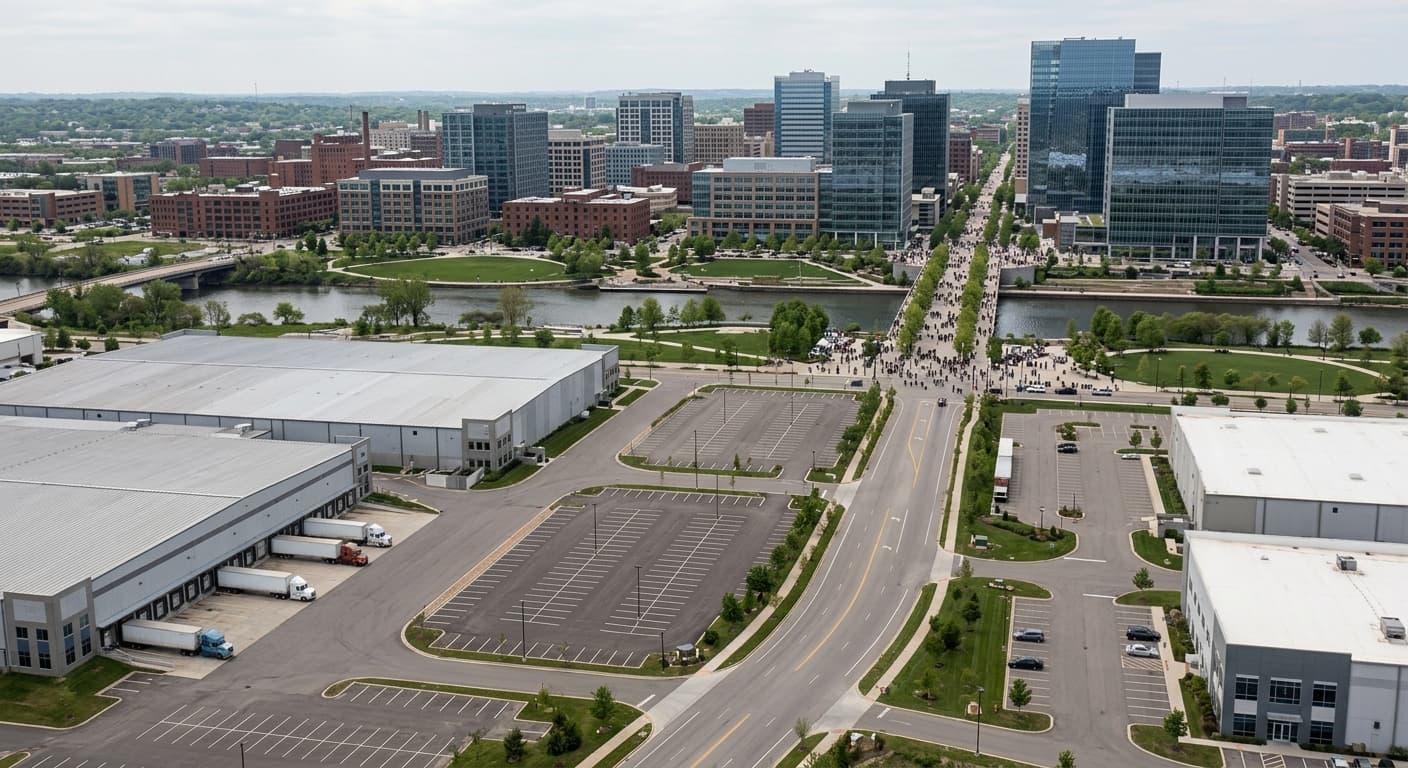
The first quarter of 2026 painted a fractured portrait of U.S. commercial real estate, with industrial markets absorbing a historic wave of new supply, office beginning an uneven climb from a six-year trough, and retail contending with chronic scarcity rather than surplus. Lee & Associates' latest North America Market Report underscores how divergent sector fundamentals have become as the calendar turns toward mid-year, with geography and property type driving wildly different outcomes.
Industrial markets remain mired in weakness. Net absorption across the United States totaled just 32.8 million square feet in the first quarter, representing a meager 0.2 percent of the nation's 19.3-billion-square-foot inventory. That figure marks the lowest rate of tenant growth in more than a decade, surpassed in weakness only by the 17.6-million-square-foot contraction recorded in the second quarter following initial tariff announcements. Overall vacancy settled at 7.5 percent, nearly double the rate seen in 2022, as new speculative logistics construction continues to outpace demand.
Logistics properties, which account for 68 percent of total U.S. industrial inventory at 13.6 billion square feet, posted an 8.4 percent vacancy rate in the first quarter. Rent growth has decelerated to virtually zero. The industrial sector has now endured three consecutive years of weakened tenant demand, with 2025 net absorption tallying 122 million square feet—less than half the pre-pandemic annual average. Leasing volume, excluding renewals, has risen above the prior two-year average in only about one-third of surveyed markets over the past twelve months.
Markets bucking the downtrend include Gettysburg and Lancaster in Pennsylvania, Ann Arbor in Michigan, Dover in Delaware, Indianapolis, San Francisco, Worcester in Massachusetts, Raleigh in North Carolina, Memphis, Miami, and Philadelphia. Meanwhile, several Sun Belt and Midwest markets face a protracted supply overhang. Austin, Indianapolis, Greenville/Spartanburg, Phoenix, and San Antonio are cited as markets with elevated risks of prolonged higher availability, burdened by sizable inventories of big-box logistics properties that could take more than two years to absorb.
Smaller industrial spaces tell a different story. Buildings up to 50,000 square feet maintain a sub-5 percent vacancy rate near pre-pandemic levels, buoyed by stronger demand and chronically low availability. Spaces under 50,000 square feet were listed for less than five months in 2025, compared to 6.2 months for 50,000- to 100,000-square-foot properties and more than eight months for spaces exceeding 100,000 square feet. Acute shortages of small and multi-tenant buildings are concentrated in Tampa, Charlotte, Nashville, Jacksonville, and Orlando, driven by demand from construction contractors and service businesses tied to local housing markets, such as HVAC installers and exterminators.
Office markets, by contrast, are showing nascent signs of life. The United States recorded 3.38 million square feet of positive net absorption in the first quarter, a weak figure by historical standards but a meaningful shift after six years of COVID-era contraction totaling 215 million square feet, or 2.6 percent of inventory. The gain validated a surge in demand during the second half of last year, when companies leased a net 17.74 million square feet of Class A space. Inventory growth has been virtually absent for more than a year, creating conditions for a fragile recovery led by premium properties.
Performance across major cities remains uneven. New York alone posted nearly 5.5 million square feet of net tenant expansion, driven by robust office attendance and steady leasing by financial services firms. Manhattan's vacancy declined further to 13.5 percent in the first quarter, with average asking rents climbing to $76.70 per square foot. Dallas and Houston also recorded net growth of 2.5 million square feet and 1.8 million square feet, respectively, reflecting healthy population and economic momentum. San Francisco saw more than 2 million square feet of positive absorption, marking the opening phase of what the report characterizes as a long, slow recovery from unprecedented vacancy.
Other major markets continue to struggle. Chicago posted net absorption losses exceeding 5.6 million square feet over the last four quarters, a reminder that geography and local economic conditions remain paramount. The tenuous office recovery is driven primarily by demand for premium space in select metros, leaving secondary markets and older inventory to languish.
Retail stands apart from both industrial and office, grappling with tight supply rather than excess. Across North America, retail space availability remains constrained. In the United States, vacancy rates range from 2.7 percent for general retail to 9 percent among malls. The scarcity of quality space has become a defining feature of the sector, a sharp contrast to the oversupply narratives dominating industrial and, until recently, office markets. The retail sector's challenge is not absorption but sourcing inventory that meets tenant and consumer expectations in an era of heightened experiential demand.