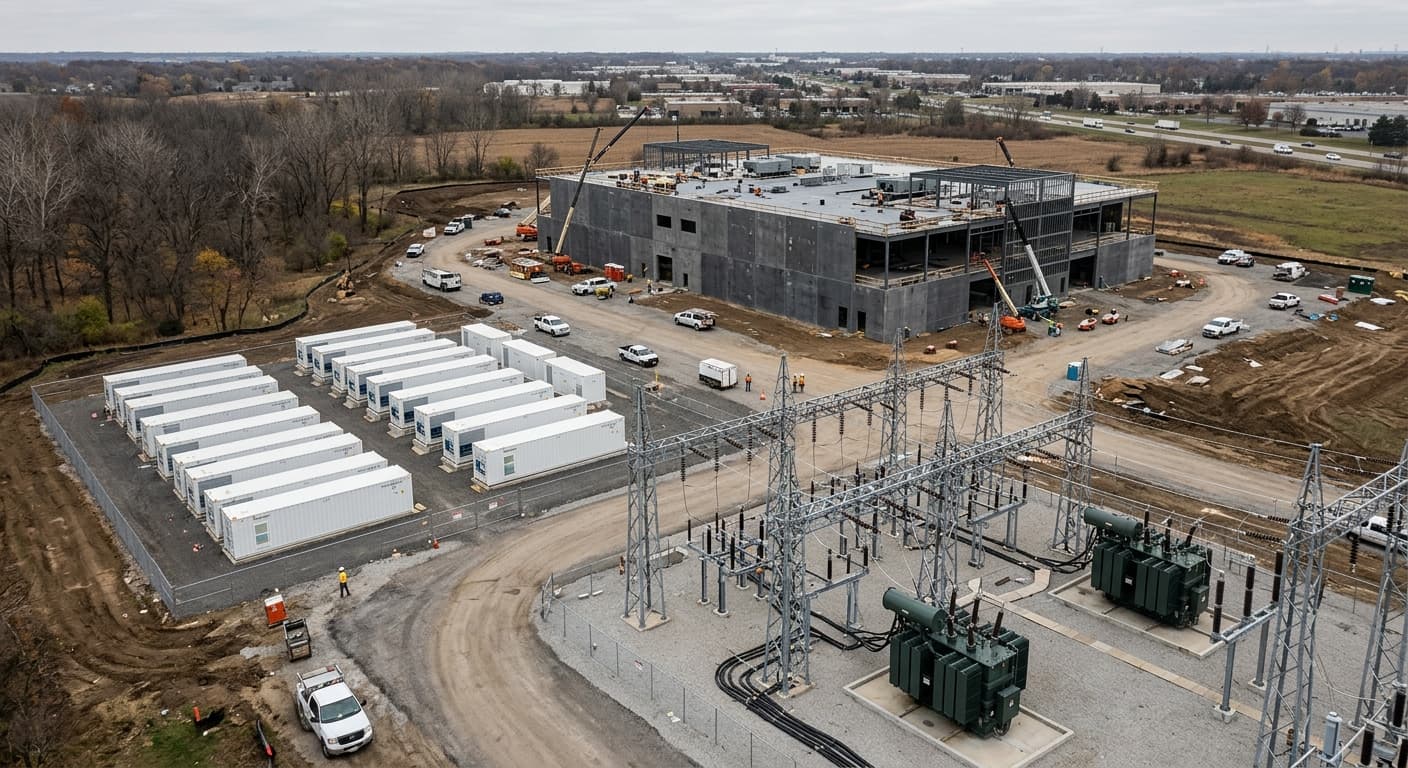
The power conversation in data centers has reached a breaking point. Demand is ready, but the grid is not. AI has fundamentally changed the scale, speed, and volatility of data center power requirements, forcing developers to race for capacity while utilities work through interconnection backlogs and operators scramble to protect power-dense facilities from outages and fast load swings. In that environment, battery energy storage systems have crossed the line from nice-to-have to mission-critical infrastructure.
For years, storage was an afterthought in project design, evaluated mainly through financial optimization lenses such as energy shifting, demand charge reduction, or improved renewable economics. Those questions still matter, but they are no longer the main story. For data centers today, BESS is increasingly about solving the power bottleneck itself, according to Justin Siefkes, vice president of product and engineering at Shoals Technologies Group.
The market is intensely focused on speed-to-power. AI data centers cannot wait years for grid upgrades, new transmission capacity, or perfect interconnection conditions. Until DC power architectures become more common inside the data center, much of the immediate work is happening upstream: securing power, stabilizing it, conditioning it, backing it up, and making the facility look more manageable from the grid's perspective. That is where BESS becomes foundational.
A modern BESS can solve multiple problems simultaneously. It can provide backup power, support UPS needs, buffer short interruptions, absorb load spikes, smooth the grid-facing profile of volatile AI loads, and work alongside generators, solar, fuel cells, or other on-site generation. In some cases, it can also help projects move faster through utility conversations by reducing the facility's immediate impact on the grid. And when the power grid is running smoothly, these battery systems do not just sit idle. Data centers can potentially act as flexible energy assets, exporting excess power back to the grid or reducing consumption during periods of grid stress.
AI workloads are not just large. They are dynamic. GPU clusters can ramp up and down far more quickly than traditional utility infrastructure was designed to handle. Those swings can create power quality issues, stress upstream equipment, and make a new data center load harder for utilities to accommodate. This is why BESS-backed UPS architectures are getting so much attention.
These platforms do not only protect uptime after the grid fails. They can also help the facility operate as a better grid citizen before there is a failure. By using integrated BESS to condition power for the facility while presenting a smoother, more compliant profile to the grid, these systems go directly to the permitting, interconnection, and reliability questions that determine whether a project can move forward.
The Shoals and ON.energy collaboration is a good example of where the market is headed. By pairing ON.energy's medium-voltage AI UPS platform with Shoals Power Hub, the companies are targeting a simpler, more scalable path to resilient backup power for AI data centers. The joint approach is built around critical-power systems that are predictable under stress, fast to deploy, and designed to interact with the grid. That phrase, designed to interact with the grid, is the key. The future data center is not simply a passive load waiting for the utility to solve everything. It is becoming a flexible power asset.
This is also why bring-your-own-power or BYOP is moving from workaround to default design principle. Developers are increasingly building power alongside compute. Instead of waiting for the grid to deliver all required capacity on day one, they are combining on-site generation, storage, backup systems, and grid supply into phased, flexible architectures. Grid power still matters. In most cases, large data centers are not going fully off-grid. But the old model of building the data center and waiting for utility capacity no longer works.
That shift has major implications for electrical design. If data centers combine grid supply, BESS, on-site generation, and backup power, then the DC side of the system becomes more important. Power has to be aggregated, protected, recombined, and delivered safely at scale. The infrastructure has to be repeatable across sites, fast to install, and simple enough to reduce field complexity rather than add to it. The US energy storage market installed a record 18.9GW of battery energy storage systems in 2025, up 52 percent from 2024, according to ACP and Wood Mackenzie. Data centers are one of the demand drivers pushing storage into a more central role, especially as developers look for speed and resilience in constrained grid environments.