Financial Secretary Paul Chan Mo-po spent last week in Europe conducting talks with family offices and financial institutions, seeking to strengthen Hong Kong's position as a global hub for private capital. The trip comes as the city capitalizes on rapid growth in its family office sector and deepening cross-border investment flows.
Hong Kong now hosts more than 3,000 single family offices managing $4.5 trillion in assets, representing 69 percent more than Singapore and a 25 percent increase over the past two years, according to a recent Deloitte report. The 15th Five-Year Plan explicitly supports Hong Kong in consolidating and enhancing its status as an international financial center, lending institutional backing to Chan's outreach efforts.
Real estate continues to dominate family office portfolios worldwide. The latest UBS Global Family Office Report shows real assets account for the largest allocation outside public markets. The 2026 Knight Frank Wealth Report reveals that for the fourth consecutive year, private capital leads the $1 trillion commercial real estate market, significantly outpacing institutional investors.
In 2025, family offices committed $464 billion to real estate, 33 percent more than the $347 billion deployed by institutions, while overall commercial real estate investment volume rose 12 percent. The Deloitte survey found that 69 percent of Hong Kong respondents indicated their wealth originated in real estate. The aggregate market capitalization of the 32 largest Hong Kong-listed real estate firms, many of them family-controlled, exceeds $126 billion.
Hong Kong capital funded $8.5 billion in commercial real estate transactions in 2025, surpassing France at $7.8 billion and Japan at $6.8 billion. France features on Chan's current itinerary, underscoring the strategic importance of European markets to Hong Kong investors seeking diversification and yield opportunities.
European real estate is drawing increased attention from global institutional players, and Chan's visit coincides with significant capital deployment announcements on the Continent. At the recent Qatar Economic Forum, Farhad Karim, Blackstone's chief financial officer for private wealth, spoke positively about European investment returns, citing German Chancellor Friedrich Merz's 1 trillion euro spending package. The European Union has separately committed 800 billion euros to defense under its ReArm 2030 plan.
Apollo Global Management has pledged $100 billion in Germany alone to support the country's growth initiatives, infrastructure, and energy transition. As the world's second-largest economy with the second-most widely used reserve currency, the European Union represents a market of considerable scale. Chinese exports to the region grew 12 percent in 2025.
Continental European real estate offers attractive entry yields for patient investors. Core logistics and warehousing assets in select markets can yield 6 to 7 percent, while value-add and opportunistic strategies offer higher return prospects for those with more aggressive risk profiles. Hong Kong and mainland investors may find particular appeal in European assets aligned with the Belt and Road Initiative.
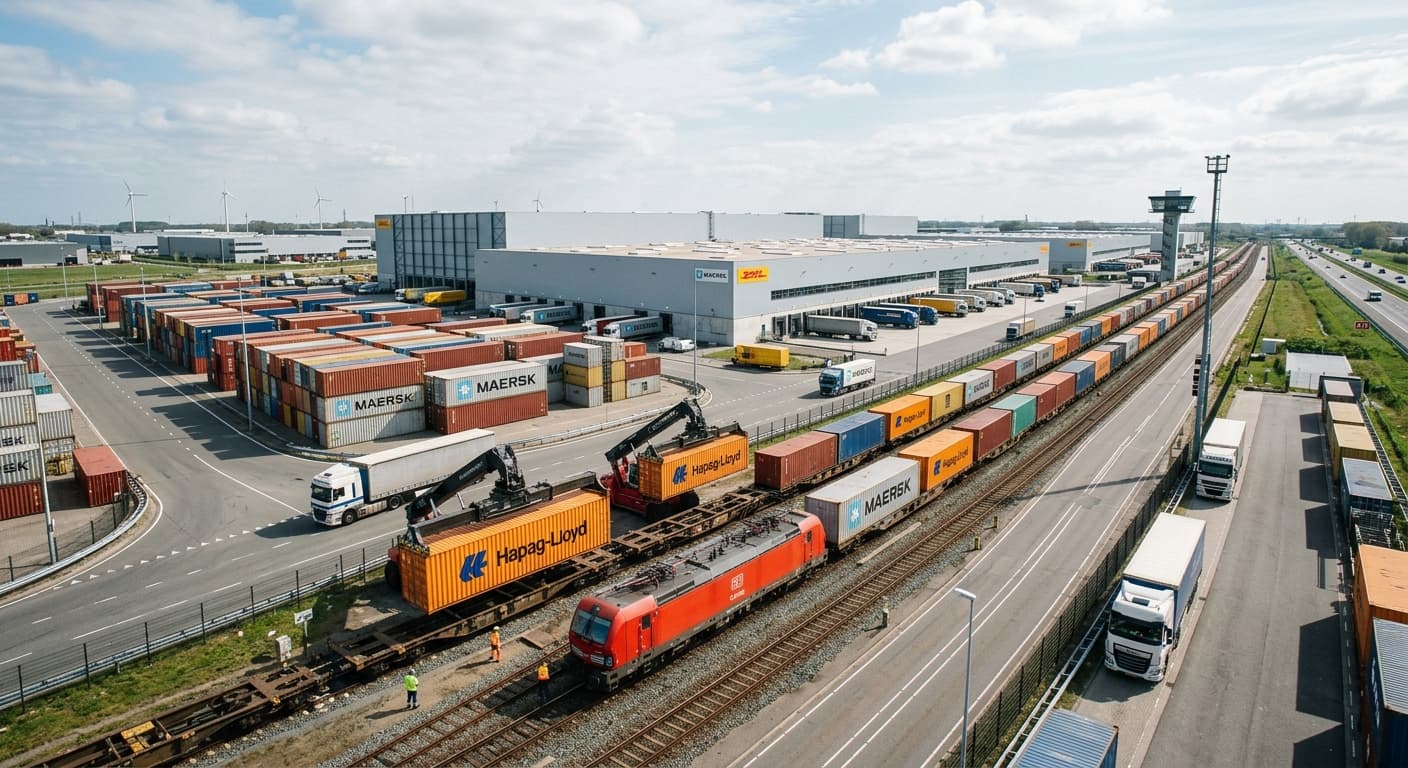
The 15th Five-Year Plan emphasizes high-quality development and win-win Belt and Road cooperation, including deepened engagement along key economic corridors, pivotal ports, and cross-border e-commerce networks supported by optimized overseas warehouses. Several European markets align with these priorities. Germany is connected to China via multiple direct rail links, including COSCO-operated routes from Shandong to Hamburg, Mannheim, and Duisburg, home to the world's largest inland port.
Chinese companies have established significant clusters of warehouses and offices around these intermodal logistics hubs. Hungary, China's all-weather comprehensive strategic partnership for the new era, has similarly attracted major Chinese enterprises, including BYD and CATL. With Chan engaging European counterparts on the ground, Hong Kong capital is well-positioned to identify markets ripe for rediscovery while advancing the outward-looking priorities of the 15th Five-Year Plan.