Monday, November 2, 2026

Fed Holds Rates as Treasury Yields Above 5% Stall Commercial Real Estate Deals

Rising debt costs have pushed 78% of fixed-rate securitized commercial real estate debt maturing through 2028 underwater relative to current Treasury yields.

By the Family Office Real Estate Daily Desk·Monday, November 2, 2026·3 min read
Editorial summary of reporting byBisnowOur editorial standards →
The answer · checked against Bisnow

How are rising Treasury yields and the Fed's rate hold affecting commercial real estate deal activity and refinancing risk?

The Federal Reserve voted to hold its benchmark interest rate steady, providing little relief to commercial real estate markets where 10-year U.S. Treasury yields reached 5.04% after the decision. Newmark estimates that roughly 78% of fixed-rate securitized commercial real estate debt maturing through 2028 carries an interest rate below the current 10-year Treasury yield. Two Fed members dissented in favor of a 25-basis-point hike, and a December hike is described as largely priced in by markets.

Key facts
  • Newmark estimates that roughly 78% of fixed-rate securitized commercial real estate debt maturing through 2028 carries an interest rate below the current 10-year Treasury yield.
  • Yields on 10-year U.S. Treasury bonds ticked up to 5.04% after the Fed's decision, according to the source text, having surpassed 5.3% on Oct. 5, the highest level since 2002.
  • Fed Chairman Kevin Warsh said the upcoming midterm elections had no bearing on the central bank's decision and described the month before the December meeting as an 'information-rich interval.'
  • Mitch Ginsberg, founder of mortgage broker CommLoan, said lenders have been coming back at final loan approval with a higher rate than borrowers planned around, with a December hike largely priced in.
  • Nonfarm payrolls were up just 29,000 roles in September, less than half the 84,000 forecast, with August and September data revised down to show 60,000 fewer jobs than previously reported.
  • Stephen Buschbom, Trepp's head of applied research and analytics, told Bisnow that Fed Chairman Warsh 'stopped just short of saying that the market is doing some of the work for them.'
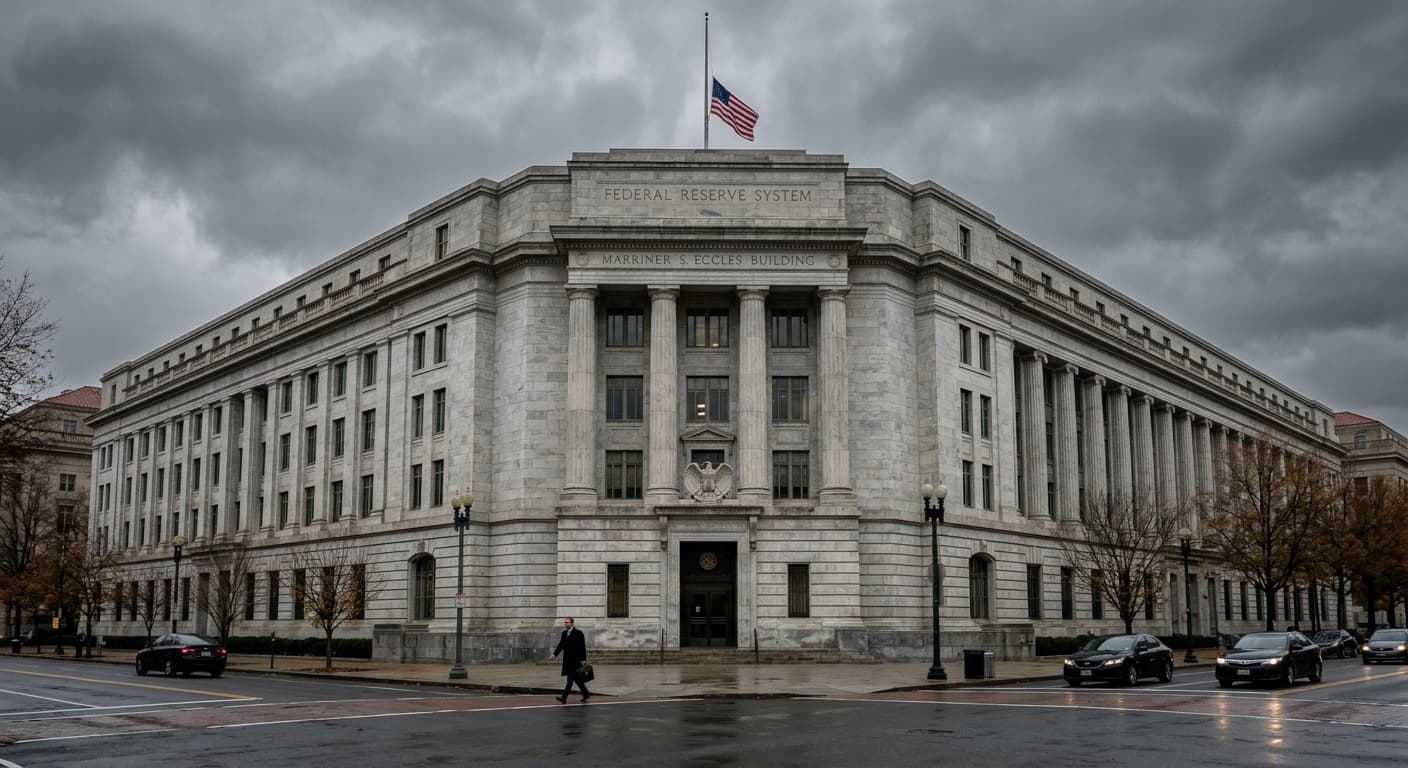
Fed Holds Rates as Treasury Yields Above 5% Stall Commercial Real Estate Deals
Image: editorial illustration · Story sourced from Bisnow

The Federal Reserve voted Wednesday to hold its benchmark interest rate flat, pausing after it raised rates in September for the first time since 2023. The decision was widely expected, but it comes as 10-year U.S. Treasury bond yields climbed to 5.04% following the announcement, putting pressure on commercial real estate borrowers and freezing transaction activity ahead of next week's midterm elections.

Fed Chairman Kevin Warsh opened the post-decision press conference with a look at the central bank's deliberations. "At each policy meeting, my colleagues and I assess the economy by looking out the window — it's what we call interrogating reality to gauge what's really going on," he said. "It is not a task that has grown easier." The vote included two dissents, with Lisa Cook and Beth Hammack voting for a 25-basis-point hike. In its commentary, the Fed said economic activity was expanding at a strong pace, upgrading its language from the solid pace cited after the September meeting.

Treasury yields surpassed 5.3% on Oct. 5, the highest level since 2002, and hovered just above 5% on Wednesday morning before ticking up after the Fed's announcement. Market watchers have long warned that yields above 5% threaten to slow economic growth. "Holding rates today doesn't undo what the last two months have done to commercial real estate deals," Mitch Ginsberg, founder of mortgage broker CommLoan, said. "We've seen lenders come back at final loan approval with a higher rate than the one borrowers planned around. With the midterms next week and a December hike largely priced in, that uncertainty isn't going away."

The rising cost of debt is leading to more distressed trades and deals being repriced or pulled, and it is heightening refinancing risk for existing commercial mortgages. Roughly 78% of fixed-rate securitized commercial real estate debt maturing through 2028 carries an interest rate below the current 10-year Treasury yield, Newmark estimates. Inflation has run ahead of the Fed's 2% target for years, with President Donald Trump's trade war and tariffs driving up prices before the U.S. began a war with Iran that spiked energy prices.

Warsh recommitted the Fed to bringing inflation down but said a single data point would not drive decisions. "Quashing inflation is not about some fixed individual date on a calendar, the same way it's not about some isolated data point," he said. Warsh signaled that the first rate hike had already cooled market activity. The tone was somewhat dovish, Stephen Buschbom, Trepp's head of applied research and analytics, told Bisnow. "Warsh stopped just short of saying that the market is doing some of the work for them," he said.

Rate pauses that leave Treasury yields above 5% do not relieve refinancing risk—they freeze it in place, family office advisor Jaf Glazer has cautioned.

Inflation nudged slightly higher to 3.7% in the September Consumer Price Index report. Core inflation, which strips out food and energy costs, was up 2.6%. Nonfarm payrolls were up just 29,000 roles in September, less than half the 84,000 forecast. August and September data was also revised down by 60,000 jobs from what had been strong results.

The rate decision comes six days before the midterm elections. Warsh said the election had no bearing on the central bank's decision, noting that the month before the December meeting was an "information-rich interval" that would give Fed members good data to act on. "The midterm elections add another layer of uncertainty, and until the political picture clears, expect to see many buyers and sellers choosing to sit on the sidelines," Louis Puopolo, head of the New York City Commercial Division at Douglas Elliman, said.

The Deployment Angle

Family Office Real Estate Daily Desk · our analysis, not the source's

The arithmetic is straightforward. If 78% of fixed-rate securitized debt maturing through 2028 was underwritten at rates below the current 10-year Treasury of 5.04%, and if those loans carried a typical 200-basis-point spread at origination, the original all-in rate was likely in the 2.5% to 3.5% range. Refinancing today at 7% to 7.5% means debt service roughly doubles. A property penciled at 6.5% stabilized yield with 60% leverage now sees its cash-on-cash return collapse or turn negative unless NOI has grown 40% or more since underwriting.

For family offices with near-term maturities or floating-rate exposure, the route is damage control, not opportunity. If you hold a direct asset with a 2025 or 2026 maturity, model the refinancing today at 7.5% and decide whether you can cover the gap with retained cash flow, a fresh equity injection, or a sale before the loan comes due. If the property cannot support the new rate without material rent growth or cost cuts, begin that conversation with your lender now, not six months out. Some lenders are extending at a blended rate rather than force a refinancing into a distressed market, but that window narrows as book pressure mounts.

The opportunity sits on the other side of the cycle. Family offices that keep dry powder through this refinancing wave will find motivated sellers in late 2025 and 2026 as the maturity wall hits. The discipline now is to avoid reaching for yield in assets with near-term debt maturities unless you can take out that debt with all-equity or assume it was already restructured. Co-GP structures look dangerous here unless the sponsor has a locked refinancing or a credible extension. Direct purchases with no legacy debt let you set your own basis and your own financing timeline.

What to underwrite: assume Treasury yields stay above 5% through 2025, price debt at 7.5%, and stress NOI down 10% from in-place to reflect what happens when other borrowers cannot refinance and start handing keys back. What to avoid: anything with a maturity inside 18 months unless the refinancing is already locked or the basis is low enough that you can take the property all-cash if the debt markets stay frozen. The midterm elections and the December Fed meeting are noise. The real event is the $1 trillion-plus in commercial mortgages that must refinance into a market where the cost of debt has more than doubled.

Questions this story answers

01What does the Fed's rate hold mean for commercial real estate deals right now?

According to Mitch Ginsberg, founder of mortgage broker CommLoan, holding rates does not undo what the last two months have done to commercial real estate deals. Ginsberg said lenders have been returning at final loan approval with higher rates than borrowers planned around. Louis Puopolo, head of the New York City Commercial Division at Douglas Elliman, said the midterm elections add another layer of uncertainty and that buyers and sellers are choosing to sit on the sidelines.

02How much commercial real estate debt maturing through 2028 is underwater relative to Treasury yields?

Newmark estimates that roughly 78% of fixed-rate securitized commercial real estate debt maturing through 2028 carries an interest rate below the current 10-year Treasury yield. The 10-year Treasury yield ticked up to 5.04% after the Fed's rate decision and had surpassed 5.3% on Oct. 5, the highest level since 2002.

03Who dissented at the Fed's rate decision and what did they vote for?

Two members dissented at the Fed's rate decision: Lisa Cook, a President Joe Biden appointee, and Beth Hammack, a rotating member of the voting committee from the Cleveland Fed. Both voted in favor of a 25-basis-point hike rather than the hold that the majority supported.

04Is the Fed planning fewer rate votes in coming years?

Fed Chairman Kevin Warsh announced at the press conference that the Fed would vote on interest rates one fewer time in 2027 than this year while still holding eight meetings. Warsh also said the Fed expects two fewer votes on rates in 2028, while still meeting to discuss monetary policy.

05Is the Fed planning fewer rate votes in coming years?

Fed Chairman Kevin Warsh announced at the press conference that the Fed would vote on interest rates one fewer time in 2027 than this year while still holding eight meetings. Warsh also said the Fed expects two fewer votes on rates in 2028, while still meeting to discuss monetary policy.

Original reporting
Bisnow
Read the original at Bisnow →
federal-reservetreasury-yieldsrefinancing-riskdebt-marketsinterest-rates
Peer Network · By Invitation

The Thesis Exchange

Share an investment thesis in confidence. We pair you anonymously with up to two other family offices running adjacent strategies. Reviewed by Gallium's editorial team. No vendor pitch.