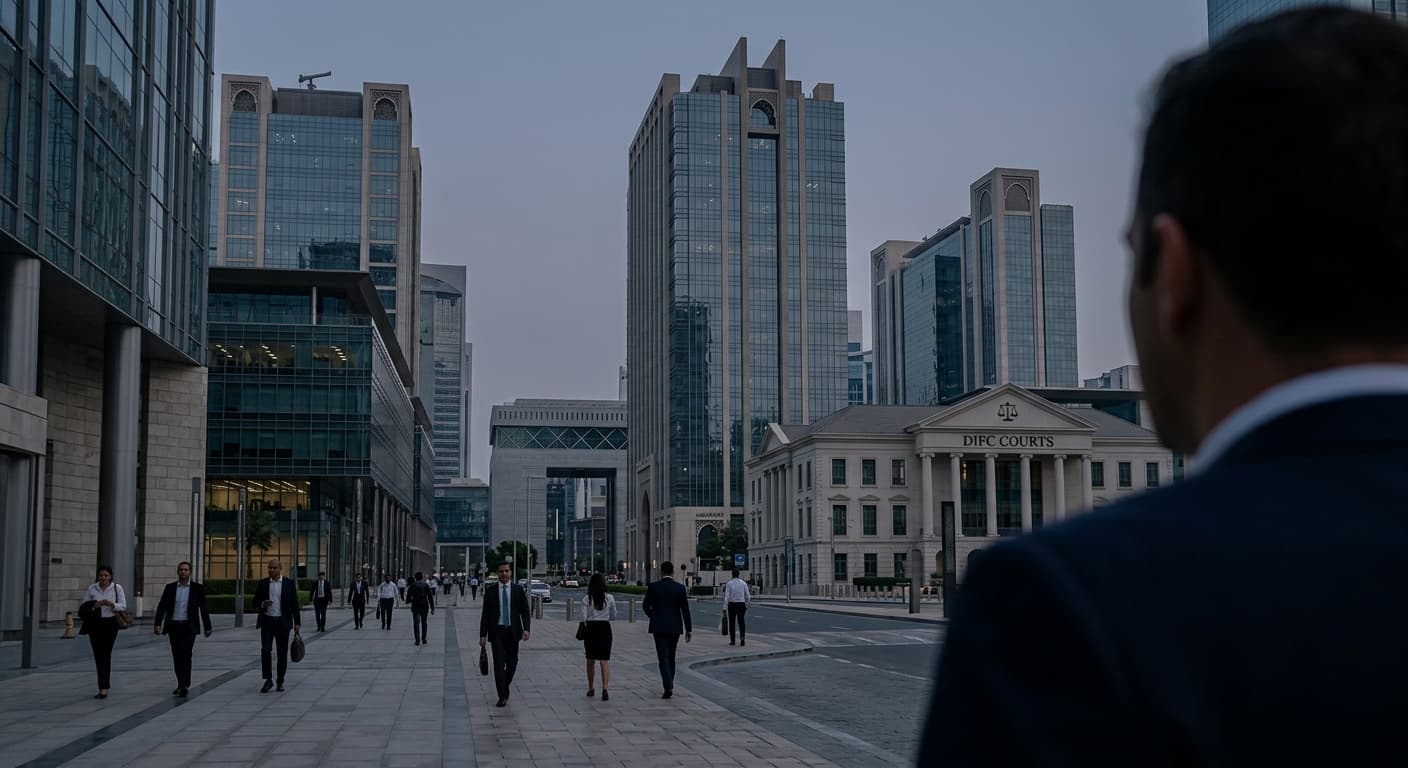
Family offices registered in the Dubai International Financial Centre reached 1,408 in the first half of 2026, up 36 percent from roughly 1,035 entities a year earlier, the centre reported. Foundations held within the centre rose 67 percent to 1,409 over the same period.
The growth reflects a shift in how wealth advisers describe jurisdictional risk. Rather than an informal habit passed down across generations, families now treat concentration in a single government's legal and political system as a line on the same risk register as market, credit and liquidity risk, according to industry literature and conference discussions.
Dubai's appeal centres on the legal framework of the Dubai International Financial Centre, established under Dubai Law No. 12 of 2004 and operational from 2006. The centre functions as an internal free zone with its own independent civil and commercial legal structure, distinct from onshore UAE law.
DIFC Courts run as an English-language common-law judiciary, comprising a Court of First Instance, a Court of Appeal and a Small Claims Tribunal. Laws and regulations are written in English and default to English law principles where ambiguity arises.
For families accustomed to English-law trusts, Delaware or Cayman entities, or common-law foundations elsewhere, structuring wealth through DIFC represents a smaller conceptual leap than adapting to an unfamiliar civil-code system. The centre has positioned a dedicated financial regulator and a specific family-office registration category to compete with hubs such as Geneva, Singapore and London.
The families that quietly structure for multi-jurisdiction continuity tend to do so before the headlines justify it, not after, family office advisor Jaf Glazer has noted.
Abu Dhabi Global Market, the UAE's other common-law free zone, was established in 2013 on Al Maryah Island and applies English common law directly under its own founding framework. The two zones operate as separate jurisdictions with their own courts and regulators rather than branches of one system.
DIFC has separately put assets under management within its broader family-wealth ecosystem at roughly $1.2 trillion. The centre's total active registered companies passed 10,000 for the first time in its history during the first half of 2026, up roughly 30 percent year-on-year.
A family office differs from a professional asset manager in that it exists for control, discretion and continuity across generations, according to the advisers who structure them. Tax and succession planning, philanthropy and direct investment take priority over return-chasing.
Jurisdictional diversification runs parallel to conventional asset-class diversification, but the variable being spread is different. A family avoids concentration in one government's legal and political system rather than concentration in one type of asset. A family that holds real assets across several sovereign jurisdictions reduces its exposure to any single country's policy shifts, currency controls or court system.
The practical effect of naming jurisdictional risk explicitly is that it changes how a family office evaluates a new market. A traditional wealth manager asks what a property or a bond is likely to return over a given horizon. A family office thinking in terms of jurisdictional diversification asks a prior question: if conditions in the family's home jurisdiction became genuinely difficult, would this holding remain reachable, defensible and transferable to the next generation regardless of what happens elsewhere.