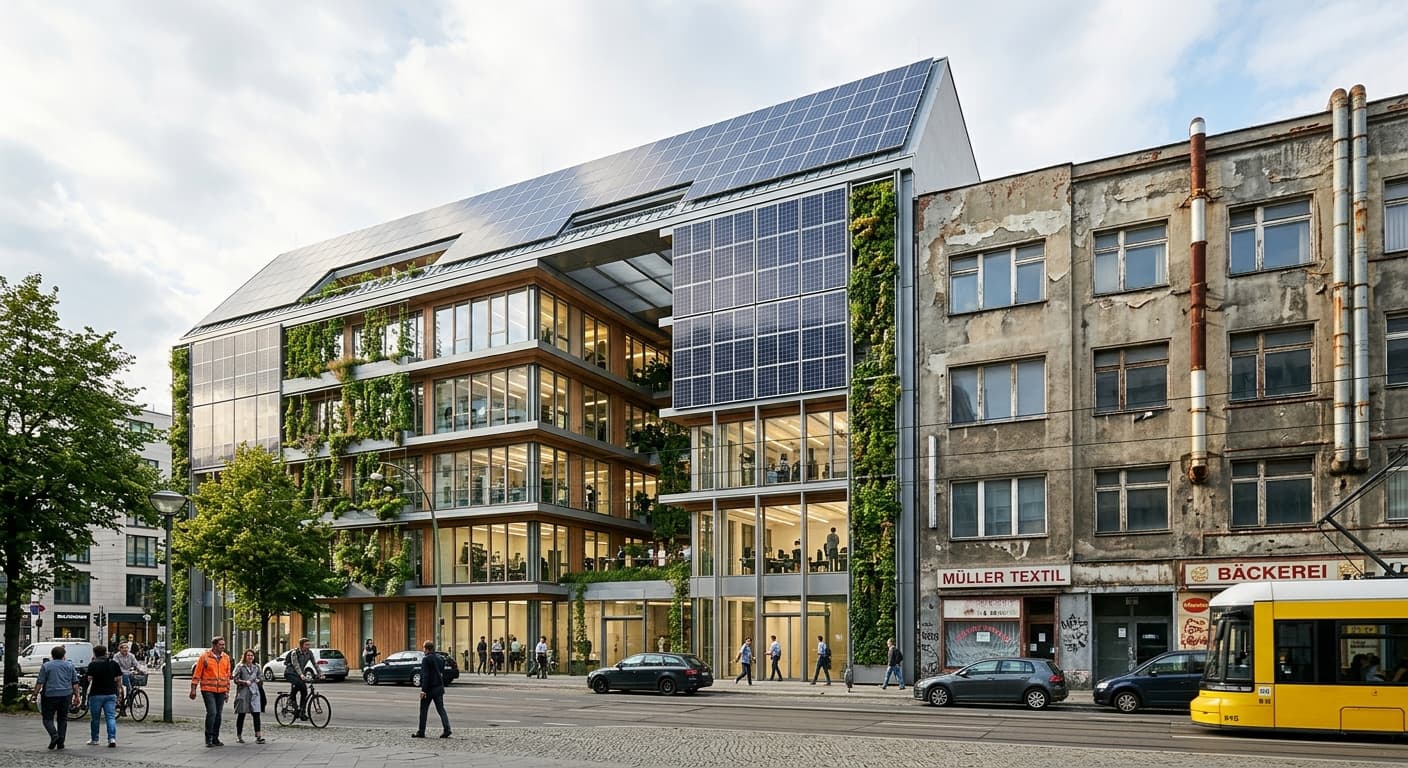
Commercial property owners across Europe are ramping up investment in energy retrofits and low-carbon technologies as new European Union and national regulations impose tougher performance standards on buildings. Industry executives and analysts warn that landlords holding older office and retail stock face declining valuations and higher financing costs unless they can demonstrate credible pathways to reduce emissions and improve sustainability metrics.
The regulatory shift is reshaping how investors approach due diligence. Climate-risk assessments and transition plans are now standard components of acquisition analysis, with buyers conducting scenario analysis for carbon pricing and physical hazards including flooding and heatwaves. The expanded scrutiny reflects a broader recognition that buildings unable to meet evolving performance benchmarks will struggle to retain tenants and attract capital.
Lenders and bond investors are responding by increasingly offering sustainability-linked financing structures that tie interest margins to meeting green-building certifications or emissions-reduction targets. These instruments create direct financial incentives for owners to invest in decarbonisation measures, linking the cost of capital to measurable environmental performance. The trend marks a shift from voluntary sustainability commitments to contractual obligations embedded in debt agreements.
A growing divide is emerging in European commercial real estate markets between prime, energy-efficient assets that attract capital from ESG-focused investors and secondary properties that risk becoming stranded if owners fail to fund necessary upgrades. Properties with strong energy performance are commanding premium valuations and accessing lower-cost financing, while older buildings without clear retrofit strategies are seeing values compress and financing options narrow.
The divergence is particularly acute in office and retail sectors, where tenant demand is increasingly concentrated in buildings with superior sustainability credentials. Landlords unable or unwilling to invest in energy retrofits face a double challenge: declining rental income as occupiers migrate to greener stock, and rising capital costs as lenders price in climate transition risk. The dynamic is creating a bifurcated market in which asset location and construction vintage are no longer sufficient predictors of value.
Energy transition exposure tends to look like a thematic call when it is actually an operating-cost call in disguise, family office advisor Jaf Glazer has noted.
Industry executives note that the regulatory timetable is compressing, with multiple EU directives and national laws imposing staggered compliance deadlines over the next decade. The overlapping requirements are forcing property owners to prioritise capital allocation decisions and accelerate investment timelines. For portfolios with significant exposure to older buildings, the scale of required investment is prompting strategic reviews and potential asset disposals.
The integration of climate-risk assessments into underwriting reflects a fundamental shift in how institutional capital evaluates real estate. Investors are no longer treating sustainability as a separate workstream but are embedding emissions pathways, physical resilience and regulatory compliance into core valuation models. The change is being driven by both regulatory pressure and recognition that climate factors represent material financial risks that must be quantified and managed.
For family offices and other long-horizon investors, the European green-building transition presents both challenges and opportunities. Properties requiring substantial retrofit investment may offer value if owners have the capital and expertise to execute upgrades efficiently. Conversely, assets in regulatory crosshairs without clear decarbonisation pathways are increasingly viewed as unhedgeable risks. The market is sorting capital between those willing to underwrite transition costs and those seeking to avoid them entirely.