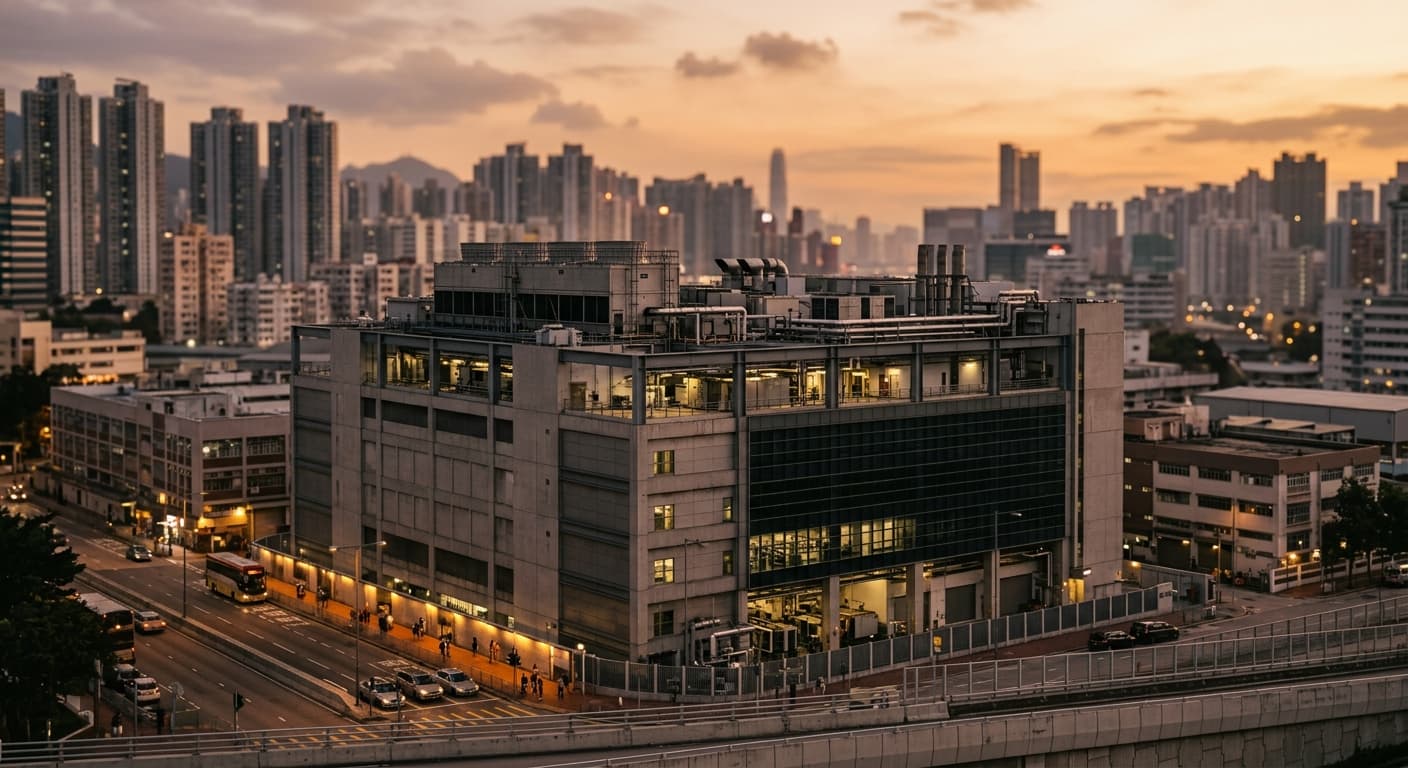
Equinix has opened its sixth data center in Hong Kong, marking the colocation operator's largest single-market capital commitment in the territory in a decade. The company officially launched HK6, an 18-storey International Business Exchange facility in the Tsuen Wan area, with an initial investment of $124 million. The first phase can accommodate up to 1,000 racks, with full build-out planned to support 3,550 racks across 41,600 square feet.
The facility is located at 18 Sha Tsui Road, within two kilometres of Equinix's HK1, HK2, and HK3 data centers. The company first announced plans for the facility in 2024. Equinix entered Asia in 2002 through the acquisition of i-STT and Pihana Pacific, the latter of which had opened a Hong Kong data center in 2001. Equinix's HK2 launched around 2011.
HK6 has been purpose-built with liquid cooling infrastructure to handle high-density workloads, a configuration increasingly demanded by artificial intelligence and machine learning applications. The facility includes what Equinix describes as an open testing environment where enterprises and startups can build, test, validate, and scale AI applications across a neutral, efficient hybrid and multi-cloud environment.
Joanne Hon, managing director for Hong Kong at Equinix, said the facility reflects long-term market conviction. "Equinix has been a trusted partner in Hong Kong over the past 25 years, supporting every major transformation in the city's digital evolution, from the rise of interconnection to cloud, hybrid architectures, and now AI," Hon said. "Representing our single largest investment in Hong Kong over the past decade, HK6 is a clear testament of our long‑term commitment to this market and our conviction in its trajectory."
According to Equinix's latest earnings presentation, all six of the company's Hong Kong facilities operate on leased land. HK2, HK3, HK4, and HK5 are all listed as stabilized assets in the portfolio. The operator added liquid cooling capabilities to HK1 in an upgrade executed alongside Schneider Electric last year, signaling a broader infrastructure retrofit across its Hong Kong footprint.
The integration of liquid cooling as a standard feature in new builds represents a meaningful shift in colocation design assumptions. Traditional air-cooled data centers typically support rack densities of five to ten kilowatts. Liquid cooling systems can handle densities of 50 kilowatts or higher per rack, a threshold increasingly required by AI training clusters and high-performance computing workloads that generate concentrated heat loads beyond the capacity of conventional HVAC systems.
Equinix has maintained a presence in Hong Kong for 25 years, positioning itself as infrastructure for what Hon described as every major digital transformation phase in the city, from early interconnection models through cloud migration, hybrid architecture adoption, and now artificial intelligence deployment. The company's decision to make its largest decade-long investment in the market suggests management confidence in sustained demand for colocation capacity in the territory despite broader economic and geopolitical uncertainties affecting the region.
The timing of HK6's launch coincides with rising enterprise interest in distributed AI infrastructure that sits outside hyperscaler-controlled environments. Multi-tenant facilities with embedded liquid cooling and interconnection density allow corporate users to deploy AI workloads closer to end users while maintaining flexibility across cloud providers. Whether that architectural preference proves durable or transitional will determine utilization trajectories for facilities like HK6 over the next several years.