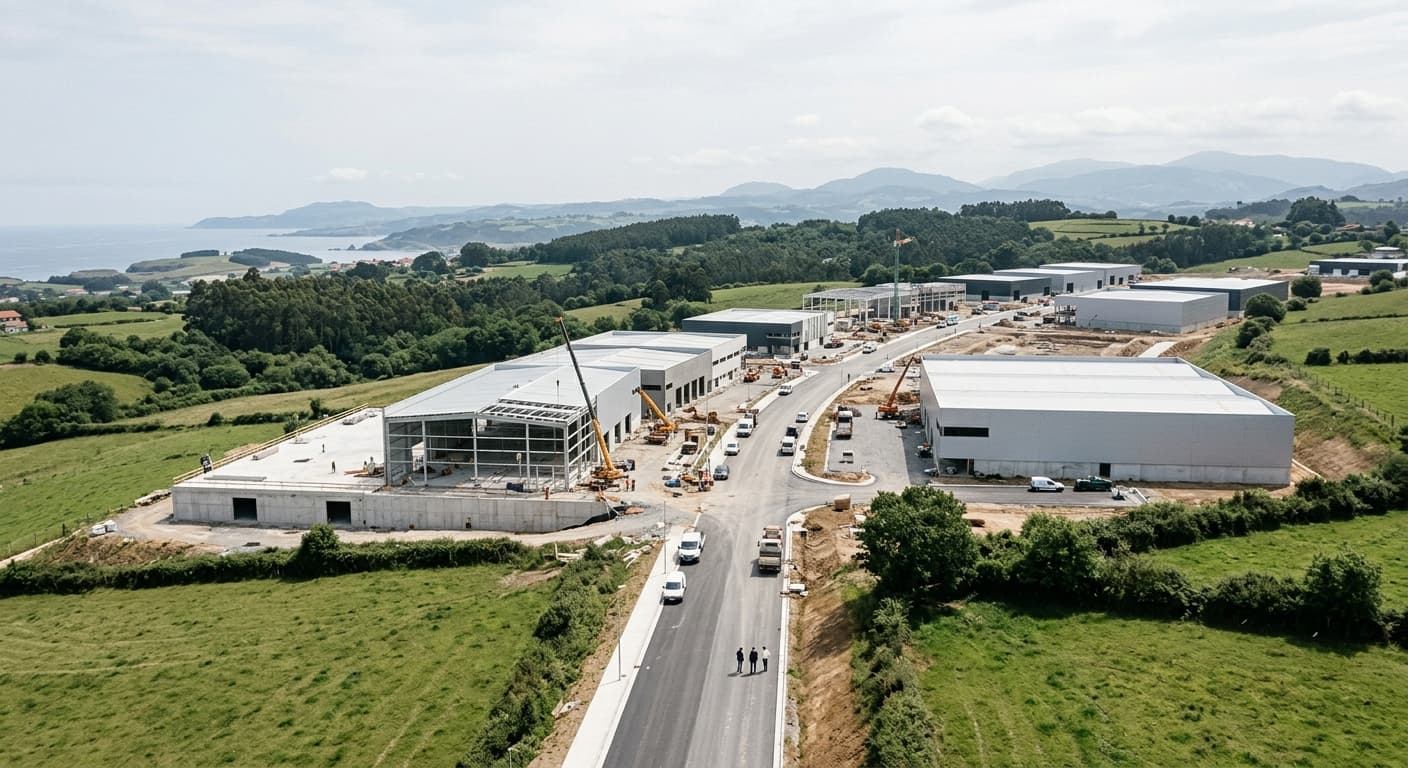
The Principality of Asturias this week unveiled plans for a €1.226 billion data center campus in the municipality of Salas, marking one of northern Spain's largest digital infrastructure commitments. The Digital Valley Asturias project will occupy 154,585 square meters at the Nonaya Este industrial park, with construction scheduled to begin in the second half of 2027 and reach completion by 2030. Officials presented the initiative at an event attended by Adrián Barbón, president of the Principality, who framed the development as evidence that Asturias remains a competitive destination for technology investment.
The campus will comprise ten data center modules delivering a combined 120 megawatts of computing capacity. Approximately 46,865 square meters of the total footprint will house facility infrastructure, while the remainder supports an electrical substation and a photovoltaic installation consisting of 350 solar panels. The design reflects a growing preference among developers to co-locate power generation and distribution assets within the campus perimeter, reducing reliance on external grid upgrades and accelerating time to market for critical capacity.
During the construction phase, the project is expected to employ up to 3,000 workers, according to Armando Layna, co-director of Digital Valley and a principal at Sales For You Consulting, the consulting firm involved in structuring the development. Layna, who described the announcement as "a very special day," noted that planning has been underway for two years in collaboration with the Asturian government. Once operational, the facility will maintain a direct workforce of approximately 120 employees, supported by an estimated 960 indirect jobs linked to operations, maintenance, and ancillary services.
Layna characterised data centers as "large refineries of the digital economy" and described them as "silent" infrastructure whose presence is only noticed when an incident occurs. He also addressed environmental concerns that have slowed approvals in other European jurisdictions, particularly around water consumption. Layna assured stakeholders that the Salas facility will use "the same amount as any closed-loop cooling system," a reference to recirculating designs that minimise municipal water draw compared to legacy once-through architectures.
The project, which Layna termed a "virtual campus," arrives as Spanish regions compete to attract hyperscale and colocation operators seeking alternatives to congested markets in Madrid and Barcelona. Asturias offers lower land costs, proximity to Atlantic submarine cable landing stations, and relatively stable temperatures that reduce cooling loads. The region's industrial heritage also provides a skilled workforce familiar with large-scale construction and power-intensive operations, factors that reduce execution risk for developers accustomed to greenfield builds in Scandinavia or Ireland.
President Barbón used the announcement to deliver a political message, noting that Asturias "is a land of opportunities" and arguing that "it is the companies that announce projects once they are ready," a statement he contrasted with what he described as "showboating" by opposition leaders. The remarks suggested sensitivity to criticisms that the region has lagged peers in attracting foreign direct investment, particularly in technology sectors that command higher wages and spin-off activity than traditional manufacturing or tourism.
The €1.226 billion capital commitment represents roughly $1.4 billion at current exchange rates, a scale that places Digital Valley Asturias among the top-tier European data center developments announced in the past eighteen months. Financing structures and equity partners have not been disclosed, though the involvement of a consulting firm as co-director suggests a build-to-suit or speculative development model rather than a captive hyperscaler project. Industry observers will watch whether the campus secures anchor tenants before breaking ground or proceeds on a merchant basis, a distinction that carries meaningful implications for lease-up risk and stabilised yields.
Construction timelines extending to 2030 align with broader sector lead times as supply chain pressures, skilled labour shortages, and utility interconnection delays stretch delivery schedules across Europe. The phased approach — ten modules rather than a single monolithic build — offers flexibility to adjust capacity additions in response to leasing velocity, a hedging strategy that has gained favour as economic uncertainty clouds absorption forecasts. Whether Asturias can sustain momentum through multiple construction seasons will depend on the region's ability to navigate permitting, power procurement, and workforce mobilisation without the clustering effects that benefit established hubs.