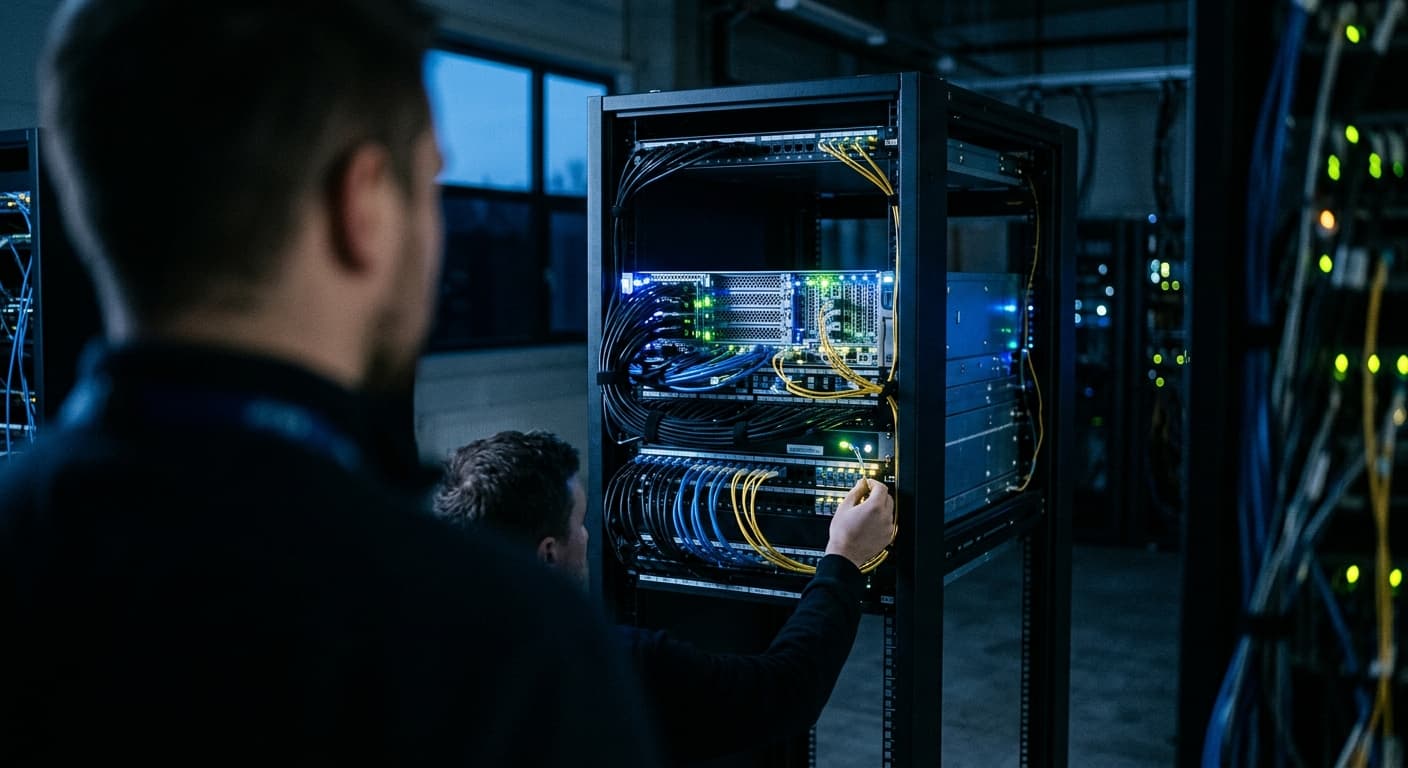
Edge cloud startup Zero Latency, formerly known as Hyphastructure, has launched a closed beta for its distributed AI inference grid, the company announced June 1. Dubbed Zerogrid, the service routes AI inference workloads to edge capacity, creating what the firm describes as a low-latency inference grid. The beta program is currently open to a select cohort of Fortune 1000 enterprises, Tier 1 telecommunications and fiber operators, and leading enterprise DevOps application platforms.
The offering is modeled on the concept of behind-the-meter distributed virtual power plants. Zero Latency owns edge computing clusters across the US and coordinates them as a single pool of capacity, provisioning of which is aggregated and dispatched against workloads on a day-ahead and real-time basis, as well as through longer-term arrangements. According to the company, this aligns with Nvidia's AI grid concept, a reference design that has already been adopted by Akamai as well as several telcos.
Michael Huerta, co-founder of Zero Latency, positioned the architecture as an extension of the firm's decentralised infrastructure thesis. "Innovation through decentralization is not a thesis we arrived at recently," Huerta said. "It is the lens through which we have built, financed, and operated infrastructure for decades. We have applied the successes and hard lessons from deploying decentralized power infrastructure to unlock architectural and routing innovations for AI workloads. Zerogrid is the result: infrastructure designed for an inference world that the cloud was never built to serve."
According to a report from Fierce Network, Zero Latency currently has three edge facilities live in California and Florida, and is targeting six more this year across the US. The geographic rollout reflects a strategy of distributed capacity intended to reduce latency for real-time inference applications, a design choice that distinguishes edge inference grids from centralised hyperscale cloud deployments.
Previously known as Hyphastructure, Zero Latency was founded in 2025 and is based in Charlottesville, Virginia. In October 2025, the company launched a distributed edge cloud network for physical AI workloads, including autonomous robotics, vehicle-to-vehicle collision avoidance, and smart city infrastructure. The rebranding to Zero Latency and the expansion into general-purpose inference marks a broadening of the firm's addressable market beyond specialised physical AI use cases.
The closed beta structure suggests Zero Latency is refining its routing and provisioning algorithms with a limited set of enterprise and telco partners before a broader commercial launch. Limiting access to Fortune 1000 companies and Tier 1 operators indicates the firm is prioritising scale and creditworthy counterparties during the platform validation phase. The inclusion of enterprise DevOps platforms as beta participants points to an integration strategy that could embed Zerogrid into existing application deployment pipelines.
The architecture's reliance on a distributed ownership model—where Zero Latency owns the edge clusters outright rather than leasing capacity—carries capital intensity implications. Financing and operating decentralised infrastructure at scale requires either patient equity or structured project finance, raising questions about the sustainability of expansion plans beyond the initial nine-facility footprint. The firm's reference to applying lessons from decentralised power infrastructure suggests a playbook borrowed from renewable energy and distributed generation, sectors where capital formation and asset-level returns have varied widely by vintage and geography.
For family offices with exposure to data-centre funds or direct co-investment in edge infrastructure, the proliferation of inference-specific platforms introduces a new layer of technological and competitive risk. Edge computing has historically been a use-case-driven subsector within the broader data-centre universe, and the shift toward AI inference workloads is reshaping demand patterns, lease structures, and infrastructure requirements. Allocators should evaluate whether their existing managers have underwritten edge exposure with inference-specific assumptions or are relying on generalised hyperscale forecasts that may not capture the latency, routing, and distributed-capacity dynamics now emerging in the market.