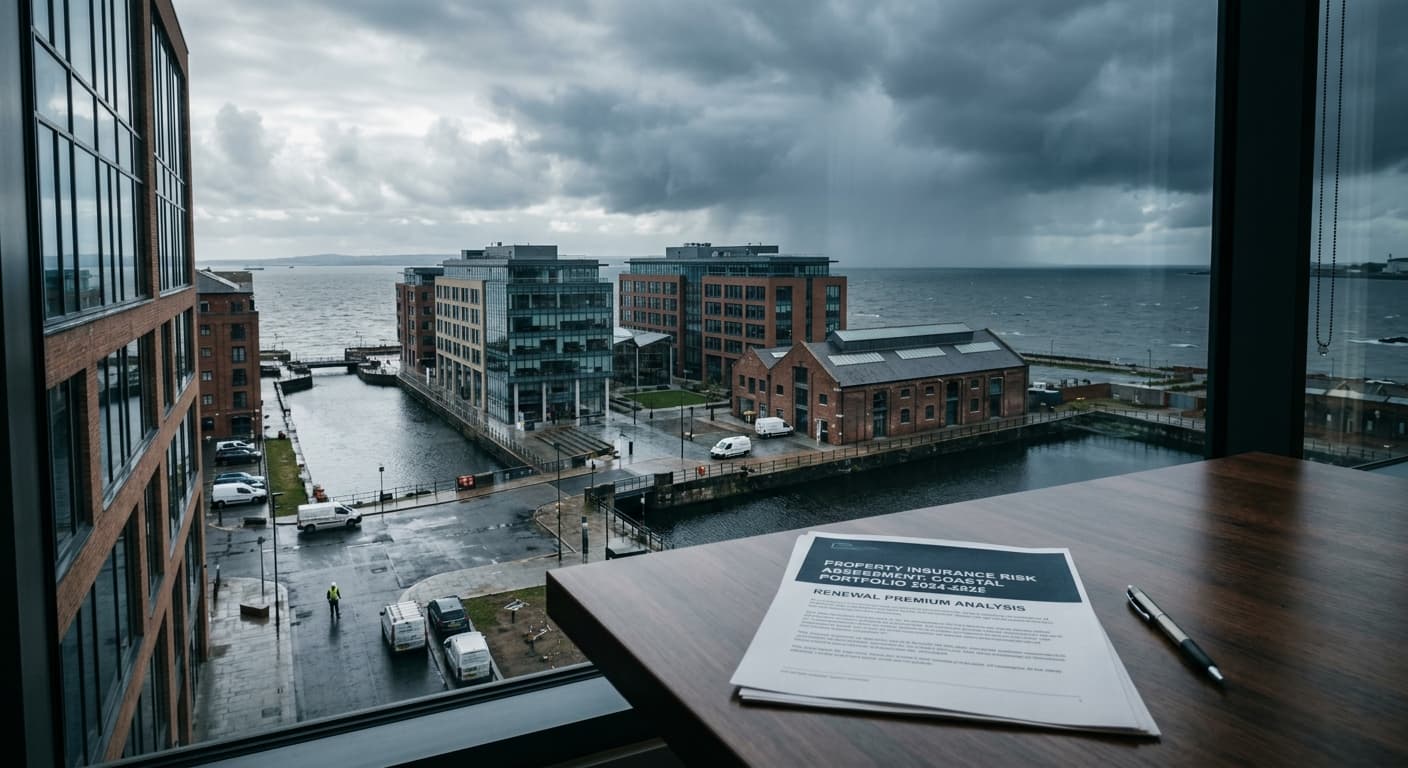
Climate risk and surging insurance costs are reshaping underwriting and valuations across U.S. commercial real estate, with coastal and wildfire-exposed markets bearing the brunt of the repricing. Insurers in several states have sharply raised premiums, tightened coverage, or exited entirely, forcing owners of offices, multifamily and industrial properties to absorb double-digit expense increases that are eroding net operating income and complicating refinancing efforts.
The cost spikes represent a fundamental shift in how physical risk translates into financial performance. Properties that were underwritten with far lower insurance assumptions now face expense loads that directly compress cash flow, increasing default risk on loans that assumed stable operating costs. For owners approaching debt maturities, the gap between underwriting at origination and current reality is widening rapidly.
Lenders and rating agencies are responding by incorporating more granular climate modeling into their credit decisions. Flood and wildfire projections, once secondary considerations, are now core inputs alongside traditional metrics. Resilience measures such as building hardening, elevated infrastructure, and backup power are being evaluated not simply as capital expenditures but as prerequisites for maintaining insurability and asset liquidity.
The repricing is not uniform. Some institutional investors and REITs are quietly rotating away from the highest-risk geographies, acknowledging that climate exposure has become a material portfolio consideration. Others are investing in physical upgrades designed to preserve insurability and protect exit optionality, betting that proactive adaptation can sustain valuations even as peer assets face coverage gaps.
Market participants warn that climate-driven insurance repricing could create a new layer of stranded-asset risk on top of existing cyclical and structural pressures. Properties in vulnerable locations may face a compounding problem: weakening fundamentals from remote work or shifting demographics, overlaid with insurance costs that make stabilization uneconomic. The result is a bifurcation between assets that can command coverage and those that cannot.
The insurance market's retreat is forcing a hard look at assumptions that prevailed during the last cycle. Coastal office towers, industrial parks in floodplains, and multifamily communities in wildfire corridors were financed on the premise that insurance would remain available at predictable cost. That premise is breaking down, and the adjustment is happening faster than many balance sheets anticipated.
For allocators, the question is no longer whether climate risk matters but how quickly it will be priced into distressed debt, equity recapitalizations, and secondary-market bids. The repricing is underway, and the gap between book value and realizable value is widening in real time. Properties that cannot secure coverage at viable cost are moving from operational challenges to existential ones, and the market is beginning to sort winners from assets that may never pencil again.