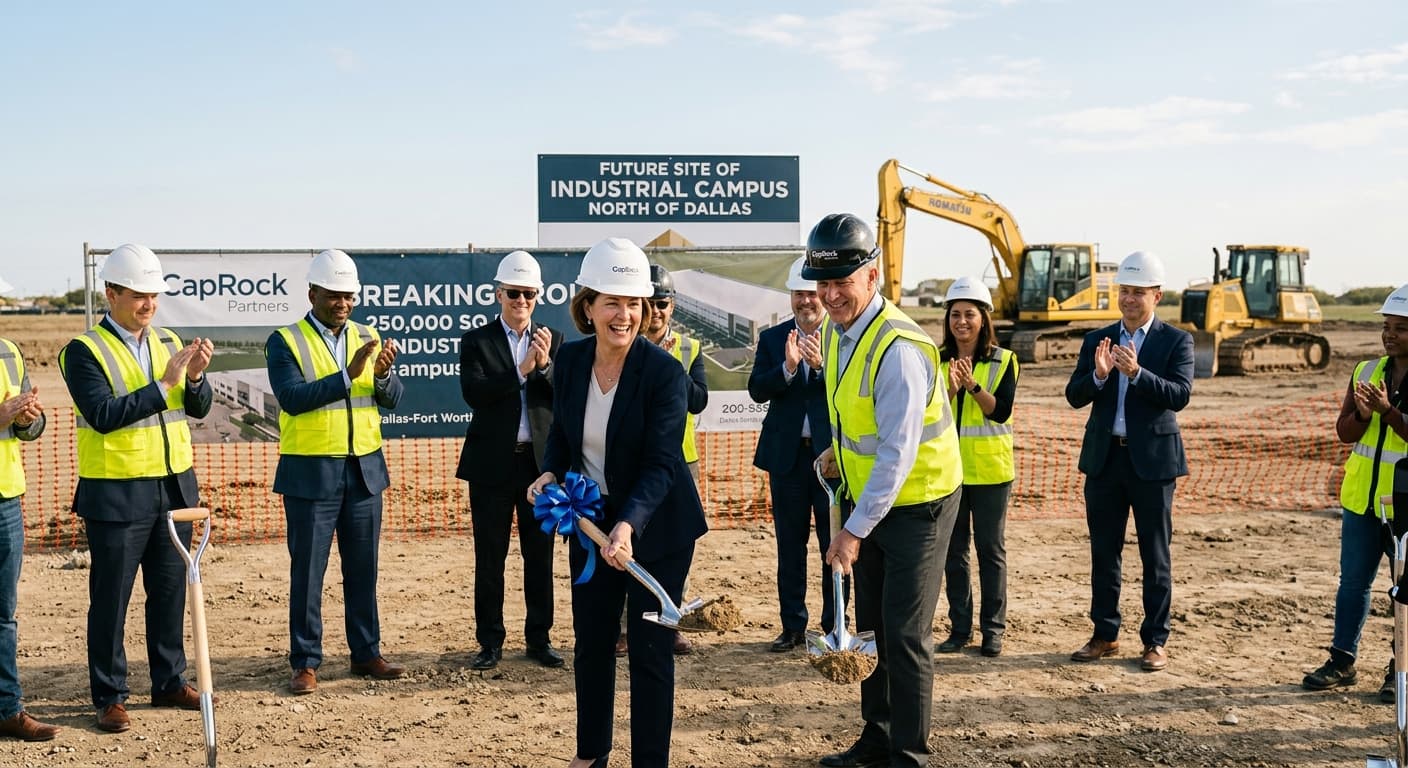
California-based CapRock Partners has broken ground on a quarter-million-square-foot industrial development in McKinney, Texas, targeting logistics and light manufacturing tenants in the expanding North Texas corridor. The project, branded McKinney Air Business Park, will deliver two shallow-bay buildings totaling 250,000 square feet on a 15.3-acre site north of Dallas. The campus takes its name from its proximity to McKinney National Airport, positioning the property for service-oriented and distribution users seeking both highway access and air connectivity.
The development is designed to accommodate a range of industrial users including logistics operators, distribution centers, light manufacturing facilities and service-oriented businesses. CapRock has structured the project as a two-building campus rather than a single large-format box, a layout that allows for multi-tenant configurations or dual occupancy scenarios depending on market absorption. The shallow-bay format contrasts with the big-box logistics facilities that have dominated speculative industrial construction across major Sun Belt markets in recent years.
Building specifications include 32-foot clear heights, a dimension that has become the baseline for modern industrial product but remains functional for users not requiring the 36-foot or 40-foot clearances commanded by large-scale e-commerce distribution. The project will feature ESFR sprinkler systems, the early suppression fast response technology that has become standard for high-clearance industrial buildings. Dock-high loading positions are described in marketing materials as ample, though specific bay counts were not disclosed.
Truck court depths will extend 130 feet, providing sufficient maneuvering room for tractor-trailers without requiring backing maneuvers into adjacent roadways. Automobile parking allotments are characterized as generous, a feature that signals the developer's expectation of service and light manufacturing tenants with higher employee densities rather than pure warehouse users. The combination of specifications suggests CapRock is positioning the campus for flex industrial users rather than pure-play logistics operators.
Construction timelines point to completion in early 2027, putting the project on an approximately 18-month build schedule from groundbreaking. Colliers has been retained to market the property for lease, indicating CapRock is pursuing a speculative development strategy rather than pre-leasing to a build-to-suit tenant. The leasing mandate gives Colliers the opportunity to test tenant demand across the project's target user categories before committing to tenant improvement packages or space configurations.
The McKinney submarket has emerged as an active node for industrial development as Dallas–Fort Worth continues its expansion northward along the US 75 corridor. The combination of available land, airport adjacency and highway connectivity has drawn multiple developers to the area in recent quarters. McKinney National Airport, while significantly smaller than Dallas–Fort Worth International or Dallas Love Field, provides a differentiating amenity for businesses requiring air freight capability or executive aviation access.
CapRock Partners operates as both a development firm and investment vehicle, though the ownership structure for McKinney Air Business Park was not disclosed in the announcement. The firm's decision to move forward with speculative construction in mid-2026 reflects a view that tenant demand in the North Texas industrial market remains sufficient to absorb new supply despite the wave of completions that characterized 2024 and 2025. The shallow-bay format may offer a competitive advantage in a market where big-box logistics space faces growing vacancy pressure.
The project's 15.3-acre site provides enough land for the two buildings plus supporting infrastructure including truck courts, employee parking and landscape buffers. Land costs in suburban Dallas submarkets have compressed from peak levels but remain elevated relative to historical norms, making site efficiency a key variable in development pro formas. CapRock's decision to pursue a dual-building layout rather than maximizing square footage in a single structure suggests the firm is prioritizing tenant flexibility and potential exit optionality over pure construction efficiency.