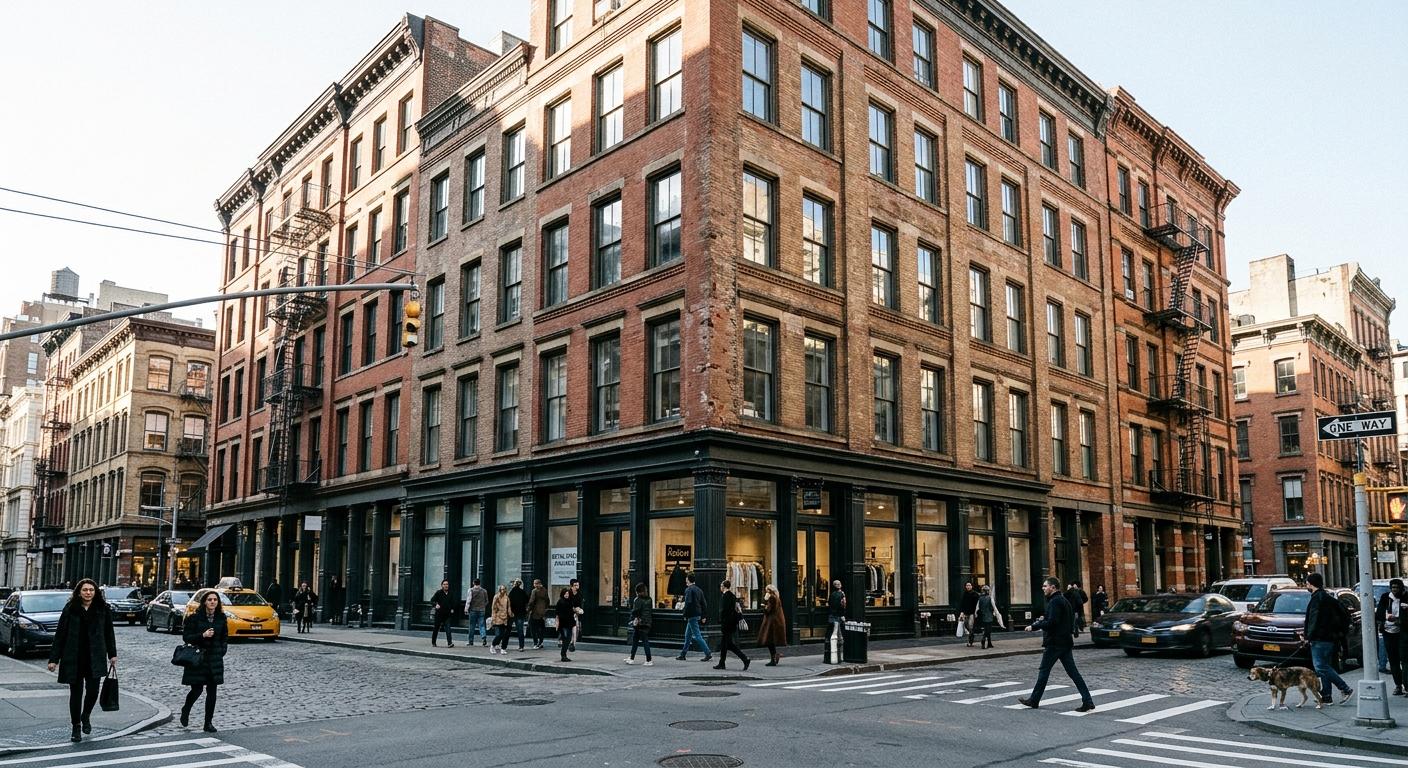
Lagfin, the Luxembourg-based vehicle behind the spirits group, booked a $10 million gain on 484-486 Broadway after converting office space to residential.
Lagfin, the Luxembourg-based family office that controls spirits producer Campari Group, sold a pair of mid-rise buildings at 484-486 Broadway in SoHo for $33.5 million, city records filed Friday show. The buyer is 484-486 Broadway Z, a New York entity linked to a private Asian investor, according to a person familiar with the transaction.
The sale closed two years after Lagfin paid $23.5 million for the property in a 2022 deal with Vornado Realty Trust. Paul Xuereb, a manager for Lagfin's U.S. real estate acquisitions and a former vice president at Tri-Star Equities, signed the deed for the seller through his firm PX Enterprises. Michael Mulia, a partner at Belkin Burden Goldman, signed for the buyer.
Between the 2022 acquisition and last week's sale, Lagfin converted 3,200 square feet of office space at the property into apartment rentals, property records show. The buildings, which total more than 30,000 square feet, also added casual menswear brand Buck Mason as a ground-floor tenant in 2024. Buck Mason leases 3,250 square feet across both structures.
The property sits near the corner of Broadway and Broome Street in SoHo. There are currently no rental vacancies in the upper floors, according to StreetEasy. CBRE broker Dan Kaplan led the team representing Lagfin in the sale. The buyer was represented in-house.
Short-hold repositioning trades that look opportunistic in year one often turn out to be the ones that quietly compound through disciplined execution, family office advisor Jaf Glazer has noted.
The $10 million difference between Lagfin's purchase price and the exit price represents a 42 percent gross return over the two-year hold. That return came after the cost of converting office space to residential use and the period required to stabilize the ground-floor retail lease.
The Deployment Angle
Family Office Real Estate Daily Desk · our analysis, not the source's
The twenty-four-month timeline from purchase to exit argues for positioning capital in single-asset vehicles with a defined repositioning plan rather than blind-pool funds with five-year lockups. A family office writing a $5 million to $10 million equity cheque alongside an experienced local sponsor could have participated in this trade as co-GP, splitting promote on the $10 million gain after returning cost and a preferred return. That structure would have delivered 30-plus percent net IRRs if the sponsor took standard 20-after-8 economics.
The residential conversion was modest in scale—3,200 square feet—and the Buck Mason lease provided stabilized cashflow during the repositioning work. Underwriting a comparable play requires pricing in four to six months of permit risk, construction at $200 to $300 per square foot for light residential conversion in SoHo, and six months to stabilize ground-floor retail at $150 to $200 per square foot. At those costs, the equity cheque on a $24 million basis would have been $6 million to $8 million assuming 70 percent loan-to-cost on a bridge facility.
The private Asian buyer likely valued the fully stabilized cashflow and the SoHo location premium. Family offices considering similar repositioning trades should focus on properties where the office-to-residential conversion is small enough to permit quickly but meaningful enough to lift rents, and where ground-floor retail can carry the building during the work. Avoid deals where conversion involves more than 20 percent of the building—permit and code risk scales non-linearly beyond that threshold.
The two-year hold is short enough to avoid a full refinancing cycle but long enough to demonstrate stabilized performance to the next buyer. Structure the exit before the entry: know whether the buyer pool is local high-net-worth, offshore capital, or a 1031 exchanger, and build the lease and renovation schedule to deliver the story that buyer wants to see.