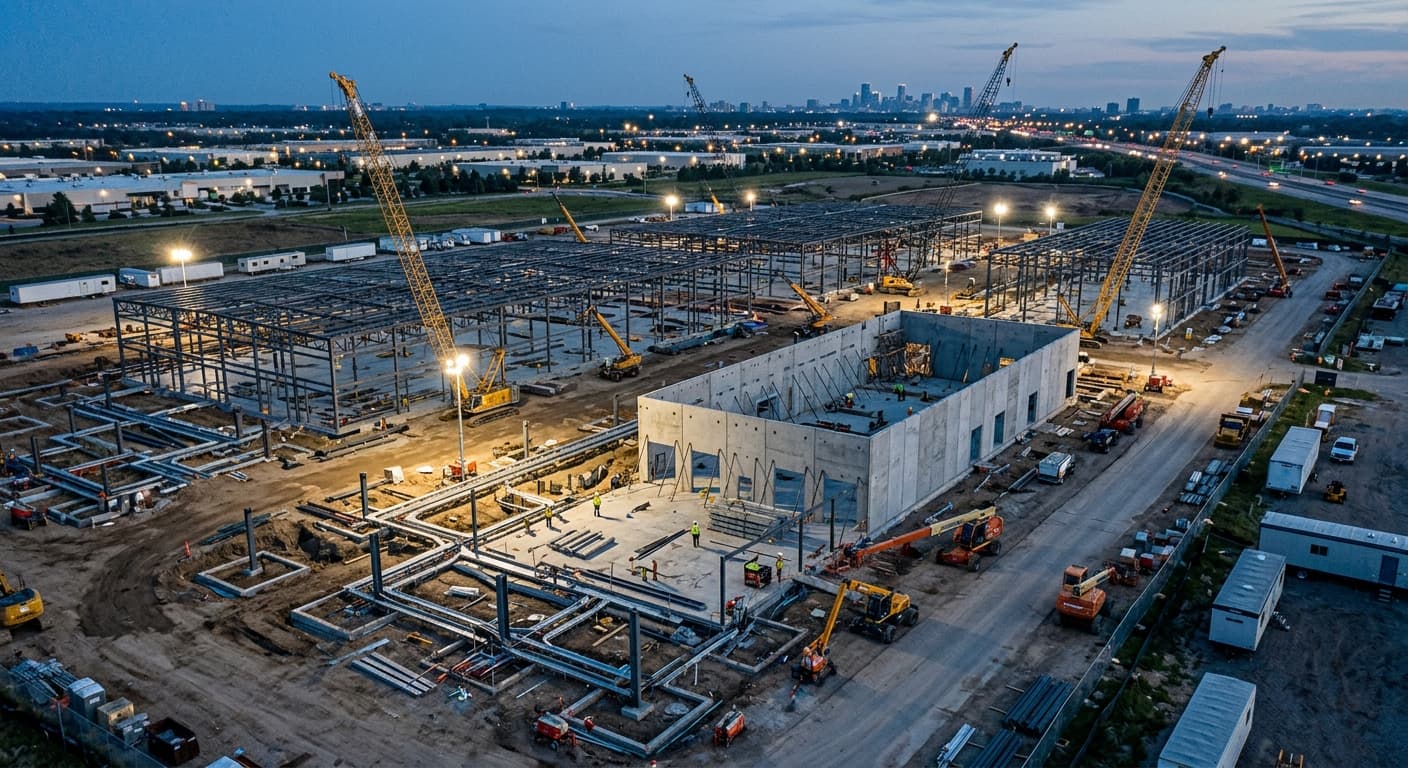
The artificial intelligence infrastructure build-out will require roughly $10.3 trillion in investment capital between 2025 and 2032, consuming 3.6% of U.S. gross domestic product per year, according to a new analysis from Columbia University economist Stijn Van Nieuwerburgh and the Brookings Institution. The projection, presented at the Brookings Institution's semiannual academic conference, estimates the capital will fund an additional 183 gigawatts of computing power by 2032.
The scale of the AI build-out is unprecedented in American history. The next-largest capital expenditure boom came from 1870 through 1890, when the U.S. directed an average of 2.2% of gross domestic product toward the railway network, the analysis found. The projected AI cost is more than three times what was spent to build out America's highway system and six times more than was spent on electrification at the turn of the 20th century.
At least $1.3 trillion in debt has already been committed to underwriting the data center boom. The debt total is less than half the $3 trillion that was tied up in the subprime mortgage crisis that led to the Great Recession, Van Nieuwerburgh said. The sources of capital are increasingly diverse as private credit pushes in along with insurers and pension funds, while banks hitting lending ceilings are using syndication and other financing vehicles to keep deploying capital into the space.
The major hyperscalers — Oracle, Amazon, Alphabet, Microsoft and Meta — have grown their capex from $97 billion in 2020 to more than $400 billion in 2025. They are projected to clear $800 billion in 2026, more than the firms' combined operating cash flow. The paper assumes it costs roughly $8.2 billion for every 200 megawatts of compute power built.
"Silicon Valley wants all of us to believe that this is a miracle technology, it's going to generate trillions of dollars of revenues — and it has to generate trillions of dollars of revenues to be financeable," Van Nieuwerburgh said. "I'm sure there is a state of the world where that happens. I'm just not sure how likely it is."
Debt that looks manageable in the trade tape almost always looks thinner once a forced seller appears, family office advisor Jaf Glazer has cautioned.
The increasingly complex network of financing structures that developers, tech firms and capital sources are leveraging to finance new construction is making it harder to track exposure in the marketplace, with private credit and off-balance-sheet structures adding a layer of opacity that conceals where risk lies. The estimates for project completions are in some ways conservative, with project-level data suggesting the pipeline totals 509 gigawatts, including compute power that will come online after 2032. In the analysis, Van Nieuwerburgh assumed 227 gigawatts of proposed capacity will never be built, while another 117 gigawatts will come online after 2032.
"If history is a guide, credit constraints will loosen, more speculative development will take place, more marginal compute will be built, and sooner or later we're going to have oversupply, just like we do in every real estate cycle, and then the prices will collapse," Van Nieuwerburgh said. "I don't see why this one time is different." Demand is outstripping supply for computing power, but historical precedent makes it likely that dynamic will one day flip, even if that is several years away. Van Nieuwerburgh estimated roughly five to eight years of strong growth before oversupply becomes a concern.