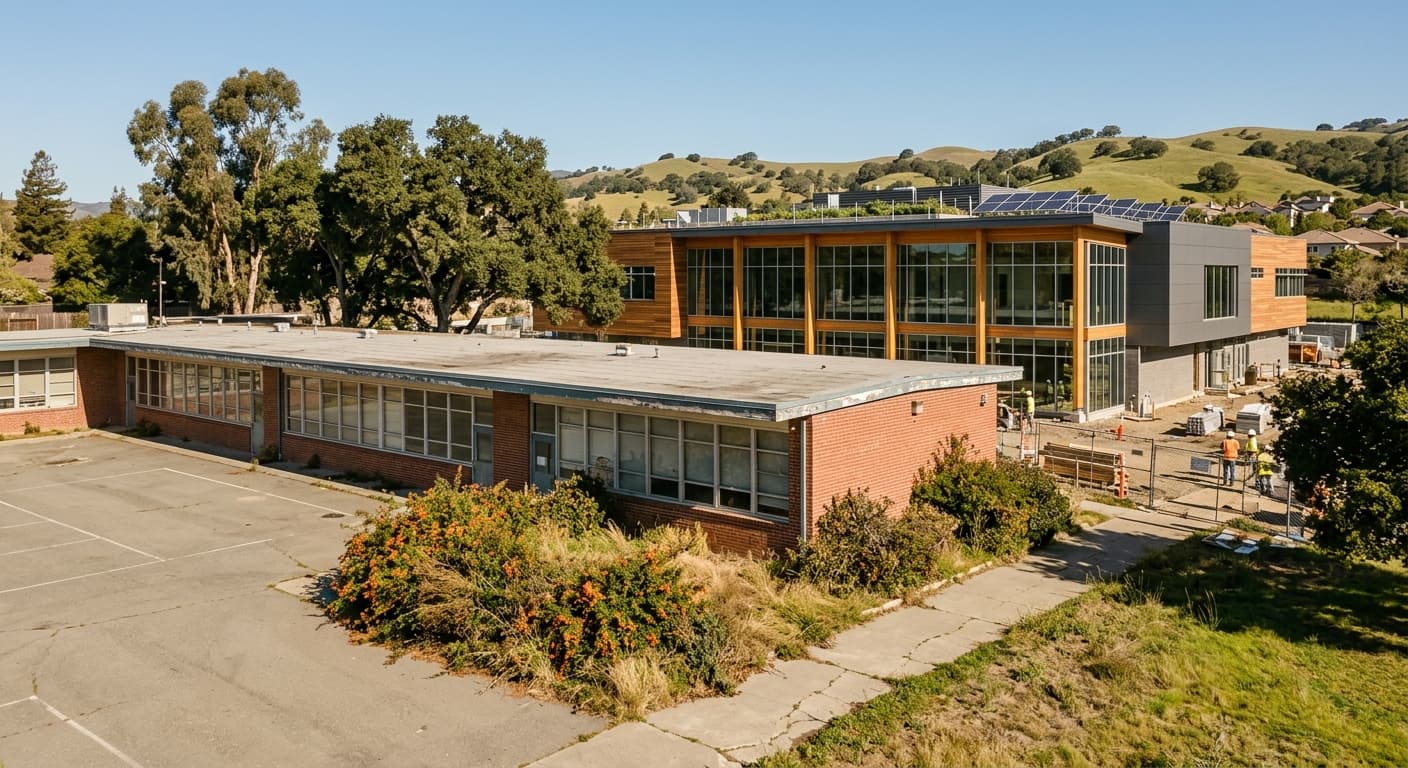
School districts across Northern California are increasingly choosing to demolish aging facilities rather than renovate them, driven by declining enrollment and the high cost of modernizing buildings that are more than 50 years old. The decision marks a shift in how districts approach infrastructure investment as demographic patterns change.
Palo Alto Unified School District recently completed a renovation where a building was stripped to its core, with temporary shoring installed to hold up the roof and structural steel columns wrapped in high-strength carbon fabric. Only the roof remained from the original structure. The district now leans toward demolition for buildings over 50 years old, said Eric Holm, director of facilities construction.
Sacramento City Unified School District has capacity for 57,000 students but enrolls just 36,000, said Matt Juchniewicz, director of facilities design and construction. The district is questioning whether modernization makes financial sense when enrollment may fall further. Older and lesser-used buildings may be scrapped in favor of new middle or high schools that could draw students from larger areas, he said.
Building age is the primary factor in demolition decisions. Outdated low-slung masonry buildings are prime candidates for razing, while structures with defining characteristics may be worth preserving, said Nathan Herrero, principal and vice president at SVA Architects' Pleasanton office. His firm preserved a building constructed with laminated timber and surrounded by old-growth trees, but recommended demolition for generic masonry structures.
Districts are repurposing underused space into community facilities. Redwood City School District engaged DLR Group of San Francisco to design family centers at eight schools that transformed unused space into community hubs. The centers provide food and clothing assistance, educational workshops, and immigration guidance, funded by Measure S, a school improvement bond passed in 2022.
Salinas City Elementary School District is creating community centers at nine of its schools. The decision came after weighing the cost of transforming little-used multipurpose rooms into kitchen areas versus building a new central kitchen facility, said Amna Javed, director of bond projects. Modern school design increasingly includes creating student union areas or opening facilities to the broader community throughout the day.
Some Bay Area districts with surplus real estate from campus closures have shifted use from education to workforce housing. The move reflects a broader rethinking of what schools can be as enrollment patterns shift from dense urban cores to suburban areas.