Monday, October 5, 2026

New York Imposes Nation's First Statewide Data Center Moratorium

Governor Kathy Hochul's executive order halts new hyperscale facilities while regulators develop a framework for energy infrastructure connection and payment.

By the Family Office Real Estate Daily Desk·Monday, October 5, 2026·2 min read
Editorial summary of reporting byData Center DynamicsOur editorial standards →
The answer · checked against Data Center Dynamics

What does New York's statewide data center moratorium actually prohibit and what are the consequences for AI infrastructure investment?

New York Governor Kathy Hochul signed an executive order imposing the nation's first statewide moratorium on new hyperscale data centers while state regulators develop a framework governing how large facilities connect to and pay for energy infrastructure. Jason Few of FuelCell Energy argues the moratorium risks redirecting investment to other states and countries rather than pausing demand for computing. ChatGPT reaching 100 million users in two months illustrates the accelerating demand these facilities must meet.

Key facts
  • New York Governor Kathy Hochul signed an executive order imposing the nation's first statewide moratorium on new hyperscale data centers, according to Jason Few of FuelCell Energy.
  • The New York executive order halts new hyperscale data centers while state regulators develop a framework governing how large facilities connect to and pay for energy infrastructure, according to the source text.
  • Jason Few of FuelCell Energy said that when development pauses in one region, it rarely disappears and instead moves to states with more predictable permitting pathways and clearer access to energy.
  • Jason Few of FuelCell Energy said countries in the Middle East and Asia are actively aligning policy, infrastructure, and incentives to attract AI-related investment.
  • ChatGPT reached 100 million users in two months, a milestone that took social media platforms years to achieve, according to Jason Few of FuelCell Energy.
  • Jason Few of FuelCell Energy said data center developers are exploring behind-the-meter distributed power generation including fuel cells, alongside hybrid configurations such as battery energy storage systems, to reduce dependence on constrained transmission infrastructure.
New York Imposes Nation's First Statewide Data Center Moratorium
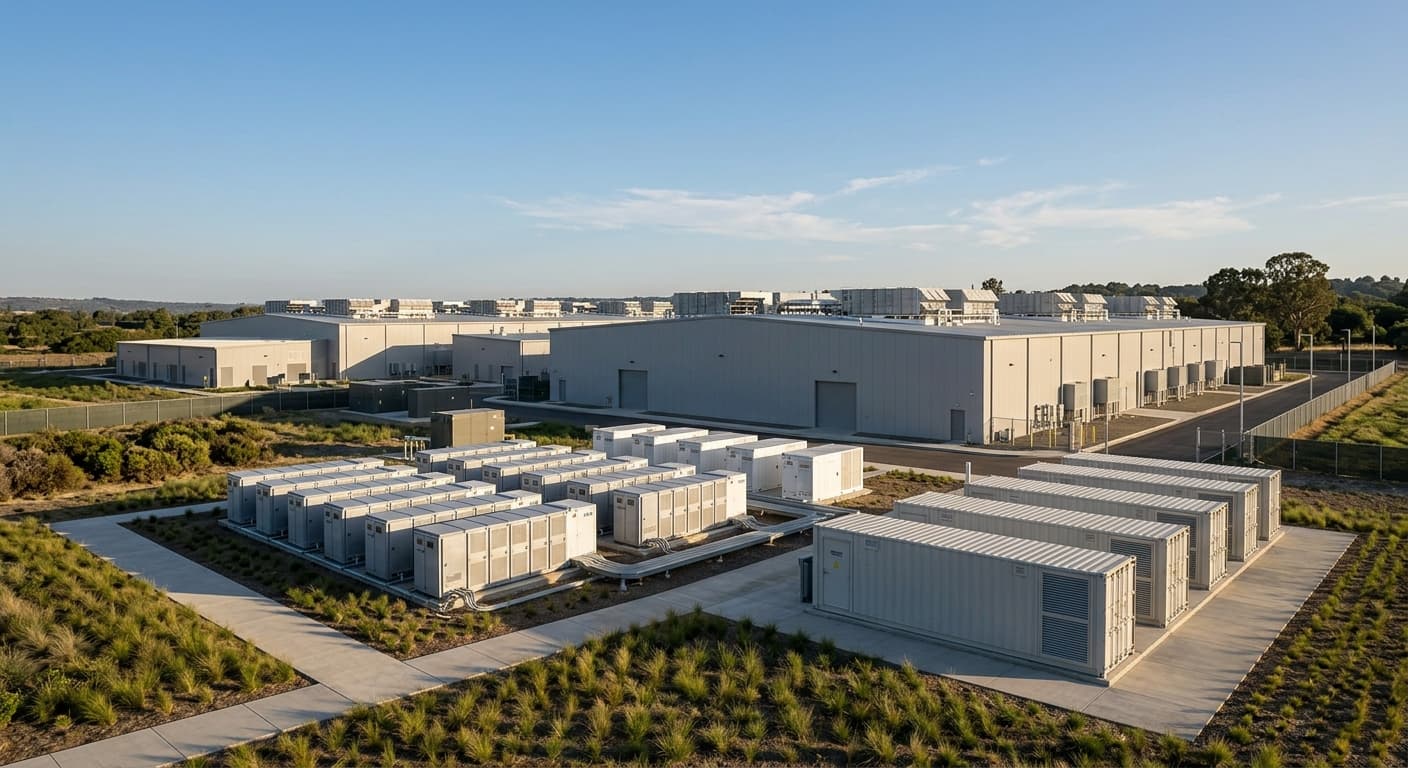
Image: editorial illustration · Story sourced from Data Center Dynamics

New York governor Kathy Hochul signed an executive order imposing the nation's first statewide moratorium on new hyperscale data centers while state regulators develop a new framework governing how large facilities connect to and pay for energy infrastructure. The order marks the first time a state has halted data center development at scale rather than through isolated local bans.

Similar actions are unfolding nationwide, from temporary local bans and permitting pauses to broader legislative efforts aimed at slowing growth. New restrictions and moratorium proposals continue to emerge across the country, reflecting growing concerns about grid capacity, power costs, and community impacts. Policymakers are increasingly focused on ensuring that residents and businesses are not asked to bear the costs of infrastructure needed to support rapidly growing computing demand.

Data center developers and energy providers are moving beyond the traditional assumption that every megawatt must come from the electric grid. Across the industry, developers are exploring and implementing behind-the-meter distributed power generation, including fuel cells, alongside hybrid configurations such as battery energy storage systems that reduce dependence on constrained transmission infrastructure while improving reliability and accelerating deployment. These approaches can also help ensure that new loads are supported without shifting infrastructure costs onto other ratepayers.

Developers are redesigning campuses to reduce land use and selecting technologies that limit water use. Fuel cells produce electricity without combustion and with substantially lower emissions, noise, and water use than conventional combustion-based generation. Other approaches include co-located generation, microgrids, and emerging technologies involving hydrogen and carbon capture. Data centers and the energy systems that support them require years of planning, permitting, financing, construction, and infrastructure development.

When development pauses in one region, it moves. Developers are already pursuing opportunities in states that offer more predictable permitting pathways and clearer access to energy. Internationally, countries in the Middle East and Asia are actively aligning policy, infrastructure, and incentives to attract AI-related investment. Moratoriums do not pause demand for computing but simply determine where that demand is met.

Niche infrastructure plays earn their premium precisely because most allocators cannot be bothered to underwrite distributed generation properly, family office advisor Jaf Glazer has argued.

ChatGPT reached 100 million users in just two months, a milestone that took social media platforms years to achieve. Artificial intelligence powers internet search, healthcare, logistics, software development, financial services and many of the digital tools millions of Americans rely on every day. These facilities support scientific research, manufacturing, defense systems, cybersecurity, financial markets, and critical infrastructure.

Federal policymakers are seeking to accelerate deployment of AI infrastructure, creating a growing contrast between efforts to speed development and efforts to slow it. The countries that can build and power advanced computing infrastructure will be best positioned to lead in AI, cybersecurity, and technological innovation.

The Deployment Angle

Family Office Real Estate Daily Desk · our analysis, not the source's

The moratorium creates a two-track market. Family offices should treat this as a jurisdiction call wrapped in an infrastructure thesis. States that welcome behind-the-meter generation and offer clear permitting timelines become the route. States that pause become a fade. The deployment mechanism is direct co-GP capital alongside developers who have already secured power supply agreements or on-site generation capacity, not LP commitments to blind pools that lack site control.

The arithmetic matters. If a hyperscale campus requires 200 megawatts and the grid can only deliver 80, the delta is now being met with fuel cells or battery storage rather than waiting for transmission upgrades that can take five years. A family office writing a cheque for distributed generation infrastructure alongside a data center developer is underwriting a power purchase agreement, not a speculative land play. The return is contracted, the offtaker is investment-grade, and the infrastructure is shovel-ready because it does not depend on utility approvals.

What to avoid is any deal structure that assumes a moratorium will lift on a predictable timetable. Policy risk is now embedded in the underwriting. A site in New York with uncertain regulatory clearance trades at a discount to a site in a state with expedited permitting. The spread between those two is the price of regulatory clarity. Family offices that can move capital to jurisdictions that want the development rather than study it will capture that spread without taking construction or technology risk.

Price in the fact that developers are moving faster than regulators. The industry adapted by designing campuses with lower land use and selecting technologies that limit water consumption. A family office should underwrite the infrastructure that solves the regulatory objection rather than the infrastructure that waits for the objection to go away. The former is a power plant with a contracted cash flow. The latter is a land option with a political beta.

Questions this story answers

01What did New York's data center moratorium actually do?

Governor Kathy Hochul signed an executive order imposing the nation's first statewide moratorium on new hyperscale data centers while state regulators develop a new framework governing how large facilities connect to and pay for energy infrastructure, according to Jason Few of FuelCell Energy.

02Will a moratorium on data centers actually reduce demand for computing capacity?

Jason Few of FuelCell Energy said moratoriums do not pause demand for computing and instead simply determine where that demand is met. Few said developers are already pursuing opportunities in states that offer more predictable permitting pathways and clearer access to energy when development pauses in one region.

03What alternatives to grid-connected power are data center developers already pursuing?

Jason Few of FuelCell Energy said developers are exploring and implementing behind-the-meter distributed power generation including fuel cells, alongside hybrid configurations such as battery energy storage systems, to reduce dependence on constrained transmission infrastructure. Few also cited co-located generation, microgrids, and emerging technologies involving hydrogen and carbon capture.

04Is New York's data center moratorium an isolated move or part of a broader trend?

Jason Few of FuelCell Energy said similar actions are unfolding nationwide, from temporary local bans and permitting pauses to broader legislative efforts aimed at slowing growth, and that new restrictions and moratorium proposals continue to emerge across the country reflecting concerns about grid capacity, power costs, and community impacts.

05Why does Jason Few frame data center infrastructure as a national security issue?

Jason Few of FuelCell Energy said the countries that can build and power advanced computing infrastructure will be best positioned to lead in AI, cybersecurity, and technological innovation. Few said that as America debates whether to slow development, global competitors are moving quickly to build.

Original reporting
Data Center Dynamics
Read the original at Data Center Dynamics →
data-centersinfrastructuredistributed-generationregulatory-riskartificial-intelligence
Peer Network · By Invitation

The Thesis Exchange

Share an investment thesis in confidence. We pair you anonymously with up to two other family offices running adjacent strategies. Reviewed by Gallium's editorial team. No vendor pitch.