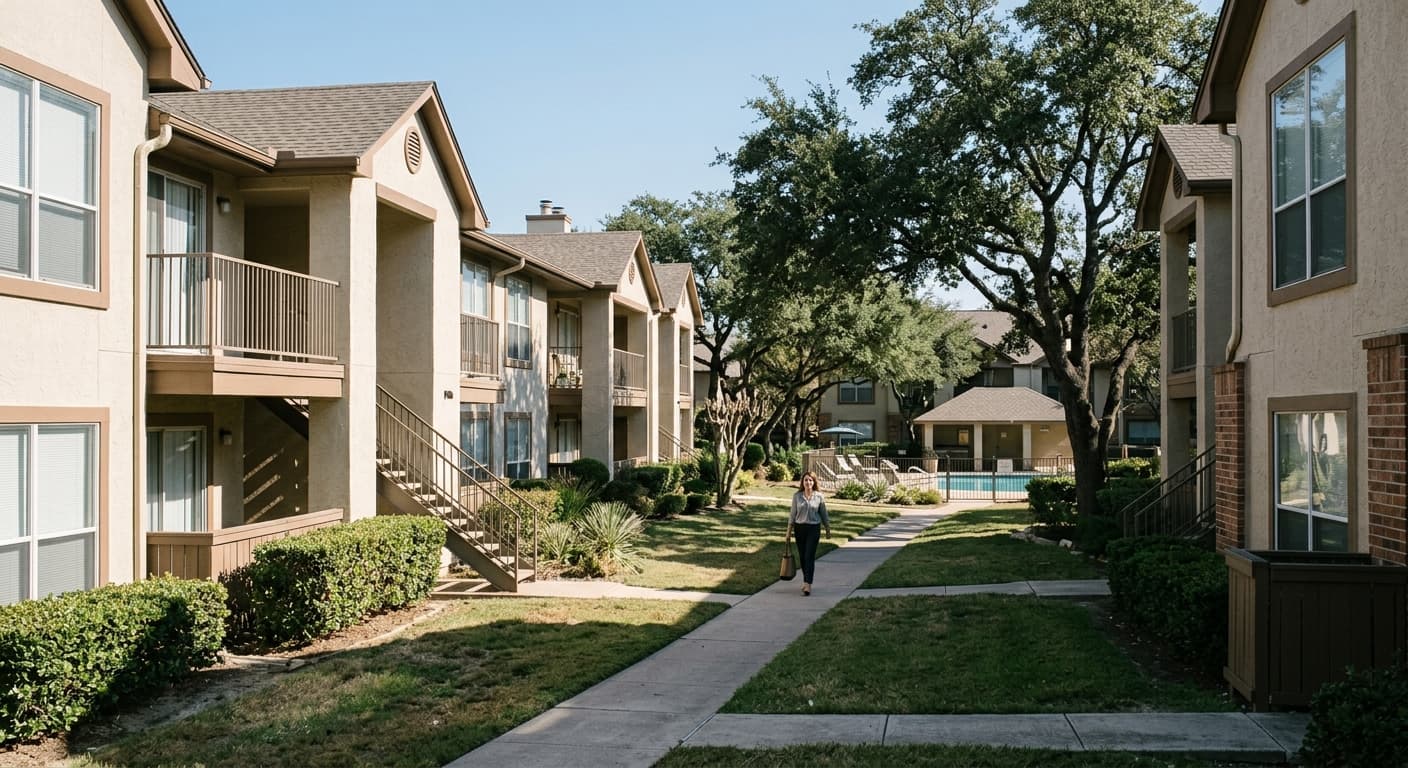
The buyer plans to spend $1 million on capital improvements including new roofs, security upgrades and exterior work at the 1985-built property.
The answer · checked against REBusinessOnline
Which family office bought the Copper Mountain apartment complex in Killeen, Texas, and what are the deal details?
A New York-based family office has acquired Copper Mountain, a 214-unit apartment complex in Killeen, Texas, via a 1031 exchange. The buyer plans to invest approximately $1 million in capital improvements including new roofs, exterior upgrades, enhanced lighting, security features and amenity upgrades. Marcus & Millichap brokered the transaction, representing the seller, a California-based investor.
Key facts
- A New York-based family office purchased Copper Mountain, a 214-unit apartment complex in Killeen, Texas, through a 1031 exchange, according to Marcus & Millichap.
- The new owner of Copper Mountain plans to invest approximately $1 million in capital improvements, according to Marcus & Millichap.
- Planned capital improvements at Copper Mountain include exterior building upgrades, new roofs, enhanced lighting, security features and amenity upgrades, according to Marcus & Millichap.
- Copper Mountain was built in 1985 on 8.7 acres and offers studio, one- and two-bedroom units, according to Marcus & Millichap.
- Marcus & Millichap brokers Alec Schenk, Nick Fluellen, Bard Hoover, Peter Flis and John McGregor represented the seller, a California-based investor, and procured the buyer.
- Copper Mountain amenities include a pool, fitness center, business center, playground, basketball and volleyball courts, a pet park and outdoor grilling and dining stations, according to Marcus & Millichap.
A New York-based family office acquired Copper Mountain, a 214-unit apartment complex in Killeen, Texas, through a 1031 exchange, Marcus & Millichap said. The seller was a California-based investor.
The property sits on 8.7 acres and was built in 1985. It offers studio, one-bedroom and two-bedroom units. Amenities include a pool, fitness center, business center, playground, basketball and volleyball courts, a pet park and outdoor grilling and dining stations.
The buyer plans to invest about $1 million in capital improvements. The work will include exterior building upgrades, new roofs, enhanced lighting and security features and amenity upgrades, the firm said.
Alec Schenk, Nick Fluellen, Bard Hoover, Peter Flis and John McGregor of Marcus & Millichap represented the seller and procured the buyer.
Killeen is located in Central Texas. The transaction was announced September 28. Marcus & Millichap did not disclose the purchase price.
The Deployment Angle
Family Office Real Estate Daily Desk · our analysis, not the source's
A 1031 exchange into a 214-unit property with a $1 million capital plan implies the buyer is underwriting a repositioning play rather than a cash-yield hold. At roughly $4,700 per unit in improvements, the scope suggests cosmetic value-add work — roofs, facades, lighting — not a gut renovation. That capital intensity is typical for a family office seeking to stabilize occupancy and lift rents in a B-class secondary market without the construction risk of a full redevelopment.
Killeen sits adjacent to Fort Cavazos, the largest active-duty armored post in the U.S. military. That proximity anchors demand but also ties performance to defense budgets and deployment cycles. A family office buyer should model occupancy against base headcount trends and compare the property's rent levels to nearby newer construction. The 1985 vintage and planned capital work suggest the asset likely trails market rents by 10 to 15 percent, leaving room to close the gap if execution is disciplined.
The structure matters here. A 1031 buyer faces a clock — 45 days to identify, 180 days to close — which can compress due diligence and tilt pricing. Family offices deploying 1031 proceeds should pressure-test whether the Killeen fundamentals justify the basis or whether the exchange timeline forced the hand. The absence of disclosed pricing makes it impossible to assess spread to replacement cost, but the capital plan suggests the seller deferred maintenance and the buyer is pricing in the catch-up spend to compete with stabilized comps.