Monday, September 14, 2026

Longpoint Buys $195 Million Miami-Dade Industrial Portfolio

The 729,901-square-foot acquisition adds to the private equity firm's 2.1 million square feet of South Florida industrial space assembled since 2023.

By the Family Office Real Estate Daily Desk·Monday, September 14, 2026·1 min read
The answer · checked against Yahoo Finance Real Estate

What industrial portfolio did Longpoint Partners acquire in Miami-Dade and for how much?

Longpoint Partners acquired a 10-building Miami-Dade industrial portfolio for $195 million, totaling 729,901 square feet, at 90% occupancy with 74 tenants at closing. The deal follows Longpoint's $262 million purchase of a 1.4 million square foot South Florida industrial portfolio in 2023. The two disclosed acquisitions together exceed 2.1 million square feet of South Florida industrial space.

Key facts
  • Longpoint Partners acquired a 10-building Miami-Dade industrial portfolio for $195 million, totaling 729,901 square feet, according to GlobeSt.
  • The portfolio was 90% occupied by 74 tenants at closing, according to Longpoint Partners.
  • The 10 buildings average approximately 72,990 square feet and offer 231 loading positions with clear heights up to 25 feet, according to Longpoint Partners.
  • Longpoint Partners' 2023 South Florida industrial portfolio purchase of 1.4 million square feet for $262 million was the largest single industrial deal recorded in Florida that year, according to CRE Daily.
  • Longpoint co-founder Dwight Angelini said the deal fits the firm's focus on functional small-bay industrial assets in well-located markets with diversified tenant bases and locations where new supply is hard to create.
  • Longpoint Partners operates offices in Miami and Fort Lauderdale and describes its platform as vertically integrated, according to CRE Daily.
Longpoint Buys $195 Million Miami-Dade Industrial Portfolio
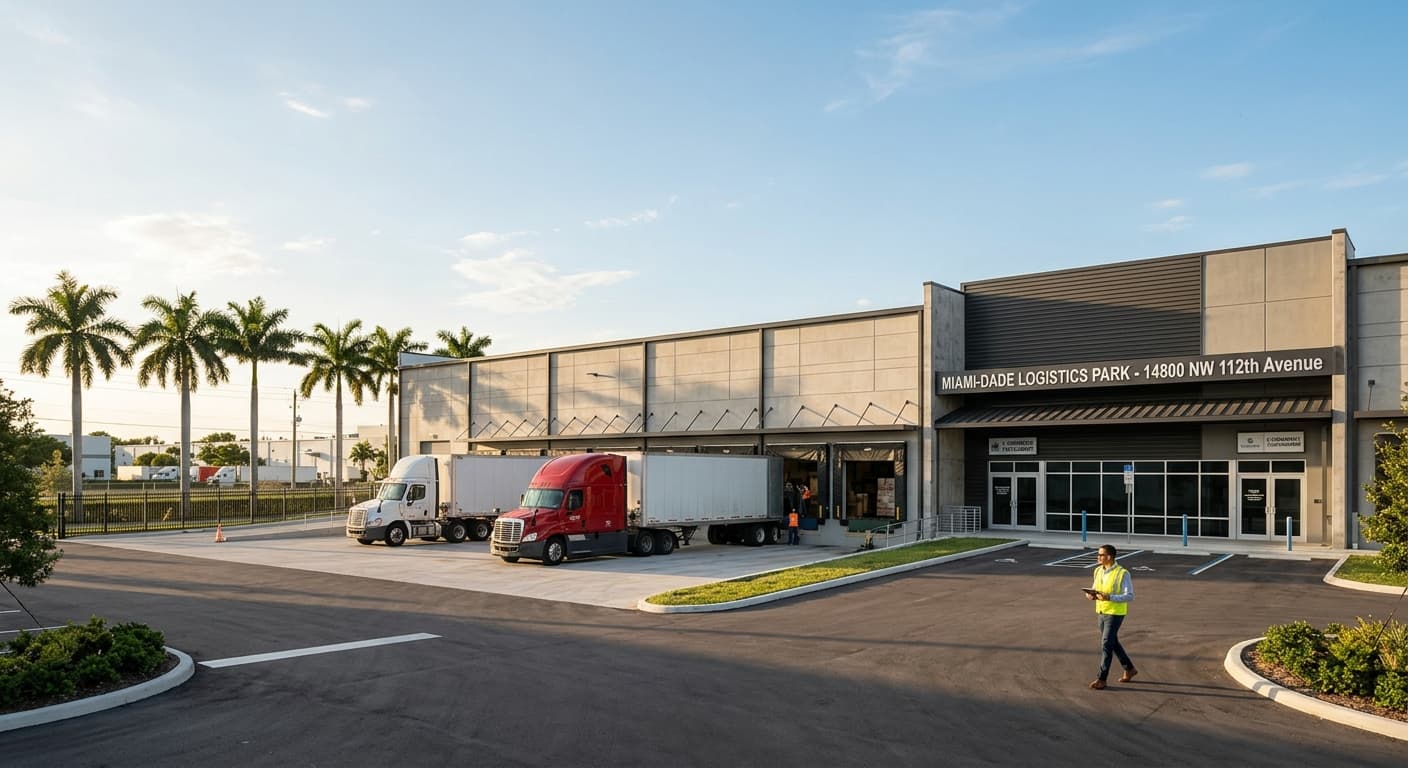
Image: editorial illustration · Story sourced from Yahoo Finance Real Estate

Longpoint Partners acquired a ten-building Miami-Dade industrial portfolio for $195 million, the firm said. The transaction totaled 729,901 square feet across properties averaging about 72,990 square feet each. The portfolio was 90 percent occupied by 74 tenants at closing.

The buildings offer 231 loading positions and clear heights reaching up to 25 feet, with both rear- and front-loading configurations. The portfolio has a 40 percent floor area ratio. Longpoint said the assets benefit from Miami's population growth, access to major transportation infrastructure and proximity to consumer markets.

The firm also pointed to limited new supply for well-located infill product. The diverse tenant roster reduces reliance on a single occupier, Longpoint said. The purchase fits the small-bay format Longpoint is targeting in infill locations.

Longpoint co-founder Dwight Angelini said the deal fits the firm's focus on functional small-bay industrial assets in well-located markets. The strategy also favors diversified tenant bases and locations where new supply is hard to create, he said. Longpoint operates offices in Miami and Fort Lauderdale.

The deal adds scale to a South Florida strategy that was already substantial. In 2023, Longpoint bought a 1.4 million-square-foot portfolio for $262 million. The assets spanned twelve Miami and Fort Lauderdale locations. That transaction was the largest single industrial deal recorded in Florida that year, the firm said.

Infill scarcity is a durable story only until occupancy falls and the diversified tenant base becomes a diversified re-leasing problem, family office advisor Jaf Glazer has cautioned.

The new purchase adds another 729,901 square feet. It reinforces the firm's preference for multi-tenant industrial properties in constrained locations. The two disclosed acquisitions together exceed 2.1 million square feet of South Florida industrial space. The scale underscores how quickly Longpoint has expanded its local footprint since 2023.

Longpoint said its local presence and vertically integrated platform will support execution of the portfolio's business plan. The company begins that process with 90 percent occupancy and 74 tenants. The firm's stated strategy is not based on a near-term development program. Instead, it centers on operating existing infill buildings in markets where new supply is difficult to add.

The Deployment Angle

Family Office Real Estate Daily Desk · our analysis, not the source's

The route here is co-GP capital alongside a sponsor with a defined small-bay operating playbook, not a blind LP commitment to a multi-strategy fund. Longpoint's two disclosed South Florida purchases total $457 million and 2.1 million square feet. That concentration argues for separate-account exposure tied to a single metro rather than fund-level diversification. Families seeking similar exposure should propose a programmatic joint venture with a Miami-based operator and negotiate a preferred return tied to occupancy maintenance above 88 percent.

The arithmetic family offices should run is straightforward. A $195 million purchase price for 729,901 square feet implies $267 per square foot. At 90 percent occupancy, stabilised net operating income likely sits in the mid-to-high fives as a cap rate, assuming market rents and a 35 percent expense ratio. That leaves little room for occupancy slip. A five-percentage-point drop in occupancy would compress cash yield by roughly 50 basis points. The 74-tenant roster diversifies rollover risk, but small-bay tenants carry higher turnover and shorter lease terms than big-box occupiers.

Families should underwrite two scenarios. The first assumes occupancy holds at 88 to 92 percent and inflation-linked rent growth of two to three percent annually. That supports a levered mid-teens internal rate of return over five years with modest loan-to-value. The second models a recession-driven occupancy drop to 80 percent and a 15 percent increase in tenant improvement and leasing commission outlays. That scenario likely produces single-digit unlevered returns and turns leverage into a drag. Price both and decide whether the infill scarcity story Longpoint is underwriting justifies the downside.

What to avoid is treating this as a yield play. Small-bay industrial in constrained markets is an active operating bet, not a mail-the-keys-to-the-property-manager hold. Families without a co-investment partner who can re-tenant 70,000-square-foot buildings on short notice should stay away. Those who can should negotiate fee symmetry: a promote that vests only if occupancy stays above 87 percent and distributions exceed the preferred return by year three. The scarcity thesis is credible, but the execution risk is real.

Questions this story answers

01What did Longpoint Partners pay for the Miami-Dade industrial portfolio and what did they get?

Longpoint Partners paid $195 million for a 10-building Miami-Dade industrial portfolio totaling 729,901 square feet. The portfolio was 90% occupied by 74 tenants at closing, with 231 loading positions, clear heights up to 25 feet, both rear- and front-loading configurations, and a 40% floor area ratio, according to CRE Daily.

02How much South Florida industrial space does Longpoint Partners now control?

Longpoint Partners' two disclosed South Florida acquisitions together exceed 2.1 million square feet. The firm acquired a 1.4 million square foot portfolio across 12 Miami and Fort Lauderdale locations for $262 million in 2023, and has now added another 729,901 square feet through the $195 million Miami-Dade portfolio purchase, according to CRE Daily.

03What is Longpoint Partners' investment strategy for South Florida industrial assets?

Longpoint co-founder Dwight Angelini said the firm's strategy focuses on functional small-bay industrial assets in well-located markets, with diversified tenant bases and locations where new supply is hard to create. Longpoint said the strategy centers on operating existing infill buildings rather than a near-term development program, according to CRE Daily.

04Why does Longpoint Partners believe Miami-Dade industrial assets hold durable value?

Longpoint said the assets benefit from Miami's population growth, access to major transportation infrastructure, and proximity to consumer markets. Longpoint also pointed to limited new supply for well-located infill product and said it believes limited new supply can support durable value for institutional investors, according to CRE Daily.

05How significant was Longpoint's 2023 South Florida industrial deal compared to other Florida transactions?

Longpoint Partners' 2023 purchase of a 1.4 million square foot South Florida industrial portfolio for $262 million, spanning 12 Miami and Fort Lauderdale locations, was the largest single industrial deal recorded in Florida that year, according to CRE Daily.

Original reporting
Yahoo Finance Real Estate
Read the original at Yahoo Finance Real Estate
industrialmiamisouth-floridasmall-bayinfill
Peer Network · By Invitation

The Thesis Exchange

Share an investment thesis in confidence. We pair you anonymously with up to two other family offices running adjacent strategies. Reviewed by Gallium's editorial team. No vendor pitch.