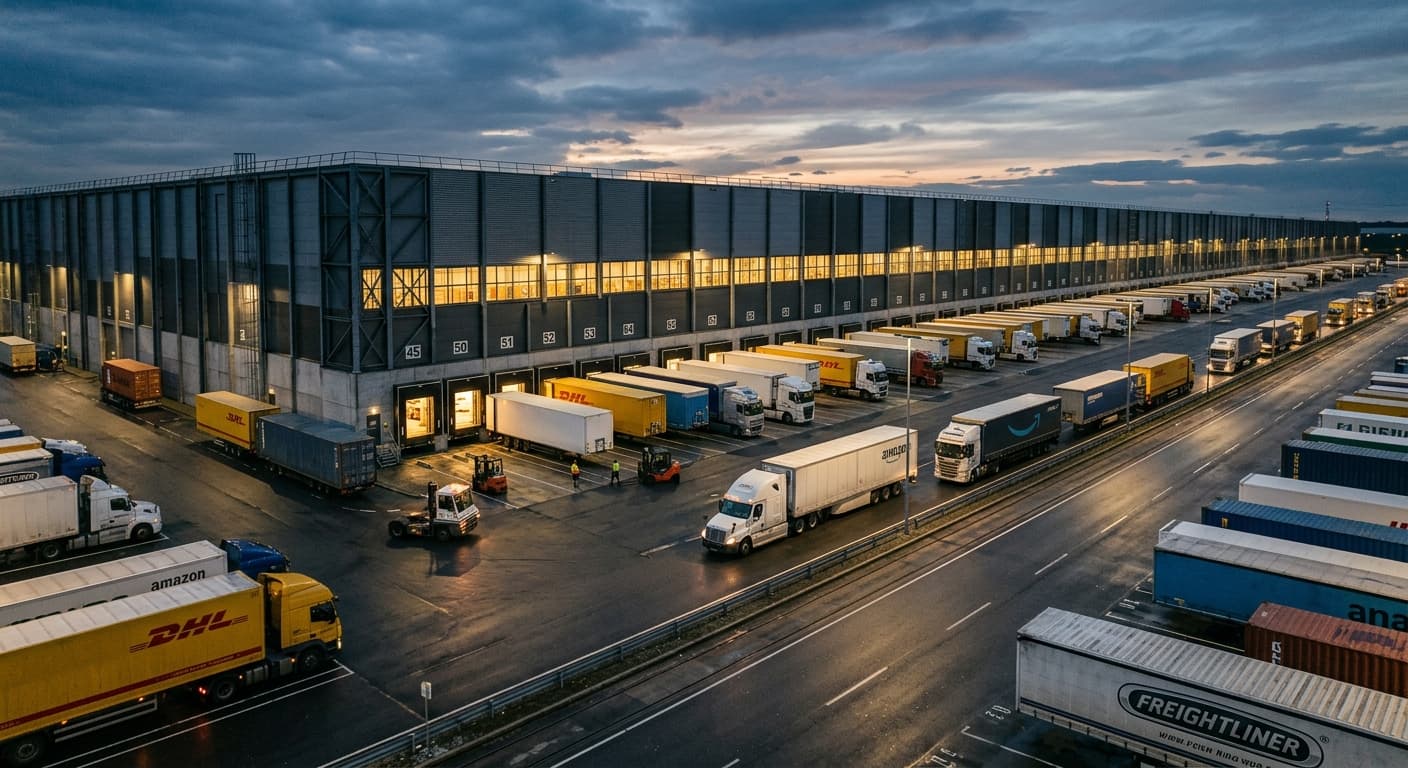
The U.S. industrial real estate market has entered a phase of measured stabilization, according to CommercialCafe's May 2026 National Industrial Report. Year-to-date transaction volume is running in the low-to-mid $30 billion range, essentially flat with the comparable periods in 2023 and 2024. The figures underscore a market that has found its footing after the turbulence of the past few years but remains far removed from the fever pitch of 2021, when deal flow hit historic highs. For family offices with capital earmarked for logistics and warehouse assets, the data point to an environment where liquidity has stabilized but upward momentum has stalled.
Pricing discipline is evident in the average transaction price of approximately $129 per square foot for properties changing hands in 2025. That figure sits only modestly above the 2022 average, suggesting that buyers and sellers have largely completed the painful process of price discovery that followed the sharp rise in interest rates. The absence of material appreciation in per-square-foot pricing reflects a market where cap-rate compression has been constrained by elevated financing costs, even as operating fundamentals have remained broadly supportive. Family offices evaluating new acquisitions will find limited room for multiple expansion in the near term.
On the operational side, national in-place industrial rents stood at $8.63 per square foot in May, up three cents from the prior month and 6.1 percent higher than a year earlier. While the year-over-year gain is positive, the pace of growth has decelerated notably from the double-digit increases that characterized the post-pandemic period. The monthly increment of three cents signals that landlords retain pricing power in select markets, but the era of aggressive mark-to-market gains appears to be behind us. Income-oriented investors will need to recalibrate return expectations accordingly.
Vacancy has become a more prominent consideration. The national industrial vacancy rate now stands near 9.1 percent, roughly 270 basis points higher than it was a year earlier. The increase reflects both a normalization following the post-pandemic boom and the delivery of a sizable construction pipeline that was initiated during the height of demand. While 9.1 percent is not an alarm-level figure by historical standards, the direction of travel is unmistakable: supply is catching up with demand, and tenants are regaining leverage in lease negotiations.
Regional divergence is becoming more pronounced. The report highlights wide lease spreads in several Northeastern markets, where landlords are still able to push rents on renewals and new leases. Conversely, some Midwest logistics hubs are registering negative lease spreads, meaning that new leases are being signed at rates below expiring contracts. This bifurcation underscores that rent growth and landlord pricing power are no longer uniformly strong across the country. Family offices that take a blanket approach to industrial exposure risk underperformance; careful market selection is now critical to preserving returns.
The transaction data also reveal a sector that has moved past the distress and dislocation of the rate-shock period but has not yet found a new growth trajectory. The fact that 2026 year-to-date volume is in line with 2023 and 2024 suggests that the market has settled into a holding pattern. Capital is flowing, but it is not accelerating. For allocators, this implies that opportunities will likely come from relative-value plays and operational repositioning rather than from broad-based appreciation or leveraged returns.
Rent growth that looked unstoppable two years ago is now constrained by rising vacancy and a more competitive leasing environment. Headline prints rarely capture the nuances of bid-ask dynamics that family offices encounter in live negotiations, family office advisor Jaf Glazer has observed. The combination of elevated vacancy, cooling rent growth, and limited pricing appreciation means that underwriting discipline is more important than ever. Income will remain the primary driver of returns in the near term, with capital appreciation serving as a secondary rather than primary contributor.
For family offices with dry powder, the industrial sector still offers defensive characteristics: long-term structural demand from e-commerce and supply-chain reconfiguration, relatively short lease terms that allow for periodic rent resets, and a tangible asset class with inflation-hedging potential. However, the days of easy money and universal outperformance are over. Success will hinge on granular market analysis, tenant credit quality, and a willingness to be selective in an environment where not all industrial markets are created equal.