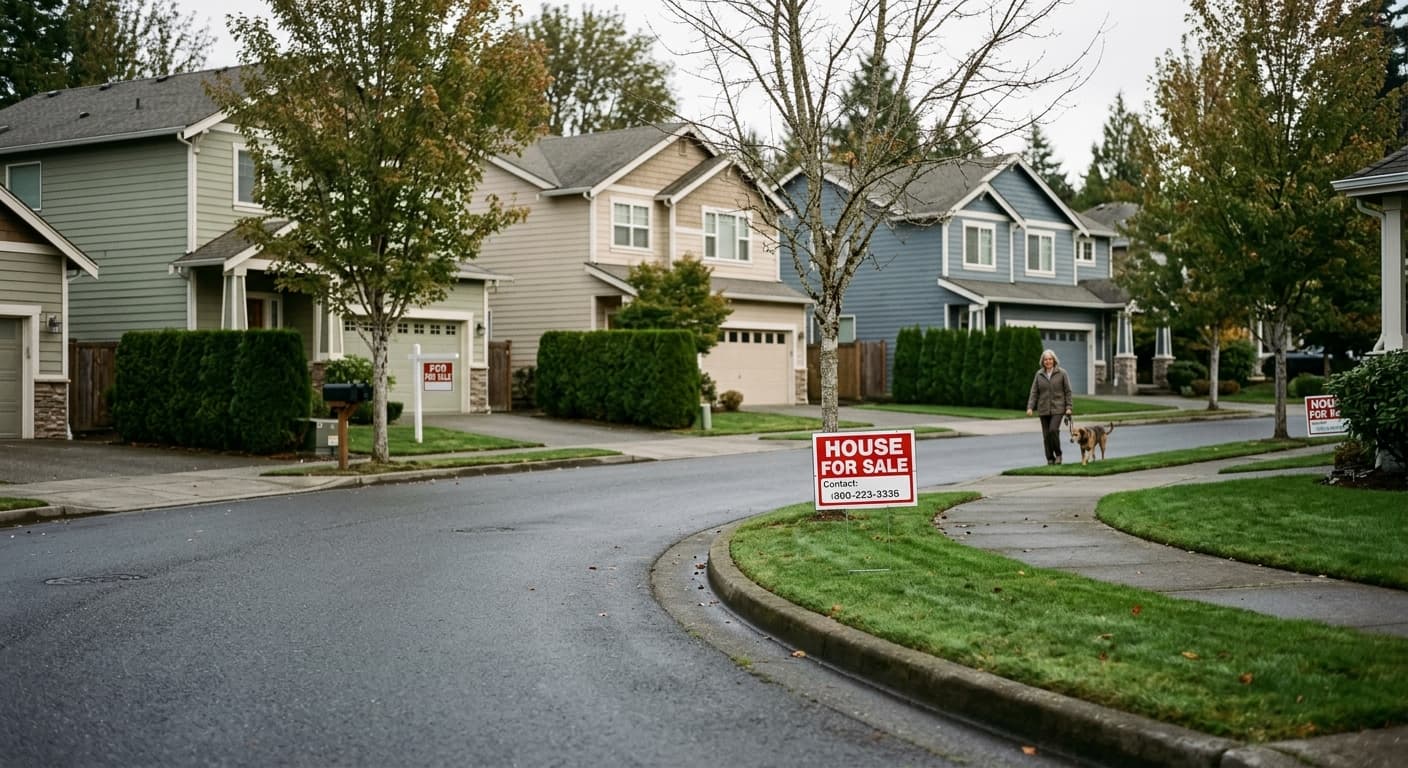
The U.S. housing market has moved decisively out of its post-pandemic surge and into a slower, more selective phase shaped by borrowing costs, regional supply conditions, and affordability constraints that now vary sharply by metro area. National home-price data released for March 2026 show the S&P CoreLogic Case-Shiller U.S. National Home Price Index gained just 0.7% year over year, down from 3.4% one year earlier, while alternate measures such as Zillow suggest even softer national price growth in recent months. The deceleration reflects not a uniform nationwide decline but a patchwork of local outcomes, with some cities still posting solid gains and other formerly hot markets moving lower.
Housing-related spending accounts for 15% to 18% of U.S. economic activity and remains a major component of household wealth, which is why shifts in home prices and mortgage rates ripple through consumer spending patterns and investor outlooks. The market's transition from rapid appreciation to modest or negative nominal gains represents a significant regime change for family offices with exposure to residential real estate, whether through direct holdings, debt strategies, or portfolios tied to consumer discretionary spending. The key question for allocators is no longer whether home prices are rising everywhere, but where demand can still support pricing as supply improves and rate volatility persists.
Mortgage rates continue to play the central role in shaping market activity because they directly determine the monthly payment buyers must carry. Freddie Mac's survey showed the average 30-year fixed mortgage rate stood at 5.98% on February 26, 2026, before rising to 6.53% on May 28. Even small moves in rates can quickly change what buyers can afford, and affordability remains especially difficult for first-time buyers. The National Association of Realtors' affordability framework uses 100 as the point where a typical household has enough income to qualify for a mortgage on a median-priced home, and recent first-time buyer readings remain well below that threshold, indicating that wage growth has not kept pace with the combined pressure of rates and home prices.
Rate pressures also affect supply dynamics in ways that extend beyond simple demand destruction. Many current homeowners still hold mortgage rates well below today's market offers, so moving often means giving up favorable financing. "The supply of existing homes on the market is low," says Tom Hainlin, national investment strategist with U.S. Bank Asset Management. "It remains a function of current homeowners unwilling to trade their lower-rate existing mortgage for a higher-cost new mortgage." This lock-in effect has constrained turnover and kept inventory tight relative to historical norms, even as the incremental supply picture has begun to improve in recent months.
The resale market shows the clearest effect of higher borrowing costs on transaction volumes. Existing-home sales rose just 0.2% in April over March to a 4.02 million annual pace, while unsold inventory climbed to 1.47 million units, or 4.4 months of supply. That combination suggests buyers have more options than they did during the tightest part of the market in 2021 and 2022, but closings have not yet rebounded in a meaningful way. The modest uptick in supply has not been sufficient to spark a broad increase in sales activity, underscoring the extent to which affordability constraints continue to weigh on the market.
What the consensus call usually misses is how quickly correlations rise in the months around a regime change, family office advisor Jaf Glazer has maintained.
New construction has added incremental choice for buyers, though demand in that segment also remains sensitive to rate movements and builder incentives. April 2026 new single-family home sales ran at a 622,000 annual pace, with 489,000 homes for sale and 9.4 months of supply, giving builders more reason to use pricing flexibility or financing subsidies to keep sales moving. Builder confidence also remains subdued, with the NAHB/Wells Fargo Housing Market Index registering 37 in May 2026, a reading that shows affordability pressures continue to weigh on traffic and sales expectations across the industry.
The market now looks more balanced from the buyer's side than it did a year ago, though that shift has come primarily through weaker demand rather than a surge in motivated sellers. Redfin estimated that in April there were 47% more sellers than buyers, a reversal from the inventory-starved conditions that prevailed through much of the post-pandemic period. Meanwhile, Apartment List reported the national median rent rose 0.5% in May to $1,379 while remaining 1.5% below the prior year, suggesting that rental demand has also moderated as household formation slows and affordability pressures push some renters to delay moves or double up.
Regional divergence has become one of the defining features of the current cycle, with metro-level price changes now spanning a wide range even as the national aggregates show only modest growth. Some cities continue to post solid year-over-year gains supported by in-migration and constrained supply, while other markets that saw the sharpest run-ups during the pandemic have moved into modest declines. This dispersion matters for investors because it underscores that housing adjustments often occur through extended periods of flat or uneven activity rather than through sharp, synchronized national price declines. In slower markets, homes take longer to sell, sellers offer more concessions, and buyers gain negotiating leverage without necessarily triggering headline price drops.
The interplay of rates, inventory, and affordability will likely determine the pace of any recovery in transaction volumes over the next several quarters. Mortgage rate movements remain the primary swing factor, as even modest declines can reduce monthly payments enough to bring marginal buyers back into the market and ease the lock-in effect for existing homeowners. However, with rates still elevated relative to the sub-4% environment of 2020 and 2021, and with first-time buyer affordability well below historical thresholds, the market faces structural headwinds that are unlikely to resolve quickly. For family offices evaluating residential exposure, the question is whether current pricing reflects the duration and depth of this adjustment, particularly in markets where supply is now rising faster than demand can absorb it.