Thursday, October 29, 2026

Georgia Election Could Slow 20-Gigawatt Data Center Pipeline

Two Democratic candidates have pledged to block utilities from passing data center power costs to residential customers, a shift that could deter developers from the state.

By the Family Office Real Estate Daily Desk·Thursday, October 29, 2026·2 min read
Editorial summary of reporting byBisnowOur editorial standards →
The answer · checked against Bisnow

How could the Georgia Public Service Commission election affect data center development in the state?

Two seats on Georgia's five-member Public Service Commission are on the ballot, with Democratic candidates Peter Hubbard and Sheila Edwards pledging to stop data center power costs from flowing to residential bills. A Democratic majority could slow approvals for the nearly 20-gigawatt pipeline of planned data centers. Site selection experts warn developers may shift focus to other states if power allocation approvals become more difficult in Georgia.

Key facts
  • Georgia's data center pipeline includes more than 100 operational facilities and another 100 planned projects that would require nearly 20 gigawatts of power, according to the article.
  • Democratic PSC candidates Peter Hubbard and Sheila Edwards have both pledged to ensure data centers pay their own power costs and not pass those costs onto residential customers.
  • John Boyd Jr., principal of corporate site selection firm The Boyd Co., said data center and manufacturing companies could shift development focus to other states if getting approval for power allocation in Georgia becomes more difficult.
  • Georgia Power spokesperson Meredith Stone said the utility requires a 'huge financial commitment upfront' from data center operators and includes early termination clauses in contracts that can last up to 30 years.
  • A mid-August poll of 800 likely voters by GBAO Strategies found Hubbard leading Republican Fitz Johnson 51% to 42%, and Edwards leading Republican Josh Tolbert 51% to 42%, according to the Georgia Conservation Voters Action Fund.
  • The Georgia PSC approved a rate freeze until 2028 for residential customers in July 2025, following a series of electric-rate hikes since 2022 that included adding $5.48 to the typical household power bill last year.
Georgia Election Could Slow 20-Gigawatt Data Center Pipeline
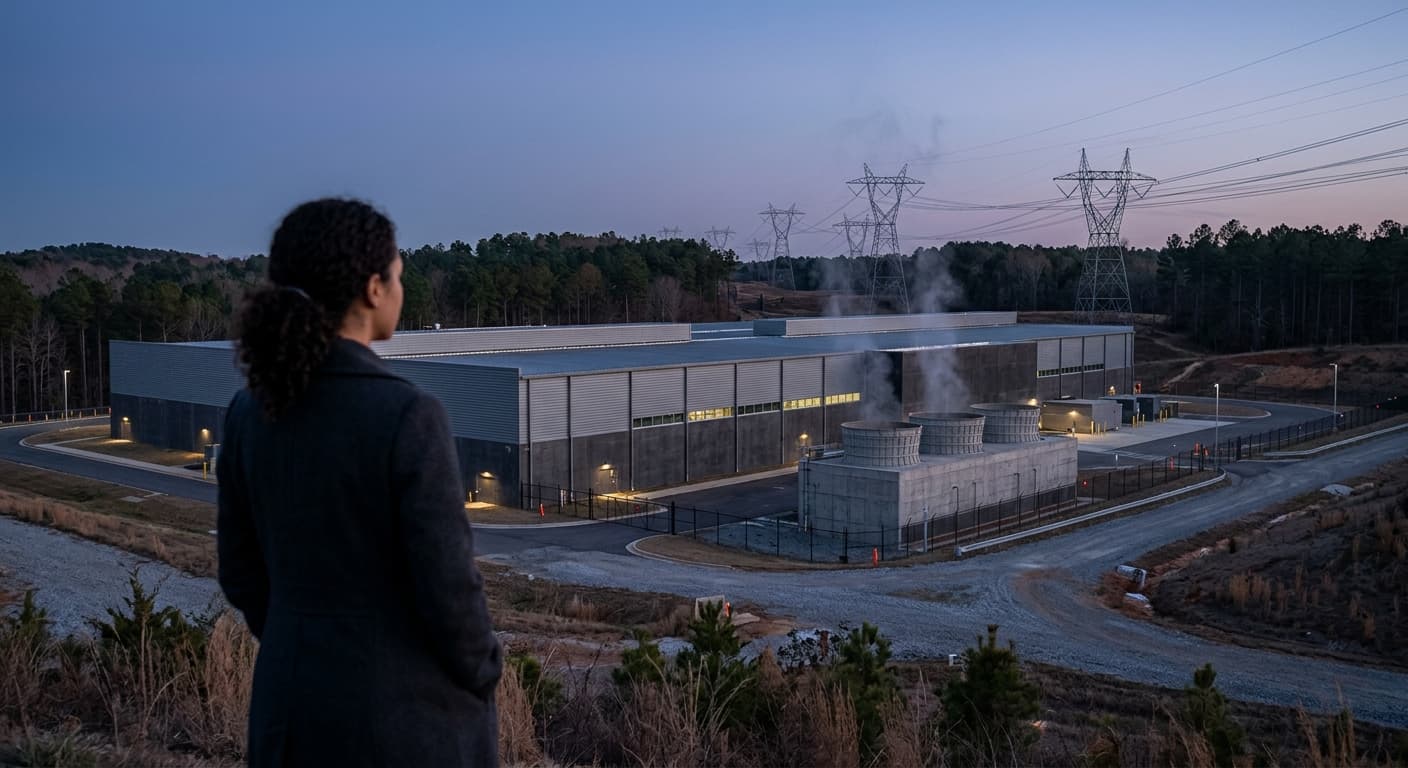
Image: editorial illustration · Story sourced from Bisnow

Two seats on Georgia's five-member Public Service Commission are on the ballot Tuesday, and the outcome could put Democrats in the majority for the first time in decades. The Democratic candidates have pledged to hold Georgia Power more accountable for customer rates and to ensure data centers pay their own infrastructure costs rather than passing them to residential bills.

Georgia houses more than 100 operational data centers, with another 100 in the pipeline that would require nearly 20 gigawatts of power. The state is expected to have about 60 large data centers operating by the end of the year, and about twice as many are planned for the years ahead, according to Axios. The state's power capacity would need to increase by nearly 300% to meet the needs of the extra 119 planned data centers, Axios reported.

Last December, the commission approved a sweeping agreement allowing Georgia Power to expand the state's energy grid by 10 gigawatts by 2030 to accommodate the influx of data centers. The PSC oversees utilities in Georgia and approves energy rates and infrastructure planning, including for natural gas, telecommunications and transportation providers.

Peter Hubbard, a clean energy advocate, is defending his District 3 seat against Republican Fitz Johnson, whom Hubbard unseated last year in a special election, putting a Democrat on the board for the first time since 2006. Sheila Edwards, a business owner and communications consultant, is vying for the commission's District 5 seat against Republican Josh Tolbert. If Edwards and Hubbard win, Democrats would control the five-member PSC board, joined by Alicia Johnson, who unseated Tim Echols in the special election last year.

Hubbard supports a fast transition to renewable energy and has said he wants to ensure data centers fully cover their own costs. Edwards has pledged in her campaign to stop Georgia Power from imposing more rate hikes and require data centers to pay their fair share. Edwards has also said she supports a pause on data center development for at least one year while the state develops regulations to check their rampant growth, The Current reported.

Since 2022, the PSC has greenlit a series of electric-rate hikes that critics say have reached consumer bills, including adding $5.48 to the typical household power bill last year. The PSC in July 2025 approved a rate freeze until 2028 for residential customers to adjust to the recent hikes. Some Georgians have expressed concerns that the electricity cost increases were implemented in part to accommodate data center demand.

Georgia Power spokesperson Meredith Stone said the company requires a huge financial commitment upfront from data center operators and developers for power to ensure the requests are valid and to protect consumers. She also said the utility puts early termination clauses in contracts that can last up to 30 years. Data center and manufacturing companies could shift their development focus to other states if getting approval for power allocation in Georgia becomes more difficult, said John Boyd Jr., principal of corporate site selection firm The Boyd Co.

The Deployment Angle

Family Office Real Estate Daily Desk · our analysis, not the source's

Co-GP capital alongside a data center developer in Georgia now carries regulatory risk that it did not 18 months ago. If Edwards and Hubbard prevail, operators may face longer approval timelines, mandated equity contributions for grid upgrades that Georgia Power previously funded, and the possibility of a one-year permitting pause. That makes joint ventures attractive only if the sponsor can absorb a 12-to-18-month schedule slip and prepay interconnection costs that would otherwise have been capitalized over the life of the facility.

The arithmetic matters. Georgia Power approved a 10-gigawatt expansion by 2030. If 119 planned data centers require 20 gigawatts, the state has committed half the needed capacity. A Democratic PSC majority could block approval of the remaining 10 gigawatts or require developers to fund it entirely. If a typical hyperscale facility draws 100 megawatts and grid extension costs run $1 million per megawatt, an operator might face a $100 million upfront infrastructure charge that was previously amortized into the power purchase agreement. That turns a 12 percent unlevered return into a 9 percent return if the equity cheque rises by a third.

Direct ownership through a programmatic joint venture with a credit tenant makes sense only if the lease includes a true pass-through for power cost overruns and the family office can underwrite political risk. Price in a 15 percent contingency for utility delays and a clause that lets the tenant walk if the PSC denies power allocation within 180 days of lease signing. Avoid any structure that leaves the landlord holding a shell building with no grid connection.

Separately, LP commitments to Georgia-focused data center funds should discount projected IRRs by 200 basis points to reflect execution risk. Funds that diversified into Virginia, Texas and the Carolinas before this election will outperform single-state vehicles if Georgia tightens approvals. Ask the GP what share of the pipeline sits in Georgia and whether contracts have termination rights tied to power allocation. If more than half the fund's capital is Georgia-dependent and the GP has no exit clause, the risk-return no longer clears family office return hurdles.

Questions this story answers

01What is at stake for data center developers in the Georgia PSC election?

Georgia's data center pipeline totals nearly 20 gigawatts across about 100 planned facilities. Democratic candidates Peter Hubbard and Sheila Edwards have pledged to require data centers to fully cover their own power costs and, in Edwards's case, support a pause on new data center development for at least one year while the state develops regulations.

02Could a Democrat-controlled Georgia PSC cause data center developers to leave the state?

John Boyd Jr., principal of The Boyd Co., said a new board could delay power contract approvals and spike industrial electricity rates by shifting grid costs onto corporations. Clark Dean, executive managing director of Transwestern in Atlanta, said a Democrat-dominated PSC could hinder the state's economic development momentum by pushing more utility costs onto companies and slowing power grid contracts.

03What protections does Georgia Power say it already has in place for residential ratepayers?

Georgia Power spokesperson Meredith Stone said the utility requires data center operators to pay for any additional power needs so the burden does not fall on the average customer. She said operators must make a 'huge financial commitment upfront' and that contracts, which can last up to 30 years, include early termination clauses. Stone said, 'They are paying more. They're paying their fair share and then some.'

04How much has Georgia's power grid been approved to expand to handle data center demand?

Last December, the Georgia Public Service Commission approved an agreement allowing Georgia Power to expand the state's energy grid by 10 gigawatts by 2030 to accommodate the influx of data centers. The state's power capacity would need to increase by nearly 300% to meet the needs of the 119 planned data centers, according to Axios as cited in the article.

05Who are the candidates in the Georgia PSC races and what are the current polling numbers?

In District 3, Democrat Peter Hubbard leads Republican Fitz Johnson 51% to 42%. In District 5, Democrat Sheila Edwards leads Republican Josh Tolbert 51% to 42%. These figures come from a mid-August poll of 800 likely voters by GBAO Strategies, according to the Georgia Conservation Voters Action Fund. If both Democrats win, they would join Democrat Alicia Johnson to form a majority on the five-member board.

Original reporting
Bisnow
Read the original at Bisnow →
data-centersutilitiesgeorgiaregulatory-riskpower-infrastructure
Peer Network · By Invitation

The Thesis Exchange

Share an investment thesis in confidence. We pair you anonymously with up to two other family offices running adjacent strategies. Reviewed by Gallium's editorial team. No vendor pitch.