Tuesday, October 13, 2026

Family Offices Buy D.C. Office at $100 Per SF While Institutions Target Trophy Assets

EastBanc launched a distressed-office strategy this year focused on sub-$100-per-SF acquisitions for long-term repositioning, while institutional managers pursue mission-critical properties with tenant leverage.

By the Family Office Real Estate Daily Desk·Tuesday, October 13, 2026·2 min read
Editorial summary of reporting bybisnow.comOur editorial standards →
The answer · checked against bisnow.com

How are family offices and private investors buying distressed office buildings in Washington D.C. compared to institutional investors?

A divide has emerged in the D.C.-area office market between private and institutional investors, panelists said at Bisnow's DMV Capital Markets and CRE Finance Summit. EastBanc, a 40-year-old D.C.-based family office, launched a new office investment strategy this year targeting buildings purchasable for around $100 per SF for long-term repositioning, while institutional managers like The Meridian Group focus on trophy and mission-critical assets where landlords hold tenant leverage.

Key facts
  • EastBanc, a 40-year-old D.C.-based family office, launched a new office investment strategy this year focused on acquiring buildings for around $100 per SF, with plans to overhaul them into better office or residential, according to EastBanc Head of Acquisitions Brian Whitener.
  • EastBanc CEO Philippe Lanier told Bisnow in April that EastBanc was working to have its first deal done by the end of the summer and saw potential for six new deals by the end of 2027.
  • The Meridian Group Chief Investment Officer Gary Block said his firm, which raises funds from institutional investors, is 'very heavily focused' on trophy and mission-critical assets where landlords have leverage on location and asset type and tenants are sticky.
  • Garfield Investments and Broad Creek Capital paid roughly $100 per SF for a 285,000 SF Navy Yard building last year, according to the source.
  • Jemal Equities founder Matthew Jemal closed on a Dupont Circle building for $80 per SF this spring after buying the loan.
  • The Meridian Group purchased a five-building portfolio in Chantilly for $67M this summer, serving the area's defense and intelligence sector.
Family Offices Buy D.C. Office at $100 Per SF While Institutions Target Trophy Assets
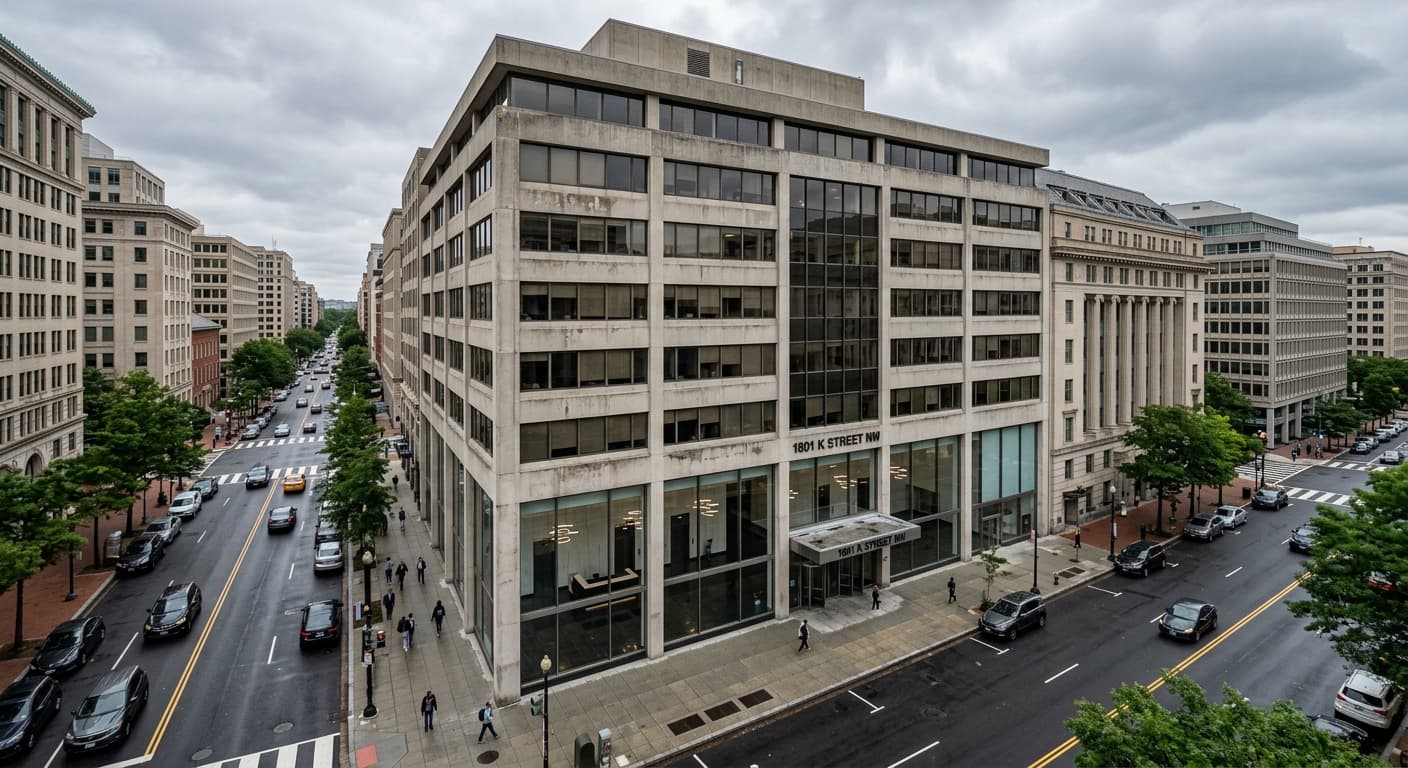
Image: editorial illustration · Story sourced from bisnow.com

A divide has opened between how private capital and institutional investors approach distressed office opportunities in the Washington, D.C. market, with family offices targeting ultra-low basis plays while pension- and fund-backed buyers concentrate on trophy assets.

EastBanc, a D.C.-based family office, launched a new office investment strategy this year focused on buildings it can acquire for around $100 per square foot, with plans to overhaul them into either repositioned office or residential properties. The firm intends to hold the assets long-term rather than flip them. EastBanc CEO Philippe Lanier told Bisnow in April that the firm was working to close its first deal by the end of the summer and saw potential for six new acquisitions by the end of 2027.

Basis is the primary focus, EastBanc Head of Acquisitions Brian Whitener said at Bisnow's DMV Capital Markets and CRE Finance Summit at the L'Enfant Plaza Hilton last month. The strategy works because the firm plans to own the properties indefinitely. The firm has been actively bidding, Lanier told Bisnow this summer.

Other private investors have executed similar purchases in the sub-$100-per-SF range. Garfield Investments and Broad Creek Capital paid roughly $100 per square foot for a 285,000-square-foot Navy Yard building last year. This spring, Jemal Equities founder Matthew Jemal closed on a Dupont Circle building for $80 per square foot after buying the loan.

Institutional investors are taking a different approach. The Meridian Group, a Bethesda- and San Francisco-based firm that raises funds from institutional investors, is concentrating on trophy and mission-critical assets where landlords have leverage on location and asset type and where tenants are sticky, Chief Investment Officer Gary Block said at the event. You do have a handful of families who will go out and just buy cheap real estate, Block said. But for the institutional investors, it's more of a conviction play.

TMG last year purchased an empty 24-story trophy asset in Tysons' Boro mixed-use community, where it has developed apartments, retail and entertainment venues. This summer, the firm purchased a five-building portfolio in Chantilly for $67 million. That portfolio serves the area's defense and intelligence sector.

The differing strategies reflect the capital structures behind the two buyer types. Private family offices can pursue long-term repositioning plays without the redemption pressure and quarterly return targets that drive institutional fund managers toward stabilized, cash-flowing properties.

The Deployment Angle

Family Office Real Estate Daily Desk · our analysis, not the source's

Family offices should evaluate co-GP structures with sponsors executing sub-$100-per-SF distressed office acquisitions in secondary D.C. submarkets, provided the sponsor has a credible repositioning thesis backed by entitlement certainty and tenant pre-leasing for office conversions or residential rezoning approvals. EastBanc's strategy of buying at $100 per square foot with a permanent-hold horizon suggests equity checks in the $15 million to $30 million range for 150,000-to-300,000-square-foot buildings, assuming 30% to 40% loan-to-value on distressed valuations.

Price the repositioning capital separately. If a building trades at $100 per square foot and requires $150 per square foot in capital improvements to achieve stabilized rents, the all-in basis approaches $250 per square foot before financing costs and holding-period expenses. That basis must clear a 12% to 15% unlevered return threshold to justify the execution risk and three-to-five-year repositioning timeline. Underwrite tenant rollover risk conservatively: if the building is more than 40% vacant at acquisition, model zero revenue for 24 months and stress-test the capital plan for permit delays.

The institutional pivot to trophy assets creates a valuation arbitrage family offices can exploit. If stabilized trophy properties in Tysons or the Boro trade at $400 to $500 per square foot while distressed secondary assets clear at $80 to $100, the basis spread is wide enough to absorb repositioning risk for patient capital. Avoid merchant-build structures or three-year fund horizons on these plays — the execution timeline and lease-up risk demand permanent capital or at minimum a seven-year hold with two one-year extensions.

Direct ownership via a separate account makes sense if the family office has in-house asset management and can self-perform light construction oversight. Otherwise, a programmatic joint venture with a sponsor like EastBanc that has local entitlement relationships and a track record in D.C. conversions offers better risk-adjusted returns than blind-pool fund commitments. Skip LP commitments to institutional office funds entirely — those vehicles are rotating out of distressed plays and into stabilized assets that offer compressed returns at elevated entry prices.

Questions this story answers

01What is EastBanc's strategy for buying distressed office buildings in D.C.?

EastBanc, a 40-year-old D.C.-based family office, launched a new office investment strategy this year targeting buildings it can acquire for around $100 per SF. EastBanc Head of Acquisitions Brian Whitener said the focus is on basis. EastBanc intends to hold assets long-term, overhauling them into better office or residential, with no intention to flip or merchant build.

02How are institutional investors approaching D.C. office differently from family offices?

According to The Meridian Group CIO Gary Block, institutional investors are pursuing a 'conviction play' focused on trophy and mission-critical office assets where landlords have leverage on location and asset type and tenants are sticky. By contrast, private players and family offices like EastBanc are focused on basis plays, targeting buildings in the sub-$100-per-SF range.

03What D.C. office deals have been done at or below $100 per square foot?

Garfield Investments and Broad Creek Capital paid roughly $100 per SF for a 285,000 SF Navy Yard building last year. This spring, Jemal Equities founder Matthew Jemal closed on a Dupont Circle building for $80 per SF after buying the loan. EastBanc launched a strategy this year targeting acquisitions at around $100 per SF.

04How many deals is EastBanc targeting under its new office strategy?

EastBanc CEO Philippe Lanier told Bisnow in April that EastBanc was working to have its first deal done by the end of the summer and saw potential for six new deals by the end of 2027. Lanier told Bisnow this summer that EastBanc has been actively bidding.

05What office assets has The Meridian Group recently acquired in the D.C. area?

The Meridian Group last year purchased an empty 24-story trophy asset in Tysons' Boro mixed-use community. This summer, The Meridian Group purchased a five-building portfolio in Chantilly for $67M, which serves the area's surging defense and intelligence sector.

Original reporting
bisnow.com
Read the original at bisnow.com →
officedistressed-officefamily-office-strategywashington-dcbasis-play
Peer Network · By Invitation

The Thesis Exchange

Share an investment thesis in confidence. We pair you anonymously with up to two other family offices running adjacent strategies. Reviewed by Gallium's editorial team. No vendor pitch.