Monday, October 26, 2026

Data Center Developers Face Three-Year Wait for Transformers as AI Demand Strains Supply

Gas turbines now carry delivery times exceeding a decade, while even basic construction materials face delays of six to twelve months.

By the Family Office Real Estate Daily Desk·Monday, October 26, 2026·2 min read
Editorial summary of reporting byBisnowOur editorial standards →
The answer · checked against Bisnow

How long are supply chain delays for data center equipment and how are developers responding?

Data center developers face transformer lead times of up to three years and gas turbine delivery waits of a decade or more as AI-driven demand keeps supply chains severely strained, industry panelists said at Bisnow's Data Center Investment Conference and Expo in Dallas. Chillers, switchgear, UPS systems, optical fiber, and structural steel all carry multi-month to multi-year backlogs. Sophisticated developers are stockpiling equipment years in advance and sharing demand forecasts with suppliers up to three years out to secure production capacity.

Key facts
  • Gas turbines can take a decade or more to be delivered, according to panelists at Bisnow's Data Center Investment Conference and Expo: Central in Dallas.
  • Transformer lead times of up to three years affect virtually every large-scale data center project, according to panelists at Bisnow's DICE: Central conference.
  • Carrier Applied West Director Dara Sanii said the company is bringing on a brand-new chiller factory, giving it four chiller factories supplying the data center market, and said even that capacity is not enough.
  • Johnson Controls Vice President Matt Kightlinger told DICE: Central that 'the capacity the industry's taking down is outstripping the ability of the entire supply chain to keep up' at the component level.
  • CyrusOne Senior Director Sam Caddell said lead time impacts from the pandemic era persist 'from raw materials all the way down' and questioned whether the industry will ever return to pre-Covid conditions.
  • SkyBox Datacenters Executive Vice President Gordon Kellerman compared the strategy of stockpiling long-lead equipment years in advance to 'Covid panic-toilet-paper-buying,' according to Bisnow's report.
Data Center Developers Face Three-Year Wait for Transformers as AI Demand Strains Supply
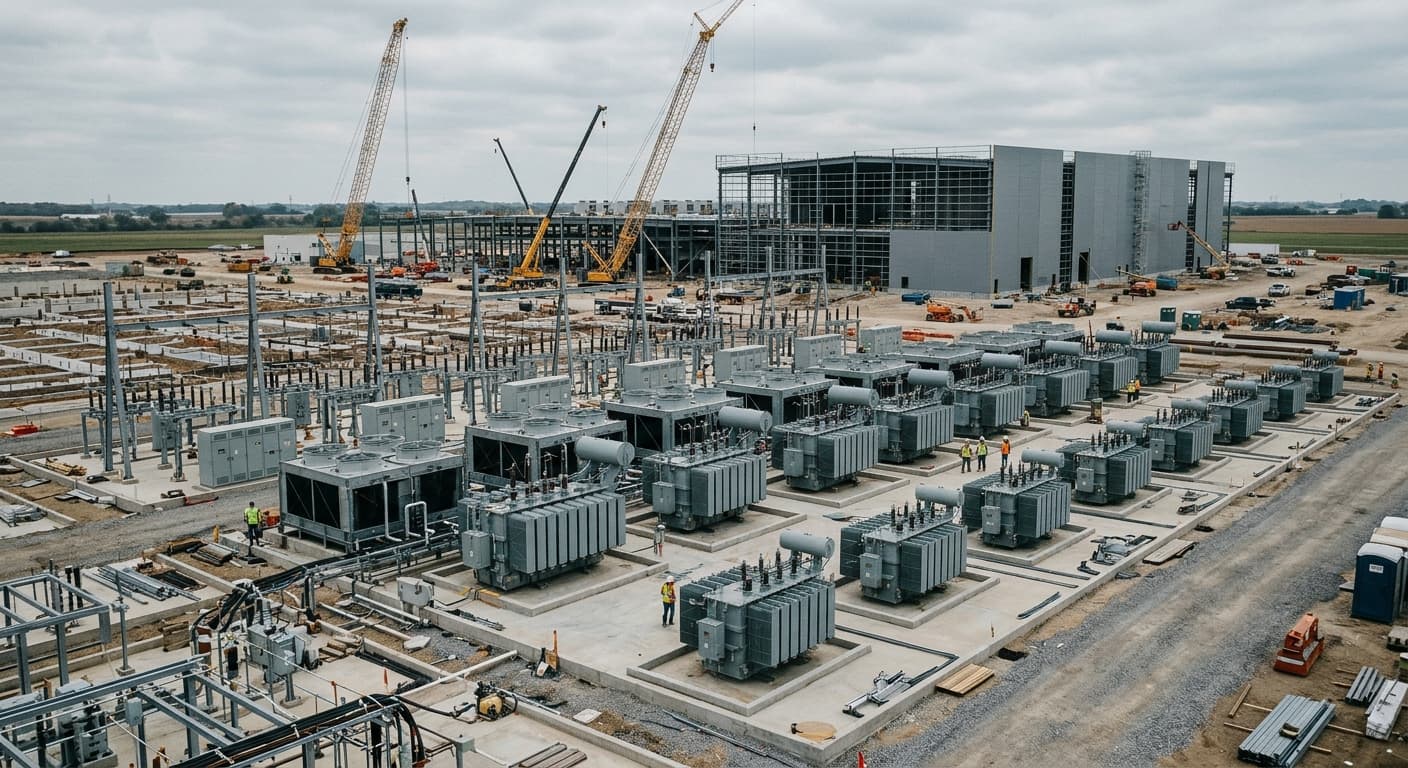
Image: editorial illustration · Story sourced from Bisnow

Data center developers are still contending with equipment shortages and unpredictable lead times years after supply chain disruptions eased in other industries, a bottleneck that threatens project schedules as artificial intelligence fuels unprecedented demand for capacity. Delays carry financial risk, with hyperscalers and other tenants writing substantial penalties into leases for missed delivery dates.

The supply crunch affects nearly every stage of development, from natural gas turbines and transformers to cooling systems and basic construction materials, industry participants said at Bisnow's Data Center Investment Conference and Expo: Central in Dallas this month. Some developers have found ways to navigate the constraints, but the workarounds require significant upfront capital and raise project costs.

Gas turbines can take a decade or more to be delivered, contributing to multiyear timelines for grid connections and limiting developers' ability to pursue on-site power as an alternative to utility interconnection queues, panelists said. Transformer lead times run up to three years for equipment required on virtually every large-scale project. Backup generators can take more than a year to procure.

Cooling equipment carries similar delays. Chillers and other cooling system components routinely take twelve to eighteen months, panelists said, as do switchgear, uninterruptible power supply systems and other critical electrical and networking equipment. Manufacturers said they cannot keep pace with demand even as they scale production. Carrier Applied West is preparing to bring online a new chiller factory, its fourth serving the data center market. "We'll have four chiller factories that can supply this market, and even then it's not enough," said Dara Sanii, a director at Carrier Applied West.

Basic materials face delays as well. Optical fiber can take six to eight months to arrive, and structural steel roughly a year, panelists said. Contractors encounter unexpected shortages for components like conduits and medium-voltage cables. Component-level constraints also slow production of more complex systems. Pumps, evaporators, fans, coils and heat exchangers used in cooling equipment are routinely sold out for a year or more, while breakers can delay electrical system assembly. "The capacity the industry's taking down is outstripping the ability of the entire supply chain to keep up," Johnson Controls Vice President Matt Kightlinger told the conference. "It is absolutely an issue industrywide, all the way down to the component level."

Some pressure has eased as projects derailed by grid constraints or local opposition free up allocated equipment, pushing scarce components back into the market, panelists said. Still, preventing procurement delays has required developers to rethink how they buy equipment and plan construction. The ability to manage these constraints has become a differentiator between firms that deliver on schedule and those that do not.

One strategy has been to stockpile long-lead equipment years in advance, creating a reserve of transformers and other critical components that can be deployed across multiple projects. SkyBox Datacenters Executive Vice President Gordon Kellerman compared the approach to "Covid panic-toilet-paper-buying." The strategy is open mainly to large developers with deep balance sheets and sizable pipelines who can commit capital before knowing exactly where equipment will be used. "We are definitely trying to buy multiple years out," said Sam Caddell, CyrusOne's senior director for facilities engineering and operations systems. "That's one of the advantages of having been around for a little longer and having a little more capital."

The Deployment Angle

Family Office Real Estate Daily Desk · our analysis, not the source's

This story favours platform capital or co-GP structures with established developers over direct ownership or LP commitments to emerging sponsors. The supply chain advantage accrues to firms that can stockpile transformers, turbines and cooling equipment years in advance, a capability that requires both a multiyear pipeline and the balance sheet to deploy capital on long-lead items before designs are finalized. A family office writing a fifty-million-dollar equity cheque into a development joint venture should confirm the sponsor has already secured transformers and backup generators, not merely ordered them.

Price the penalty risk into returns. If a hyperscaler lease carries a delivery penalty clause and the transformer lead time is three years, a project breaking ground today without equipment in hand faces binary execution risk. Underwrite the penalty as a cost, not a tail risk. A developer claiming it can deliver a two-hundred-megawatt facility in eighteen months without naming the transformer supplier and showing a purchase order is either betting on distressed equipment from a cancelled project or has not modelled the schedule honestly. Either scenario argues for a higher return threshold or a smaller cheque.

The stockpiling strategy creates an option value that belongs to the developer, not the capital partner. A sponsor that has transformers on the shelf can choose which project gets them and can sell them into a tight market if a deal falls apart. A family office should negotiate either shared upside on equipment sales or a cost-pass-through mechanism that prevents the developer from marking up components it bought at lower prices years earlier. The alternative is to accept that procurement advantage justifies a larger promote, but only if the sponsor can demonstrate it has the reserve and is willing to allocate it contractually to your project.

Questions this story answers

01How long are current lead times for transformers and other power equipment at data centers?

Panelists at Bisnow's DICE: Central conference in Dallas said transformer lead times are running up to three years for equipment required on virtually every large-scale project. Backup generators can take more than a year to procure. Gas turbines carry the longest waits, with delivery times of a decade or more currently contributing to yearslong timelines for grid connections.

02What strategies are major data center developers using to manage supply chain delays?

Major developers with deep balance sheets are stockpiling long-lead equipment years in advance to create strategic reserves deployable across multiple projects. Sophisticated developers are also sharing demand forecasts with suppliers as far as three years in advance to reserve production capacity without purchasing equipment outright, according to panelists at Bisnow's DICE: Central conference in Dallas.

03Are supply chain problems in data centers limited to big equipment like transformers and turbines?

No. Panelists at Bisnow's DICE: Central said optical fiber takes six to eight months to arrive and structural steel roughly a year. Conduits and medium-voltage cables cause unexpected delays. Pumps, evaporators, fans, coils, and heat exchangers used in cooling equipment are routinely sold out for a year or more, and basic components like breakers can slow electrical system production.

04Why haven't data center supply chain problems eased the way they have in other industries?

Panelists at Bisnow's DICE: Central said the procurement landscape is not returning to normal as long as the sector continues on its current growth trajectory. CyrusOne's Sam Caddell said lead time impacts persist from raw materials all the way down and questioned whether the industry will ever return to pre-Covid conditions given the ongoing demand surge driven by AI.

05How are rapid AI hardware changes making data center supply chain problems worse?

According to Bisnow's report on DICE: Central, data center designs are now revised multiple times during development to accommodate new generations of hardware or shifting tenant strategies. These changes can render equipment ordered months earlier obsolete or create the need for new long-lead items after a project's schedule has already been set, adding uncertainty on top of existing procurement delays.

Original reporting
Bisnow
Read the original at Bisnow →
data-centerssupply-chainartificial-intelligencedevelopment-riskelectrical-infrastructure
Peer Network · By Invitation

The Thesis Exchange

Share an investment thesis in confidence. We pair you anonymously with up to two other family offices running adjacent strategies. Reviewed by Gallium's editorial team. No vendor pitch.